

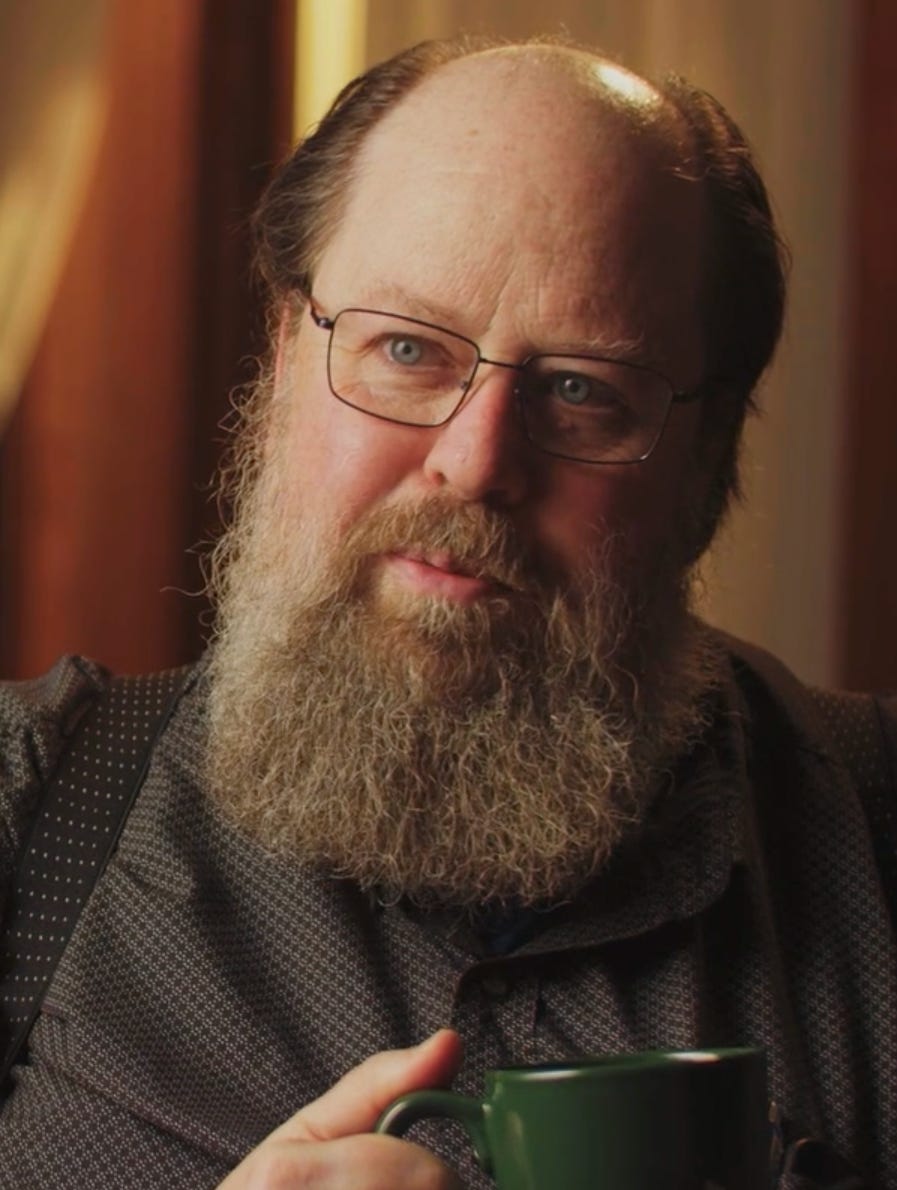
It didn’t take much—one book and a handful of essays—for me to become a full-blown Hart-head. Were he born in another age, David Bentley Hart might have been an Augustine or an Aquinas, or even an Aristotle; but he was born in our time and so he is a wildly prolific author of fiction and non-fiction with special interests in Christian theology, philosophy of mind, baseball, and dogs, and likely one of the most widely-read persons in the world.
Outside the high school curriculum, Hart took up French, German, Spanish, Italian, Russian, and modern Greek. At the University of Maryland, Hart studied classics, history, world literature, religious studies and philosophy while also learning to read Chinese and Sanskrit. As a teenager, Hart started to read the early Church Fathers along with contemporary Eastern Orthodox theologians, converting to Orthodoxy at the age of twenty-one.
He is also notorious for his sardonic wit. For example:
At its most depraved, the picture becomes something like Galt’s Gulch, in the single worst novel ever penned by any member of any bipedal species.
I do not follow Rod Dreher’s writings and certainly would never subscribe to his Substack publication. It is not that I have any prejudice against him; I simply dislike everything he writes, says, or stands for; other than that, I think he’s just dandy.
Gopnik has his virtues—he has written some good pieces on Proust and on French culture—but he is no scholar of the ancient world, theology, or religion in general, he lacks even the most basic philosophical training, and his critical skills when applied to such matters prove feeble to the point of nonexistence.
He is also, uh, not a fan of Trump or Vance, to say the very least.
A few weeks back, the venomous garden gnome J. D. Vance, in the course of explaining the administration’s policy on the Russian invasion of Ukraine, asserted that every war is ultimately ended by a negotiated settlement, and one need only look back at history—and to the Second World War in particular—to see that this is so. Keen eye there. And we always do well to heed the lessons of history. Perhaps it is time to acquaint ourselves again with the famous peace negotiations in Berlin in 1918, or the Berlin and Tokyo Peace Summits of 1945, or the Appomattox Accords of 1865, or the Waterloo Non-Aggression and Trade Treaty of 1815, and so forth. I am simply grateful to have so towering an intellect ready to step into the breach should the unthinkable happen. That ivy league degree in hillbilly studies was not wasted.
In my previous essay, “The Asymmetry”, I shared several long quotes from The Experience of God: Being, Consciousness, Bliss (2013). Here, I’d like share some further excerpts from the book that give a sense of its core arguments (roughly: atheism/naturalism is absurd and incoherent and you are an idiot for espousing it) and of Hart’s literary flair. Enjoy.
Wisdom and Revelation
The Incoherence of Naturalism
God Properly Understood
Theism vs. Naturalism
The Metaphysics of Eminence
The Experience and Mystery of Wonder
God vs. Gods
Super-naturalism
God as ‘No-Thing’
The Transcendental Structure of Consciousness and Intentionality
Faith as the Ground of Knowledge
The Blissfulness of Being and Consciousness
Euthyphro’s (non)Dilemma
The Divinity of Beauty
The Impossibility of Atheism
The Mechanical Philosophy and its Pathologies
Modernity and its Pathologies
The Clarity of Contemplation
The Only Proof
1. Wisdom and Revelation
Wisdom is the recovery of innocence at the far end of experience; it is the ability to see again what most of us have forgotten how to see, but now fortified by the ability to translate some of that vision into words, however inadequate. There is a point, that is to say, where reason and revelation are one and the same. I know that, in putting the matter thus, I risk losing the sympathy of a large number of readers both rationalists and fideists, both the skeptical and the devout—but I hope my meaning will become clear in what follows. God is not only the ultimate reality that the intellect and the will seek but is also the primordial reality with which all of us are always engaged in every moment of existence and consciousness, apart from which we have no experience of anything whatsoever. Or, to borrow the language of Augustine, God is not only “superior summo meo” (beyond my utmost heights) but also “interior intimo meo” (more inward to me than my inmost depths). Only when one understands what such a claim means does one know what the word “God” really means, and whether it is reasonable to think that there is a reality to which that word refers and in which we should believe.
2. The Incoherence of Naturalism
The only fully consistent alternative to belief in God, properly understood, is some version of “materialism” or “physicalism” or (to use the term most widely preferred at present) “naturalism”; and naturalism—the doctrine that there is nothing apart from the physical order, and certainly nothing supernatural—is an incorrigibly incoherent concept, and one that is ultimately indistinguishable from pure magical thinking. The very notion of nature as a closed system entirely sufficient to itself is plainly one that cannot be verified, deductively or empirically, from within the system of nature. It is a metaphysical (which is to say “extra-natural”) conclusion regarding the whole of reality, which neither reason nor experience legitimately warrants. It cannot even define itself within the boundaries of its own terms, because the total sufficiency of “natural” explanations is not an identifiable natural phenomenon but only an arbitrary judgment. Naturalism, therefore, can never be anything more than a guiding prejudice, an established principle only in the sense that it must be indefensibly presumed for the sake of some larger view of reality; it functions as a purely formal rule that, like the restriction of the king in chess to moves of one square only, permits the game to be played one way rather than another.
3. God Properly Understood
To speak of “God” properly, then—to use the word in a sense consonant with the teachings of orthodox Judaism, Christianity, Islam, Sikhism, Hinduism, Bahai, a great deal of antique paganism, and so forth—is to speak of the one infinite source of all that is: eternal, omniscient, omnipotent, omnipresent, uncreated, uncaused, perfectly transcendent of all things and for that very reason absolutely immanent to all things. God so understood is not something posed over against the universe, in addition to it, nor is he the universe itself. He is not a “being,” at least not in the way that a tree, a shoemaker, or a god is a being; he is not one more object in the inventory of things that are, or any sort of discrete object at all. Rather, all things that exist receive their being continuously from him, who is the infinite wellspring of all that is, in whom (to use the language of the Christian scriptures) all things live and move and have their being. In one sense he is “beyond being,” if by “being” one means the totality of discrete, finite things. In another sense he is “being itself,” in that he is the inexhaustible source of all reality, the absolute upon which the contingent is always utterly dependent, the unity and simplicity that underlies and sustains the diversity of finite and composite things. Infinite being, infinite consciousness, infinite bliss, from whom we are, by whom we know and are known, and in whom we find our only true consummation.
4. Theism vs. Naturalism
One of the more persistent and inexcusable rhetorical conceits that corrupt the current popular debates over belief in God is the claim that they constitute an argument between faith and reason or religion and science. They constitute, in fact, only a contest between different pictures of the world: theism and naturalism (this seems the most satisfactory and comprehensive term, at any rate), each of which involves a number of basic metaphysical convictions; and the latter is by far the less rationally defensible of the two. Naturalism is a picture of the whole of reality that cannot, according to its own intrinsic premises, address the being of the whole; it is a metaphysics of the rejection of metaphysics, a transcendental certainty of the impossibility of transcendental truth, and so requires an act of pure credence logically immune to any verification (after all, if there is a God he can presumably reveal himself to seeking minds, but if there is not then there can be no “natural” confirmation of the fact). Thus naturalism must forever remain a pure assertion, a pure conviction, a confession of blind assurance in an inaccessible beyond; and that beyond, more paradoxically still, is the beyond of no beyond. And naturalism’s claim that, by confining itself to purely material explanations for all things, it adheres to the only sure path of verifiable knowledge is nothing but a feat of sublimely circular thinking: physics explains everything, which we know because anything physics cannot explain does not exist, which we know because whatever exists must be explicable by physics, which we know because physics explains everything. There is something here of the mystical…
…Even if one could conceivably prove, as is occasionally suggested these days, that cosmic information is somehow ceaselessly generated out of quantum states, this still would not have decided the issue of causality in favor of the naturalist position. As a brilliant physicist friend of mine often and somewhat tiresomely likes to insist, “chaos” could not produce laws unless it were already governed by laws.
In the end, one is of course perfectly free to believe in the, so to speak, “just-there-ness” of the quantum order and of the physical laws governing it. I tend to see this as bordering upon a belief in magic, but that may be mere prejudice. What is absolutely certain is that the naturalist view of things is, as I have said, just a picture of the world, not a truth about the world that we can know, nor even a conviction that rests upon a secure rational foundation. The picture that naturalism gives us, at least at present, is twofold. On the one hand, the cosmos of space and time is a purely mechanistic reality that, if we are to be perfectly consistent, we must see as utterly deterministic: that is to say, to work a small variation on Laplace’s fantasy, if we could know the entire history of the physical events that compose the universe, from that first inflationary instant to the present, including the course of every particle, we would know also the ineluctable necessity of everything that led to and follows from the present; even what we take to be free acts of the will would be revealed as the inevitable results of physical forces reaching all the way back to the beginning of all things. On the other hand, this deterministic machine floats upon a quantum flux of ceaseless spontaneity and infinite indeterminacy. Together, these two orders close reality within a dialectical totality a perfect union of destiny and chance, absolute determinism and pure fortuity—hermetically sealed against all transcendence. And yet, once again, the picture is radically incomplete, not only because it is unlikely that the classical Newtonian universe and the universe of quantum theory can be fitted together so seamlessly, but because neither level of reality explains the existence of the other, or of itself. And, also once again, nothing we know obliges us to find this picture more convincing than one in which higher causes (among which we might, for instance, include free will) operate upon lower, or in which all physical reality is open to a transcendent order that reveals itself in the very existence of nature.
5. The Metaphysics of Eminence
I suppose that if I had to give a kind of portmanteau name to the view of things I find most convincing, it would be the “metaphysics of eminence”— borrowing the scholastic notion that lower reality is always “more eminently” or “virtually” contained in higher realities, while the higher is participated in and expressed by the lower. Or perhaps one could simply call this the metaphysics of the transcendental, which includes such (by current standards) incredible beliefs as: beautiful things are caused by, among other things, transcendent beauty. Whatever one calls it, however, and however dependent it is on the clearly inadequate spatial metaphors of the above and the below, it is a vision of reality in which the higher is not the epiphenomenal and largely illusory residue of the lower down there where reality is really real, as it were but a causal order in its own right, comprising the forms and ends and rational harmonies that shape and guide and explain the world. Then, beyond all those forms of causality, comprehending, transcending, pervading, underlying, and creating them, is that which is highest and most eminent of all, the boundless source of all reality, the infinity of being, consciousness, and bliss that is God.
6. The Experience and Mystery of Wonder
The beginning of all philosophy, according to both Plato and Aristotle, lies in the experience of wonder. One might go further and say that the beginning of all serious thought—all reflection upon the world that is not merely calculative or appetitive—begins in a moment of unsettling or delighted surprise. Not, that is, a simple twinge of curiosity or bafflement regarding some fact out there not yet in one’s possession: if anything, it is the sudden awareness that no mere fact can possibly be an adequate explanation of the mystery in which one finds oneself immersed at every moment. It is the astonishing recollection of something one has forgotten only because it is always present: a primordial agitation of the mind and will, an abiding amazement that lies just below the surface of conscious thought and that only in very rare instants breaks through into ordinary awareness. It may be that when we are small children, before we have learned how to forget the obvious, we know this wonder in a more constant, innocent, and luminous way, because we are still trustingly open to the sheer inexplicable givenness of the world. In the dawn of life we sense with perfect immediacy, which we have no capacity or inclination to translate into any objective concept, how miraculous it is that—as Angelus Silesius (1624-1677) says—“Die Rose ist ohne warum, sie biühet, weil sie blühet”: “The rose is without why; it blooms because it blooms.” As we age, however, we lose our sense of the intimate otherness of things; we allow habit to displace awe, inevitability to banish delight; we grow into adulthood and put away childish things. Thereafter, there are only fleeting instants scattered throughout our lives when all at once, our defenses momentarily relaxed, we find ourselves brought to a pause by a sudden unanticipated sense of the utter uncanniness of the reality we inhabit, the startling fortuity and strangeness of everything familiar: how odd it is, and how unfathomable, that anything at all exists; how disconcerting that the world and one’s consciousness of it are simply there, joined in a single ineffable event. When it comes, it is a moment of alienation from the ordinary perhaps, but not one of disaffection or loss; as long as the experience lasts, in fact, it has a certain quality of mystifying happiness about it, the exhilarating feeling that one is at the border of some tremendous and beautiful discovery. One realizes that everything about the world that seems so unexceptional and drearily predictable is in fact charged with an immense and imponderable mystery. In that instant one is aware, even if the precise formulation eludes one, that everything one knows exists in an irreducibly gratuitous ‘what it is’ has no logical connection with the reality ‘that it is’; nothing within experience has any “right” to be, any power to give itself existence, any apparent “why”. In that instant one recalls that ones every encounter with the world has always been an encounter with an enigma that no merely physical explanation can resolve.
One cannot dwell indefinitely in that moment, of course, any more than one can remain a child forever. For one thing, there is an almost paralyzing fullness to the experience, a kind of surfeit of immediacy that is at the same time an absolute remoteness from practical things. For another, there is nothing to hold on to in the experience, because the source of one’s amazement is not some particular object among the objects of the world but simply the pure eventuality of the world as such. The question of why anything at all exists is one that already exceeds its occasion, already goes beyond the reality of all particular things, and attempts to lay hold, however uncertainly, of the transcendent conditions of that reality. Sooner or later, therefore, one simply must let the apprehension slip away, just so that one can get on with the business of life. One has to revert to one’s habitual obliviousness to the mystery, to a “single-mindedness” that can once again close the chasm that has briefly opened between “what” and the “that” of reality, or one will not be able to start moving forward again. At times, the memory of the experience may even need to be forcibly suppressed with ingenious or (at least) convenient rationalizations. One may, for instance, dismiss this fleeting shock of “ontological surprise” as a transient neurological aberration, a momentary phantom doubling of reality in the mind producing the false impression of some kind of dichotomy between the world and its own existence
The American philosopher Richard Taylor once illustrated this mystery, famously and fetchingly, with the image of a man out for a stroll in the forest unaccountably coming upon a very large translucent sphere. Naturally, he would immediately be taken aback by the sheer strangeness of the thing, and would wonder how it should happen to be there. More to the point, he would certainly never be able to believe that it just happened to be there without any cause, or without any possibility of further explanation; the very idea would be absurd. But, adds Taylor, what that man has not noticed is that he might ask the same question equally well about any other thing in the woods too, a rock or a tree no less than this outlandish sphere, and fails to do so only because it rarely occurs to us to interrogate the ontological pedigrees of the things to which we are accustomed. What would provoke our curiosity about the sphere would be that it was so obviously out of place; but, as far as existence is concerned, everything is in a sense out of place. As Taylor goes on to say, the question would be no less intelligible or pertinent if we were to imagine the sphere either as expanded to the size of the universe or as contracted to the size of a grain of sand, either as existing from everlasting to everlasting or as existing for only a few seconds. It is the sheer unexpected “thereness” of the thing, devoid of any transparent rationale for the fact, that prompts our desire to understand it in terms not simply of its nature, but of its very existence…Even so, one must try to understand, even if only now and then. Reason is restless before this question. And any profound reflection upon the contingency of things must involve the question of God, which—whether or not one believes it can be answered— must be posed again and again in the course of any life that is truly rational.
7. God vs. Gods
Whether or not the question of God can be answered satisfactorily, however, or even formulated satisfactorily, these reflections should at least make it clear, once again, that it is entirely different in kind from any merely local or psychological or cultic question regarding “gods” or “a god.” The gods are enfolded within nature and enter human thought as the most exalted expressions of its power; they emerge from the magnificent energy of the physical order. God, however, is first glimpsed within nature’s still greater powerlessness—its transitoriness and contingency and explanatory poverty. He is known or imagined or hoped for as that reality that lies beyond the awful shadow of potential nothingness that falls across all finite things, the gods included. The gods are beings among other beings, the most splendid beings of all, but are still dependent upon some prior reality that constitutes the imperturbable foundation of their existence. God, however, is beyond all mere finite beings, and is himself that ultimate ground upon which any foundations must rest. Thus the Mundaka Upanishad speaks of Brahma, the first-born among the gods, coming forth from Brahman, the eternal Godhead who is the source of all being, and then teaching the other gods about Brahman. The gods could not exist apart from nature; nature could not exist apart from God.
8. Super-naturalism
It should be no less clear, moreover, that philosophical naturalism could never serve as a complete, coherent, or even provisionally plausible picture of reality as a whole. The limits of nature’s powers are the same whether they are personified as deities or not. It is at the very point where physical reality becomes questionable, and reason finds it has to venture beyond the limits of nature if it is to make sense of nature, that naturalism demands reason turn back, resigned to pure absurdity, and rest content with a non-answer that closes off every avenue to the goal the mind necessarily seeks. The question of existence is real, comprehensible, and unavoidable, and yet it lies beyond the power of naturalism to answer it, or even to ask it. An old and particularly sound metaphysical maxim says that between existence and nonexistence there is an infinite qualitative difference. It is a difference that no merely quantitative calculation of processes or forces or laws can ever overcome. Physical reality cannot account for its own existence for the simple reason that nature—the physical—is that which by definition already exists; existence, even taken as a simple brute fact to which no metaphysical theory is attached, lies logically beyond the system of causes that nature comprises; it is, quite literally, “hyperphysical,” or, shifting into Latin, super naturam. This means not only that at some point nature requires or admits of a supernatural explanation (which it does), but also that at no point is anything purely, self-sufficiently natural in the first place. This is a logical and ontological claim, but a phenomenological, epistemological, and experiential one as well. We have, in fact, no direct access to nature as such; we can approach nature only across the interval of the supernatural. Only through our immediate encounter with the being of a thing are we permitted our wholly mediated experience of that thing as a natural object; we are able to ask what it is only in first knowing that it is; and so in knowing nature we have always already gone beyond its intrinsic limits. No one lives in a “naturalistic” reality, and the very notion of nature as a perfectly self-enclosed continuum is a figment of the imagination. It is the supernatural of which we have direct certainty, and only in consequence of that can the reality of nature be assumed, not as an absolutely incontrovertible fact but simply as far and away the likeliest supposition.
9. God as ‘No-Thing’
One of the more provocatively counterintuitive ways of expressing the difference between God and every contingent reality is to say that God, as the source of all being, is, properly speaking, not himself a being or, if one prefer, not a being among other beings. Nicholas of Cusa (1401-1464), for instance, spoke of God as the non aliud: the “not other” or “not something else.” For the Neoplatonist Plotinus (c. 204-270), the divine is that which is no particular thing, or even “no-thing.” The same is true for Christians such as John Scotus Eriugena (c. 815-c. 877) or Meister Eckhart (c. 1260-c. 1327). Angelus Silesius, precisely in order to affirm that God is the omnipotent creator of all things, described God as “ein lauter Nichts“—“a pure nothingness”—and even (a touch of neologistic panache here) “ein Übernicht.” If this all sounds either perilously blasphemous of preciously paradoxical, this is because language of this sort is meant to give us pause, or even offense, in order to remind us as forcefully as possible that, as the great Muslim philosopher Mulla Sadra (c. 1572-1640) insisted, God is not to be found within the realm of beings, for he is the being of all realms.
10. The Transcendental Structure of Consciousness and Intentionality
Consciousness does not merely passively reflect the reality of the world; it is necessarily a dynamic movement of reason and will toward reality. If nothing else is to be concluded from the previous chapter, this much is absolutely certain: subjective consciousness becomes actual only through intentionality, and intentionality is a kind of agency, directed toward an end. We could never know the world from a purely receptive position. To know anything, the mind must be actively disposed toward things outside itself, always at work interpreting experience through concepts that only the mind itself can supply. The world is intelligible to us because we reach out to it, or reach beyond it, coming to know the endless diversity of particular things within the embrace of a more general and abstract yearning for a knowledge of truth as such, and by way of an aboriginal inclination of the mind toward reality as a comprehensible whole. In every moment of awareness, the mind at once receives and composes the world, discerning meaning in the objects of experience precisely in conferring meaning upon them; thus consciousness lies open to—and enters into intimate communion with—the forms of things. Every venture of reason toward an end, moreover, is prompted by a desire of the mind, a “rational appetite.” Knowledge is born out of a predisposition and predilection of the will toward beings, a longing for the ideal comprehensibility of things, and a natural orientation of the mind toward that infinite horizon of intelligibility that is being itself.
That may seem a somewhat extravagant way of describing our ordinary acts of cognition, but I think it so obviously correct as to verge on a truism. The mind does not simply submissively register sensory data, like wax receiving the impression of a signet, but is constantly at work organizing what it receives from the senses into form and meaning; and this it does because it has a certain natural compulsion to do so, a certain interestedness that exceeds most of the individual objects of knowledge that it encounters. The only reason that we can regard the great majority of particular things we come across with disinterest, or even in a wholly uninterested way, and yet still experience them as objects of recognition and reflection is that we are inspired by a prior and consuming interest in reality as such. There simply is no such thing as knowledge entirely devoid of desire—you could not make cognitive sense of a glass of water or a tree on a hill apart from the action of your mind toward some end found either in that thing or beyond that thing and so all knowledge involves an adventure of the mind beyond itself. Again, as Brentano rightly saw, this essential directedness of consciousness sets it apart from any merely mechanical function. Desire, moreover, is never purely spontaneous; it does not arise without premise out of some aimless nothingness within the will but must always be moved toward an end, real or imagined, that draws it on. The will is, of its nature, teleological, and every rational act is intrinsically purposive, prompted by some final cause. One cannot so much as freely stir a finger without the lure of some aim, proximate or remote, great or small, constant or evanescent. What is it that the mind desires, then, or even that the mind loves, when it is moved to seek the ideality of things, the intelligibility of experience as a whole? What continues to compel thought onward, whether or not the mind happens at any given moment to have some attachment to the immediate objects of experience? What is the horizon of that limitless directedness of consciousness that allows the mind to define the limits of the world it knows? Whatever it is, it is an end that lies always beyond whatever is near at hand, and it excites in the mind a need not merely to be aware, but truly to know, to discern meaning, to grasp all of being under the aspect of intelligible truth.
Perhaps this is all only the special predicament and glory of a remarkably fortunate primate, and we have become the rational possessors of the world only because we have somehow acquired a pathetic hunger for an illusory end—“truth as such” —that transcends all those merely concrete objects of awareness in which we might or might not have some interest. Perhaps it is only the accidental exaggeration in our species of an animal capacity for recognizing danger or noticing something comestible slinking through the forest shade that has somehow produced in us this paradoxical longing for an ultimate abstraction, and rendered us not merely responsive to our physical environment but obsessively conscious of it as well, insatiably transforming the real into the conceptual, arranging experience into webs of associations, ideas, and words. It seems unlikely, however. Nature could scarcely have implanted that supreme abstraction in us, at least not according to any physicalist calculus of material causation, because abstract concepts are not natural objects. And so an essential mystery lies at the very heart of rational life: in all experience there is a movement of the self beyond the self, an ecstasy—a “standing-forth”—of the mind, directed toward an end that resides nowhere within physical nature as a closed system of causes and effects. All rational experience and all knowledge is a kind of rapture, prompted by a longing that cannot be exhausted by any finite object. What, then, do we really seek in seeking to know the world? What lures us on into reality? Is it only an illusion, or is it something that opens the world to us precisely because it is a genuine dimension of reality, in which the mind and the world together participate?
There are, very broadly speaking, two ways of desiring a thing: as an end in itself or for an end beyond itself. This seems quite obvious. But, if one thinks about it, there appears to be no actual object among finite things that we can truly desire—if we desire it at all— except either in both ways at once or in the second way only. That is to say, no finite thing is desirable simply in itself, if only in the trivial sense that whatever we find desirable about that thing must correspond to some prior and more general disposition of the appetites and the will. I might, for example, conceive a longing for some particularly beautiful object out of the purest aesthetic motives; but this still means that I cannot regard that object as its own index of value. Rather, I am moved by a more constant and general desire for beauty as such, as an absolute value of which I have some sort of intentional grasp and in light of which I am able to judge the object before me as either beautiful or not. The object itself pleases me, perhaps, but only because the appetite it appeases, without wholly satisfying, is a more original and expansive longing for the beautiful. If not for that rather abstract and exalted orientation of the will it, that is, I were a person entirely lacking in aesthetic longings of any kind, refined or coarse, passionate or tepid—I would not desire that object at all.
There is always a kind of deferral of finite desire toward ultimate ends, and there is always a greater and more remote purpose for the sake of which one wants whatever one wants. This is true even when one’s interest in an object is inspired by some perfectly mundane concern, such as its monetary worth. One desires money not in itself but only for what it can purchase; and one desires the things money can purchase not simply as ends in themselves but because they correspond to more general and abstract longings for comfort, prestige, power, diversion, or what have you; and one desires all such things out of a still deeper and more general desire for happiness itself, whatever that may be, and for a fuller share in the goodness of being. In this world, the desirable is always desirable in respect of some yet more elementary and comprehensive need or yearning. All concretely limited aspirations of the will are sustained within formally limitless aspirations of the will.
In the end, the only objects of desire that are not reducible to other, more general objects of desire, and that may therefore truly be said to be desirable entirely in and of themselves, are a small number of universal, unconditional, and extremely abstract ideals that, according to a somewhat antique metaphysical vocabulary, are called “transcendentals.” Traditionally, these are said to be predicates or properties that in some way apply to all existing things, because they are essential aspects of existence as such: the intrinsic perfections of being in its fullness. There are both purely ontological transcendentals, such as being and unity, and critical or “criteriological” transcendentals, such as truth, goodness, and beauty; ultimately, though, they are distinct from one another only conceptually, from our necessarily limited vantage, but in themselves are wholly convertible with one another, each being only one name for the single reality of being itself. Precise scholastic enumerations and definitions of the various transcendentals, however, do not concern me here. What interests me is the simple but crucial insight that our experience of reality does in fact have a transcendental structure. Our minds and our wills are, in an absolutely necessary way, related to being—to everything that exists and to existence itself—always under the forms provided by certain absolute orientations of imagination, desire, and (for want of a better word) faith. Whatever ontological or metaphysical substance one may or may not be willing to accord to such immense generalities as truth, goodness, and beauty, the very shape of conscious intentionality is entirely determined by them; they constitute an absolute orientation for thought, that horizon of being of which I spoke above, toward which the mind is always turned and against which every finite object is set off, in clear and distinct outlines, in the great middle distance of the phenomenal world…
…The vanishing point of the minds inner coherence and simplicity is met by the vanishing point of the world’s highest values; the gaze of the apperceptive “I” within is turned toward a transcendental “that” forever beyond; and mental experience, of the self or of the world outside the self, takes shape in the relation between these two “supernatural” poles. The rational mind is able to know reality with the fullness it does because of its singular ability to go beyond each object of experience, and thereby to comprehend that object within more capacious conceptual categories; and ultimately the mind knows the world as a whole because it has always already, in its intentions, exceeded the world. Consciousness contains nature, as a complete and cogent reality, because it has gone beyond nature. And the mind possesses the capacity to understand and to judge because it is obedient to absolute values that appear as concrete realities nowhere within the physical order. Just as the contingency of our existence points ultimately toward some unconditioned source of being, so the contingency of our desires points toward unconditioned final causes. And, again, whether one believes these values are in some sense actual, ontological constituents of reality, or one believes instead that they are only fortunate illusions that have in some unimaginably improbable way emerged from the hypertrophy of our animal brains, it is by their transcendence of all finite conditions that they give us a world. As ever, we approach nature only across the interval of the supernatural.
11. Faith as the Ground of Knowledge
Before we can want anything for ourselves we must come to know it conceptually, through our openness to purposes that lie outside ourselves and even, in some sense, outside the cosmos. Individual psychology is complicated, but subjective consciousness is simple. In even our most ordinary acts of cognition we commit ourselves to the un-conditional: the ultimate truth for which we yearn and in light of which we judge the content of experience; the ideal of absolute intelligibility that drives us to extract as much knowledge as we can from experience; the transcendent that imparts to us the gift of the immanent. Speaking purely phenomenologically, the structure of rational consciousness is ecstatic: our minds are capable of reflecting the world because there is a kind of elation in our thinking, a joy, or at least anticipation of joy, which seeks its fulfillment in an embrace of truth in its essence. Every movement of the intellect and will toward the truth is already an act of devotion, or (again) of faith, in a number of related senses. In a quite undeniable way, for instance, almost everything we know about the greater world is something we have to take on trust, from the testimony of others; even our scientific knowledge is, for most of us, the report of those in whom we vest our confidence because we must, knowing that they will undertake the work of experiment and theory that the rest of us cannot. At a far more elementary level, however, even the personal knowledge possessed by a trained expert in some field, or by an immediate witness to some fact or other, is a knowledge acquired in the light of an original trust in the simple givenness of reality, a primal belief in a genuine conformity of the mind to the world and in the power of reality to disclose itself to reason. No intellectual endeavor—not even, shockingly enough, mathematics—can provide the logical ground of its own governing premises and principles; every act of the intellect is sustained by a fiduciary trust in the transparency of reality to consciousness. The mind has some sort of awareness—some “fore-grasp”—of truth, one that apprises it constantly of the incompleteness of what it already understands, or of the contingency of what it believes. And what the mind seeks in attempting to discover the truth is a kind of delight, a kind of fulfillment that can supersede the momentary disappointments or frustrations that the search for truth brings. Even when one suffers some immense “shift of paradigm” in one’s understanding of reality, and comes to believe that one must radically alter one’s beliefs about things, one continues to act toward the world out of a deeper and unalterable confidence in the (so to speak) nuptial unity of mind and world, and out of an ineradicable joy in the experience of that unity. The indissoluble bond between the intellect and objective reality is forged by this faith that is also a kind of love—a kind of adherence of the will and mind to something inexhaustibly desirable.
12. The Blissfulness of Being and Consciousness
Seen from the perspective of a variety of theistic traditions, this is nothing less than the reflection of absolute reality within the realm of the contingent. It is bliss that draws us toward and joins us to the being of all things because that bliss is already one with being and consciousness, in the infinite simplicity of God. As the Chandogya Upanishad says, Brahman is at once both the joy residing in the depths of the heart and also the pervasive reality in which all things subsist. The restless heart that seeks its repose in God (to use the language of Augustine) expresses itself not only in the exultations and raptures of spiritual experience but also in the plain persistence of awareness. The soul’s unquenchable eros for the divine, of which Plotinus and Gregory of Nyssa and countless Christian contemplatives speak, Sufism’s ishq or passionately adherent love for God, Jewish mysticism’s devekut, Hinduism’s bhakti, Sikhism’s pyaar—these are all names for the acute manifestation of a love that, in a more chronic and subtle form, underlies all knowledge, all openness of the mind to the truth of things.
13. Euthyphro’s (non)Dilemma
This is why, as I mentioned far above, the famous dilemma from Plato’s Euthyphro is not much of a problem for any of the great theistic traditions. The central question posed in that dialogue (to rehearse it again) is whether the commands of the gods are good because they are the gods commands, or whether they are the gods commands because they are good. In the minds of some, this supposedly constitutes an insoluble difficulty for theism of any kind: in the former case goodness would be only an arbitrary product of the divine will, while in the latter the divine would be subordinate to some higher reality; and neither option should seem particularly attractive to pious souls. It is indeed an interesting question for any polytheist culture that conceives of its gods as finite personalities, contained within and dependent upon nature; it is probably a good question to ask of a deist as well, or of any other believer in a cosmic demiurge; but, applied to classical theism, it is simply a meaningless query, predicated upon a crude anthropomorphism. It is no more interesting than asking whether light shines because it is light or whether instead it is light because it shines. One should recall that the entire point of Plato’s inquiry in the Euthyphro was to show that there must be some eternal principle—which he would call the Form of the Good—beyond the realm of either material nature or limited and willful deities. This is all part of an ancient metaphysical project going back at least as far as Xenophanes, which is the common heritage of philosophy and rational theology alike: the attempt to distinguish the transcendent from the immanent, the changeless from the mutable, the ultimate source from its contingent derivations. For none of the great theistic traditions is “God” the name of a god, some emotionally changeable entity who has to deliberate upon his actions, either in respect of standards independent of himself or in respect of some arbitrary psychological impulse within himself. “God” is the name, rather, of that eternal and transcendent principle upon which the gods (if there are such beings) are dependent for their existence and for their share in all the transcendental perfections of being. For all the great monotheisms, God is himself the Good, or the Form of the Good, and his freedom consists in his limitless power to express his nature (goodness) unhindered by the obstacles or limitations suffered by finite beings. He is “the love that moves the sun and all the other stars,” as Dante phrases it, at once the underlying unity and the final end of all things. And the absolute nature of that love is reflected in the unconditional quality of the transcendental or ecstatic desire it excites in rational natures. As Bernard of Clairvaux (1090-1153) says, “Love is sufficient in itself, gives pleasure through itself and because of itself. It is its own merit, its own reward. Love looks for no cause outside itself, no effect beyond itself... I love because I love, I love so that I may love. Love is something great insofar as it returns constantly to its fountainhead and flows back to its source, from which it ever draws the water that continually replenishes it. ... For when God loves, he desires only to be loved in turn. His love’s only purpose is to be loved, as he knows that all who love him are made happy by their love of him.”
14. The Divinity of Beauty
It is this autotelic sufficiency, this quality of being an absolute end in itself that is the distinguishing mark of all transcendental properties. For this reason, it may be that in some sense the most exemplary of the transcendentals is beauty. No other is more obviously characterized by an almost perfect absence of utility, or possesses a power to compel that so clearly offers no gratification or profit beyond itself. The apprehension of beauty is something simple and immediate; it is wholly elusive of definition—it never makes sense to say, “This is beautiful because...”—and yet it is inescapable in its force. One knows it, one experiences it, but no concept is adequate to it. That same horizon of the absolute that excites the mind’s desire for truth and the will’s desire for the good is also the splendor or luminosity or radiance of being, in which we delight for the sake of delight alone. Beauty is gloriously useless; it has no purpose but itself.
Yes, we take pleasure in color, integrity, harmony, radiance, and so on; and yet, as anyone who troubles to consult his or her experience of the world knows, we also frequently find ourselves stirred and moved and delighted by objects whose visible appearances or tones or other qualities violate all of these canons of aesthetic value, and that somehow “shine” with a fuller beauty as a result. Conversely, many objects that possess all these ideal features often bore us, or even appall us, with their banality. At times, the obscure enchants us and the lucid leaves us untouched; plangent dissonances can awaken our imaginations far more delightfully than simple harmonies that quickly become insipid; a face almost wholly devoid of conventionally pleasing features can seem unutterably beautiful to us in its very disproportion, while the most exquisite profile can do no more than charm us. The tenebrous canvases of Rembrandt are beautiful, while the shrill daubs of Thomas Kinkade, with all their sugary glitter, are repellant. Whatever the beautiful is, it is not simply harmony or symmetry or consonance or ordonnance or brightness, all of which can become anodyne or vacuous of themselves; the beautiful can be encountered sometimes shatteringly precisely where all of these things are deficient or largely absent. Beauty is something other than the visible or audible or conceptual agreement of parts, and the experience of beauty can never be wholly reduced to any set of material constituents. It is something mysterious, prodigal, often unanticipated, even capricious. We can find ourselves suddenly amazed by some strange and indefinable glory in a barren field, an urban ruin, the splendid disarray of a storm-wracked forest, and so on.
Even sensual pleasure is inadequate to explain aesthetic experience. We may, for instance, be neurologically predisposed to find certain musical intervals pleasant; but simple consonance soon becomes tiresome by itself, and we often find far deeper aesthetic pleasure in the play of dissonance and resolution, or in certain sublime and unresolved dissonant effects. We can even acquire appreciation for a beauty that at first we did not recognize because our neurobiological capacities inhibited us. We can learn to be enraptured by the austere loveliness of Martini and bored by the vapid prettiness of American minimalism. The tonic oddity of early Takemitsu can provide us with a completely satisfying aesthetic experience, while one of Dvorák’s more uninspired pieces, though technically correct by all the canons of tonality, tension and resolution, and modulation, may strike us as little more than tedious pastiche. And, not to belabor the point, it is simply an indubitable fact of experience that aesthetic appetite is formally distinct from any instrumental purpose we might find in the objects we desire, and that aesthetic satisfaction is formally distinct from purely sensory gratification. The ultimate object of aesthetic desire remains absolute, even as it directs attention and longing toward particular things; it lies forever beyond the totality of beings, and far beyond any reckonable economy of survival or material advantage…
…When we encounter the beautiful, after all, what is it that compels us? What draws us in, and awakens us to a splendor beyond our particular interests and desires and predilections, in a canvas by Titian or Corot, a Bach violin partita, or simply a particularly well-tended garden? It is not simply this or that aspect of its composition, not simply its neurological effect, not simply its clarity or vividness or suggestive associations, and so on; it is not even just the virtuosity of its execution or the mastery exhibited in its composition. Rather, it is all of these things experienced as sheer fortuity. I may be speaking of something that escapes exact definition here, but it seems dear to me that the special delight experienced in the encounter with beauty is an immediate sense of the utterly unnecessary thereness, so to speak, of a thing. Apart from this, even the most perfectly executed work of art would be only a display of artisanal proficiency or of pure technique, which may garner our admiration but not that strange rapture that marks the most intense of aesthetic experiences. What transforms the merely accomplished into the revelatory is this invisible nimbus of utter gratuity. Rather than commanding our attention with the force of necessity, or oppressing us with the triteness of something inevitable, or recommending itself to us by its utility or its purposiveness, the beautiful presents itself to us as an entirely unwarranted, unnecessary, and yet marvelously fitting gift. Beauty—as opposed to mere strikingness, mere brilliancy—is an event, or even (one might say) eventuality as such. It is the movement of a gracious disclosure of something otherwise hidden, which need not reveal itself or give itself. In the experience of the beautiful, and of its pure fortuity, we are granted our most acute, most lucid, and most splendid encounter with the difference of transcendent being from the realm of finite beings. The beautiful affords us our most perfect experience of that existential wonder that is the beginning of all speculative wisdom. This state of amazement, once again, lies always just below the surface of our quotidian consciousness; but beauty stirs us from our habitual forgetfulness of the wonder of being. It grants us a particularly privileged awakening from our “fallenness” into ordinary awareness, reminding us that the fullness of being, which far exceeds any given instance of its disclosure, graciously condescends to show itself, again and again, in the finitude of a transient event. In this experience, we are given a glimpse again, with a feeling of wonder that restores us momentarily to something like the innocence of childhood—of that inexhaustible source that pours itself out in the gracious needlessness of being…
…In the experience of the beautiful, one is apprised with a unique poignancy of both the ecstatic structure of consciousness and the gratuity of being. Hence the ancient conviction that the love of beauty is, by its nature, a rational yearning for the transcendent. The experience of sensible beauty provokes in the soul the need to seek supersensible beauty, says Plato; it is, in the words of Plotinus, a “delicious perturbation” that awakens an eros for the divine within us. All things are a mirror of the beauty of God, says the great Sufi poet Mahmud Shabestari (1288-1340); and to be seized with the desire for that beauty, says Gregory of Nyssa, is to long to be transformed within oneself into an ever more perspicuous mirror of its splendor. Kabir (1440-1518) says that it is divine beauty that shines out from all things, and that all delight in beauty is adoration of God. For Thomas Traherne (c. 1636-1674), one of the sanest men who ever lived, to see the world with the eyes of innocence, and so to see it pervaded by a numinous glory, is to see things as they truly are, and to recognize creation as the mirror of God’s infinite beauty. It would be best to avoid rhapsody here, I suppose. Suffice it to say, as soberly as possible, that the desire for the beautiful is not—and cannot be—desire merely for the pleasurable or the profitable. The beautiful is unquestionably a transcendental orientation of the mind and the will, because the desire it evokes can never be exhausted by any finite object; it is an ultimate value that allows one to make judgments of relative value, and that weds consciousness to the whole of being as boundlessly desirable. Whether or not there actually is such a thing as an eternal beauty beyond the realm of the senses, the effect within us of beauty’s transcendence is quite undeniably real. It informs all of rational consciousness as an ideal horizon, toward which the mind is habitually drawn and apart from which the mind would not be open to the world in the way that it is. And that, in itself, is enough to render the physicalist narrative of causality profoundly dubious.
15. The Impossibility of Atheism
In this sense, faith in God is not something that can ever be wholly and coherently rejected, even if one refuses all adherence to creeds and devotions. The desires evoked by the transcendental horizon of rational consciousness are not merely occasional agitations of the will but constant dynamisms of the mind; they underlie the whole movement of thought toward the world. But for these formally excessive and ecstatic longings, which seek their satisfaction in an end beyond nature, we would know nothing of nature, could not care for it, could not delight in it. To be rational beings, capable of experiencing reality as an intelligible realm of truth, moral responsibility, and disinterested joy, is to be open at every moment before the supernatural. For classical theism, the transcendental perfections of being are simply different names for—different ways of apprehending—being itself, which is God, and are thus convertible with one another in the simplicity of the divine. In the prism of finite existence, that unity becomes a plurality of distinct aspects of reality, and we only occasionally have any sense of their ultimate unity—when, for instance, we are able to grasp a mathematical truth in part because of its elegance, or when an act of compassion strikes us with its beauty, or when our will to act morally in a certain situation allows us to see the true nature of that situation more clearly, or when we sense that the will to know the truth is also an ethical vocation of the mind (and so on). For the most part, however, we have little immediate awareness of how the transcendentals coincide with one another. Even so, any movement of the mind or will toward truth, goodness, beauty, or any other transcendental end is an adherence of the soul to God. It is a finite participation in the highest truth of existence. As Shankara says, the fullness of being, lacking nothing, is also boundless consciousness, and as such is boundless joy.
16. The Mechanical Philosophy and its Pathologies
When, however, the mechanistic metaphor began to acquire a metaphysical status of its own, it had to begin striving to eliminate its rivals. As a mere adjunct to a method, the mechanical philosophy really should have been nothing more than a prescription of intellectual abstinence, a prohibition upon asking the wrong sorts of questions; transformed into a metaphysics, however, it became a denial of the meaningfulness of any queries beyond the scope of the empirical sciences. Mysteries that might require another style of investigation altogether—phenomenology, spiritual contemplation, artistic creation, formal and modal logic, simple subjective experience, or what have you were thus to be treated as false problems, or confusions, or inscrutable trivialities. This created something of a difficulty. Since the mechanical philosophy was an approach to nature that excluded all terms peculiar to consciousness, it had no way of fitting the experience of consciousness back into its inventories of the physical order. Hence, the metaphysical ambitions of scientific naturalism inevitably required that everything that in the past had been regarded as belonging inalienably to the mental or spiritual realm would have to come to be seen as, if not simply illusory, at least entirely reducible to the sorts of mindless processes the sciences are competent to discern. In this way, the limits of scientific inquiry—as a result, I suppose, of the irrepressible will to power that corrupts most human enterprises-had come to be equated with the limits of reality.
But the history (and pathology) of the “scientistic” creed has been recounted many times before and needs no elaboration here. It is enough simply to note how painfully absurd the consequences of such thinking have often proved. At a moment in intellectual history when there are a good number of theorists not only willing, but eager, to deny the reality of unified, intentional consciousness an absolute certainty upon which all other certainties depend it is depressingly clear that behind the putative rationalism of scientific naturalism there lurks an ideological passion as immune to the dictates of reason as the wildest transports of devotional ecstasy could ever be…
…This is why, as I observed far above, much of what passes for debate between theist and atheist factions today is really only a disagreement between differing perspectives within a single post-Christian and effectively atheist understanding of the universe. Nature for most of us now is merely an immense machine, either produced by a demiurge (a cosmic magician) or somehow just existing of itself, as an independent contingency (a magical cosmos). In place of the classical philosophical problems that traditionally opened out upon the question of God—the mystery of being, higher forms of causality, the intelligibility of the world, the nature of consciousness, and so on—we now concern ourselves almost exclusively with the problems of the physical origin or structural complexity of nature, and are largely unaware of the difference.
The conceptual poverty of the disputes frequently defies exaggeration. On one side, it has become perfectly respectable for a philosophically illiterate physicist to proclaim that “science shows that God does not exist,” an assertion rather on the order of Yuri Gagarin remarking (as, happily, he never really did) that he had not seen God while in orbit.
17. Modernity and its Pathologies
Every age has its special evils. Human beings are (among many other things, of course) cruel, rapacious, jealous, violent, self-interested, and egomaniacal, and they can contrive to make nearly anything any set of alleged values, any vision of the good, any collection of abstract principles—an occasion for oppression, murder, plunder, or simple malice. In the modern age, however, many of the worst political, juridical, and social evils have arisen from our cultural predisposition to regard organic life as a kind of machinery, and to treat human nature as a kind of technology— biological, genetic, psychological, social, political, economic. This is only to be expected. If one looks at human beings as essentially machines, then one will regard any perceived flaws in their operations as malfunctions in need of correction. There can, at any rate, be no rationally compelling moral objection to undertaking repairs. In fact, the machine may need to be redesigned altogether if it is to function as we think it ought. The desire to heal a body or a soul can lead to horrendous abuses, obviously, especially when exploited by powerful institutions (religious or secular) to enlarge their control of others; but it is also, ideally, a desire that can be confined to sane ethical limits by a certain salutary dread: a tremulous reluctance to offend against the sanctity and integrity of nature, a fear of trespassing upon some inviolable precinct of the soul that belongs to God or the gods. This is not true of the desire to fix a machine. In the realm of technology, there is neither sanctity nor mystery but only proper or improper function.
Hence certain distinctively modern contributions to the history of human cruelty: “scientific” racism, Social Darwinism, the eugenics movement, criminological theories about inherited degeneracy, “curative” lobotomies, mandatory sterilizations, and so on—and, in the fullness of time, the racial ideology of the Third Reich (which regarded human nature as a biological technology to be perfected) and the collectivist ideology of the communist totalitarianisms (which regarded human nature as a social and economic technology to be reconstructed). No condition is more exhilaratingly liberating for all the most viciously despotic aspects of human character than an incapacity for astonishment or reverent incertitude before the mysteries of being; and mechanistic thinking is, to a very great extent, a training in just such an incapacity. This is why it is silly to assert (as I have heard two of the famous New Atheists do of late) that the atheism of many of those responsible for the worst atrocities of the twentieth century was something entirely incidental to their crimes, or that there is no logical connection between the cultural decline of religious belief at the end of the nineteenth century and the political and social horrors of the first half of the twentieth. Yes, certainly, a mere absence of belief in God, in the abstract, does not dictate any particular politics or moral philosophy; but, in the concrete realm of history, even essentially innocent ideas can have malign consequences.
Atheism is a not merely an attitude toward an isolated proposition regarding some particular fact or other, like whether fairies exist or whether the velocity of neutrinos is consistent with the speed of light, but is instead a conceptual picture of the whole of reality, with inevitable philosophical implications. As such, it opens up a vast array of ideological, practical, and cultural possibilities that other ways of seeing reality would preclude. It is no aspersion upon all those cheerful, good-hearted, kindly atheists out there, who long for a just and compassionate social order and who would never so much as speak harshly to a puppy, to note the great “religious” theme running through the ghastly chronicles of twentieth-century barbarism. In the absence of any belief in a transcendent purpose in life or in an eternal standard of moral truth, the great task that opens up before many imaginations is that of creating some ultimate meaning out of the imperfect—but perhaps corrigible—materials of human nature. Rather than living for a kingdom not of this world, found only in eternity, and rather than surrendering to the absurdity of our accidental universe, we must now apply ourselves to the “heroic” labor of creating the future, wresting a higher and better human reality out of the refractory materials of a defective species, even if that should require completely reconstructing the machine (genetically, racially, socially, politically, economically, psychologically)…
…That said, considering the matter in reverse order, looking from conclusions to premises, the fact remains that the grand political projects of destruction and reconstruction that imbrued such vast regions of Europe and Asia in human blood in the last century presupposed a very particular concept of nature and humanity, and a very particular range of imaginable futures. Again, every ideology opens its own special space of possibilities. And it is most definitely an ideology that is at issue here. We ought to remember that the mechanical philosophy arose not just as a new prescription for the sciences, unrelated to any of the more general cultural movements of its time, but also in association with a larger Western project of human mastery over the world: the great endeavor to subject nature to impediments and constraints (to use the language of Bacon) or even to “rack” or “torture” nature in order to force her to yield up her secrets (to use the more savage language of Leibniz). The belief that nature is essentially machinery is a license not only to investigate its organic processes but to disassemble, adjust, and use it as we see best. The early modern period was, after all, the great age of conquest: of territory, of less advanced” peoples or races, even of nature itself; it was the age of nationalism, political absolutism, colonialism, the new imperialism, and incipient capitalism, a period in which it seemed possible, for the first time ever, that human power might one day extend to the farthest reaches of terrestrial reality.
Not even the sciences could escape the force of this new, intoxicatingly audacious cultural aspiration. As I noted above, the alliance between inductive or empirical method and the new mechanical metaphysics was a matter principally of historical accident, not of logical necessity. Once that alliance had been struck, however, it was inevitable that the quiet voice of empirical prudence would have to give way to stentorian proclamations of the limitless scope of the sciences, and of the emptiness of any questions the sciences cannot answer. The discourse of power is, of its nature, bombastic, pontifical, and domineering. And, in one of its uniquely modern inflections, the discourse of power involves the claim that all truth is quantitative in form, something measurable, calculable, and potentially within the reach of human control (if not practical, at least theoretical). Martin Heidegger (1889-1976)—a morally problematic figure, admittedly, but not to be dismissed—was largely correct in thinking that the modern West excels at evading the mystery of being precisely because its governing myth is one of practical mastery. Ours is, he thought, the age of technology, in which ontological questions have been vigorously expelled from cultural consideration, replaced by questions of mere mechanistic force; for us, nature is now something “enframed” and defined by a particular disposition of the will, the drive toward dominion that reduces the world to a morally neutral “Standing reserve” of resources entirely subject to our manipulation, exploitation, and ambition. Anything that does not fit within the frame of that picture is simply invisible to us. When the world is seen this way, even organic life, even where consciousness is present, must come to be regarded as just another kind of technology. This vision of things can accommodate the prospect of large areas of ignorance yet to be vanquished (every empire longs to discover new worlds to conquer), but no realm of ultimate mystery. Late modernity is thus a condition of willful spiritual deafness. Enframed, racked, reduced to machinery, nature cannot speak unless spoken to, and then her answers must be only yes, no, or obedient silence. She cannot address us in her own voice. And we certainly cannot hear whatever voice might attempt to speak to us through her.
For what it is worth, though, the age of the great totalitarianisms seems to be over; the most extreme and traumatic expressions of the late modern will to power may perhaps have exhausted themselves. Now that the most violent storms of recent history have largely abated, the more chronic, pervasive, and ordinary expression of our technological mastery of nature turns out to be simply the interminable spectacle of production and consumption, the dialectic of ubiquitous banality by which the insatiable economic culture of the late modern West is shaped and sustained. And this, I think, is how one must finally understand the popular atheist vogue that has opened so lucrative a niche market in recent years: it is an expression of what a Marxist might call the “ideological superstructure” of consumerism. Rather than something daring, provocative, and revolutionary, it is really the rather insipid residue of the long history of capitalist modernity, and its chief impulse as well as its chief moral deficiency—is bourgeois respectability. Late modern society is principally concerned with purchasing things, in ever greater abundance and variety, and so has to strive to fabricate an ever greater number of desires to gratify, and to abolish as many limits and prohibitions upon desire as it can. Such a society is already implicitly atheist and so must slowly but relentlessly apply itself to the dissolution of transcendent values. It cannot allow ultimate goods to distract us from proximate goods. Our sacred writ is advertising, our piety is shopping, our highest devotion is private choice. God and the soul too often hinder the purely acquisitive longings upon which the market depends, and confront us with values that stand in stark rivalry to the one truly substantial value at the center of our social universe: the price tag. So it really was only a matter of time before atheism slipped out of the enclosed gardens of academe and down from the vertiginous eyries of high cosmopolitan fashion and began expressing itself in crassly vulgar form. It was equally inevitable that, rather than boldly challenging the orthodoxies of its age, it would prove to be just one more anodyne item on sale in the shops, and would be enthusiastically fêted by a vapid media culture not especially averse to the idea that there are no ultimate values, but only final prices. In a sense, the triviality of the movement is its chief virtue. It is a diverting alternative to thinking deeply. It is a narcotic. In our time, to strike a lapidary phrase, irreligion is the opiate of the bourgeoisie, the sigh of the oppressed ego, the heart of a world filled with tantalizing toys.
18. The Clarity of Contemplation
There are also, however, more advanced stages of contemplation, which require one to enter into the depths of the self, into one’s own “heart,” and here the final state that one seeks is nothing less— than a union in love and knowledge with God. Among those who are especially suspicious of religious ecstasies or enthusiasms, the word “mysticism” can often conjure up odd images of emotional frenzies, or “prophetic” hallucinations, or occult divinations, or something of the sort. If one consults the vast literature produced by the world’s mystical traditions, however, though one may come across the occasional visionary or clairvoyant (an exceedingly rare and marginal phenomenon), the feature one finds to be most conspicuously common in the contemplative experience of the divine is clarity. For the most part, the spiritual life is one of sobriety, calm, lucidity, and joy. The life of contemplative prayer invariably includes episodes of both profound dereliction and exorbitant ecstasy; as the mind gradually rises out of the constant flow of distraction, preoccupation, self-concern, and conflicting emotion that constitutes ordinary consciousness, one can swing between extremes of sorrow and joy, between (to use the Sufi terms) the crushing forsakenness of qabd and the expansive delight of bast. But these are neither acute emotional disturbances nor fits of derangement but merely passing states of the soul, moments of moral and temperamental clarity, necessary phases in the refinement of one’s experience of reality into a habitual transparency of the mind and will before the “rational light” that fills all things.
Nearly all traditions seem to agree, in fact, that even the raptures one experiences in first breaking free from the limits of normal consciousness are transient, and must be transcended if one is to achieve the immeasurably fuller and more permanent delight of mystical union with God. To a very great extent contemplative prayer involves the discipline of overcoming, at once, both frantic despair and empty euphoria, as well as a long training in the kind of discernment that allows one to distinguish between true spiritual experience and mere paroxysms of sentiment. This is the art of what Sufi tradition calls muraqaba, attentive care and meditative “watchfulness”; it requires the sort of scrupulous examination of one’s own mental and emotional states described with such precision by Evagrius Ponticus (345-399), Maximus the Confessor, and countless other writers. In Christian tradition, the mystical ascent to God has often been described as a passage (with many advances, retreats, saltations, and reversions) through distinct phases of purgation, illumination, and union: a process by which the contemplative is stripped of selfish attachments and finite emotional supports, then filled with happiness and insight and luminous confidence in God’s indwelling presence, and then borne entirely beyond the circumscriptions of the self to dwell in God.
19. The Only Proof
It was more or less for this reason that the great scholar of mysticism Evelyn Underhill, in her somewhat mordant moments, seemed to regard materialist thinking as a form of barbarism, which so coarsens the intellect as to make it incapable of the high rational labor of contemplative prayer. Certainly the literature of every advanced spiritual tradition bears witness to rigorous regimes of scrutiny and reflection and mental discipline, in light of which the facile convictions of the materialist can appear positively childish, even somewhat “primitive.” We late moderns can be especially prone to mistake our technological mastery over nature for a sign of some larger mastery over reality, some profounder and wider grasp of the principles of things, which allows us to regard the very different intellectual concerns and traditions of earlier ages or of less “advanced” peoples as quaintly charming or attractively exotic or deplorably primitive or unintelligibly alien, but certainly not as expressions of a wisdom or knowledge superior to our own. But there really is no such thing as general human progress; there is no uniform history of enlightenment, no great comprehensive epic of human emergence from intellectual darkness into the light of reason. There are, rather, only local advances and local retreats, shifts of cultural emphasis and alterations of shared values, gains in one area of human endeavor counterpoised by losses in another. It may well be, in fact, that it is precisely the predominance of our technological approach to reality that renders us pathetically retrograde in other, equally (or more) important realms of inquiry. We excel in so many astonishing ways at the manipulation of the material order— medicines and weapons, mass communication and mass murder, digital creativity and ecological ruination, scientific exploration and the fabrication of ever more elaborate forms of imbecile distraction—and yet in the realms of “spiritual” achievement—the arts, philosophy, contemplative practices—ours is an unprecedentedly impoverished age. We have progressed so far that we have succeeded in tearing the atom apart; but to reach that point we may also have had to regress in our moral vision of the physical world to a level barely above the insentient. The mechanical picture of reality, which is the metaphysical frame within which we pursue our conquest of nature, is one that forecloses, arbitrarily and peremptorily, a great number of questions that a truly rational culture should leave open. And that, after all, is the basic pathology of fundamentalism. For all we know, the tribal shaman who seeks visions of the Dreamtime or of the realm of the Six Grandfathers is, in certain crucial respects, immeasurably more sophisticated than the credulous modern Westerner who imagines that technology is wisdom, or that a compendium of physical facts is the equivalent of a key to reality in its every dimension.
In any event, even if one’s concept of rationality or of what constitutes a science is too constricted to recognize the contemplative path for what it is, the essential point remains: no matter what one’s private beliefs may be, any attempt to confirm or disprove the reality of God can be meaningfully undertaken only in a way appropriate to what God is purported to be. If one imagines that God is some discrete object visible to physics or some finite aspect of nature, rather than the transcendent actuality of all things and all knowing, the logically inevitable Absolute upon which the contingent depends, then one simply has misunderstood what the content of the concept of God truly is, and has nothing to contribute to the debate. It is unlikely, however, that such a person really cares to know what the true content of the concept is, or on what rational and experiential bases the concept rests. In my experience, those who make the most theatrical display of demanding “proof” of God are also those least willing to undertake the specific kinds of mental and spiritual discipline that all the great religious traditions say are required to find God. If one is left unsatisfied by the logical arguments for belief in God, and instead insists upon some “experimental” or “empirical” demonstration, then one ought to be willing to attempt the sort of investigations necessary to achieve any sort of real certainty regarding a reality that is nothing less than the infinite coincidence of absolute being, consciousness, and bliss. In short, one must pray: not fitfully, not simply in the manner of a suppliant seeking aid or of a penitent seeking absolution but also according to the disciplines of infused contemplation, with states of both dereliction and ecstasy with the equanimity of faith, hoping but not presuming, so as to find whether the spiritual journey, when followed in earnest, can disclose its own truthfulness and conduct one into communion with a dimension of reality beyond the ontological indigence of the physical. No one is obliged to make such an effort; but, unless one does, any demands one might make for evidence of the reality of God can safely be dismissed as disingenuous, and any arguments against belief in God that one might have the temerity to make to others can safely be ignored as vacuous.
Hmm. All of the opening supposedly funny quotes strike me as pretty puerile and strained. I’ve never been sure why someone supposedly so infused with the Spirit draws so much evident joy from silly little insults.
You might really like his "All Things Are Full of Gods", which is like an inverted version of Godel Escher Bach