

The inversion (the enantiodromia) is the first and most fundamental game-move, the germ from which freedom blossoms (“what if things were the inverse or the reverse of that way which they are now?”). What did Jesus teach but this—the first shall be last, the meek shall inherit the earth, the loving of the enemy, the turning of the cheek, the master is the servant—and what is the Kingdom of Heaven but an eternal game of opposite day? (“These who have turned the world upside down have come here too.”)
— Liber Ludens
An excerpt from Charles Taylor’s A Secular Age (2007), Chapter 1: “The Bulwarks of Belief” (emphases mine), with accompanying commentary.
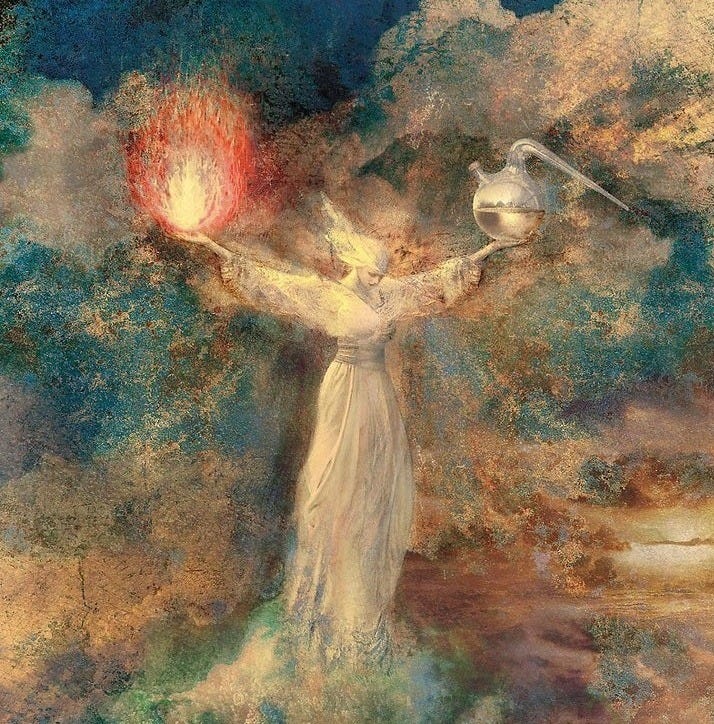
Now there is another feature, or set of features, which is crucial to this world of our ancestors, and which has also been done away with. The story of the undoing of this feature is central to the transformation. This is a feature which mediaeval Christendom had in common with many (perhaps most) civilizations dominated by a “higher” religion. We could call this feature an equilibrium in tension between two kinds of goals. On one hand, the Christian faith pointed towards a self-transcendence, a turning of life towards something beyond ordinary human flourishing. On the other, the institutions and practices of mediaeval society, as with all human societies, were at least partly attuned to foster at least some human flourishing. This sets up a tension, between the demands of the total transformation which the faith calls to, and the requirements of ordinary ongoing human life.
[…]
Another way in which this feature of equilibrium in tension emerges in this society became evident in Carnival and similar festivities, such as the Feasts of Misrule, or boy bishops, and the like. These were periods in which the ordinary order of things was inverted, or “the world was turned upside down”. For a while, there was a ludic interval, in which people played out a condition of reversal of the usual order. Boys wore the mitre, or fools were made kings for a day; what was ordinarily revered was mocked, people permitted themselves various forms of licence, not just sexually but also in close-to-violent acts, and the like.
These festivals are fascinating, because their human meaning was at once very powerfully felt in them—people threw themselves into these feasts with gusto—and yet also enigmatic. The enigma is particularly strong for us moderns, in that the festivals were not putting forward an alternative to the established order, in anything like the sense we understand in modern politics, that is, presenting an antithetical order of things which might replace the prevailing dispensation. The mockery was enframed by a understanding that betters, superiors, virtue, ecclesial charisma, etc. ought to rule; the humour was in that sense not ultimately serious (note: or was it—see below).
Natalie Davis had argued for an origin of these feasts of the urban setting in the villages, where there was recognized licence for the class of young unmarried males to indulge in mockery and mayhem, like the charivari. But as she points out, this mockery was exercised very much in support of the ruling moral values.
And yet, for all this acceptance of order, plainly something else showed through the display and the laughter, some deeply felt longings, at variance with this order. What was going on? I don’t know, but some interesting and suggestive ideas have been put forward which are worth noting.
Even at the time, the explanation was offered that people needed this as a safety valve. The weight of virtue and good order was so heavy, and so much steam built up under this suppression of instinct, that there had to be periodic blow-outs if the whole system were not to fly apart. Of course, they didn’t think in terms of steam at the time, but a French cleric expressed the point clearly in the technology of the day.
We do these things in jest and not in earnest, as the ancient custom is, so that once a year the foolishness innate in us can come out and evaporate. Don’t wine skins and barrels burst open very often if the air-hole is not opened from time to time? We too are old barrels...
Also at the time, and more since, people have related these festivals to the Roman Saturnalia. There seems no good ground to trace a real historical connection, but the supposition that something similar is resurfacing here is perfectly acceptable in principle. The thinking behind this parallel draws on theories about the Saturnalia, and other similar festivals (e.g., in ancient Mesopotamia, and also the Aztec renewals of the world). The intuition supposedly underlying these is that order binds a primitive chaos, which is both its enemy but also the source of all energy, including that of order. The binding has to capture that energy, and in the supreme moments of founding it does this. But the years of routine crush this force and drain it; so that order itself can only survive through periodic renewal, in which the forces of chaos are first unleashed anew, and then brought into a new founding of order. As though the effort to maintain order against chaos could not but in the end weaken, tire, unless this order were replunged into the primal energies of chaos to emerge with renewed strength. Or something like this; it’s hard to get it entirely clear.
Then, of course, there is Bakhtin, who brings out the utopian strain in laughter. Laughter as the solvent of all boundaries; the body which connects us to everyone and everything; these are celebrated in Carnival. A kind of carnal Parousia is adumbrated.
Victor Turner proposes another theory. The order we are mocking is important but not ultimate; what is ultimate is the community it serves; and this community is fundamentally egalitarian; it includes everyone. Yet we cannot do away with the order. So we periodically renew it, rededicate it, return it to its original meaning, by suspending it in the name of the community, which is fundamentally, ultimately of equals, and which underlies it.
I’ve laid all these out, because whatever the merits of each one, they point up an important feature of the world in which these festivals occurred. It incorporates some sense of the complementarity, the mutual necessity of opposites, that is, of states which are antithetical, can’t be lived at the same time. Of course, we all live this at some level: we work for x hours, relax for y hours, sleep for z hours. But what is unsettling to the modern mind is that the complementarity behind carnival exists on the moral or spiritual level. We’re not just dealing with a de facto incompatibility, like that of sleeping and watching television at the same time. We’re dealing with things which are enjoined and those condemned, with the licit and illicit, order and chaos. All the above accounts have this in common, that they postulate a world, and underlying this perhaps a cosmos, in which order needs chaos, in which we have to give place to contradictory principles.
Victor Turner’s discussion of this is especially interesting, because he tries to put this phenomenon of Carnival in a wider perspective. It is one manifestation of a relationship which turns up in a tremendous range of pre-modern societies in all parts of the world. In its general form, the relationship could be put in this way: all structure needs anti-structure. By ‘structure’, Turner means, borrowing a phrase from Merton, “‘the patterned arrangements of role-sets, status-sets and status-sequences’ consciously recognized and regularly operative in a given society.” We could perhaps rephrase this, and speak of the code of behaviour of a society, in which are defined the different roles and statuses, and their rights, duties, powers, vulnerabilities.
Turner’s point is that in many societies where this code is taken perfectly seriously, and enforced, even harshly most of the time, there are nevertheless moments or situations in which it is suspended, neutralized, or even transgressed. Plainly Carnival and Feasts of Misrule constituted such moments in mediaeval Europe. But these “rituals of reversal” are in fact very widespread. For instance, in the enthroning ritual of the king in various African societies, the candidate must pass through an ordeal, in which he is reviled, hectored, and even kicked and shoved by his subjects to be.
This kind of reversal has analogies to another kind of relation in which people who according to the dominant jural-political code are weak or of low status can exercise another kind of power in a complementary domain. Turner cites a number of African societies formed by militarily dominant invaders who have conquered the indigenous people. “The invaders control high political office, such as the kingship, provincial governorships, and headmanships. On the other hand, the indigenous people, through their leaders, frequently are held to have a mystical power over the fertility of the earth and of all on it. These autochthonous people have religious power, the ‘power of the weak’ as against the jural-political power of the strong, and represent the undivided land itself against the political system with its internal segmentation and hierarchies of authority.”
This situation has analogies in turn to all those societies in which various classes of powerless and low-status people can exercise a certain authority in their sphere, as is sometimes the case for women, for instance; or in which the weak, the indigent, the outsider is surrounded with a certain charisma, like holy madmen, or indeed, the poor in mediaeval society—whose altered fate in early modern society I will discuss below.
Turner further extends the range of analogies to include societies with “rites of passage” of the kind studied by Arnold van Gennep. The point of contact here is that these rituals by which people move from one status to the next—say, circumcision rites for young men, who thereby become adults—involve the neophytes stepping out of their earlier role and entering a kind of limbo, in which they are stripped of all the marks of status. Their earlier identity is in a sense obliterated, and they pass a period on the “threshold”, undergoing trials and ordeals, before they step into the new identity. The threshold image is van Gennep’s, who coined the term “liminality” for this condition. Turner sees liminality as a kind of “anti-structure”, because it’s a condition in which the markers of the ordinary code, with its rights, duties and status criteria, have been temporarily wiped away.
What all these situations have in common is that there is a play of structure and anti-structure, code and anti-code; this either takes the form of the code’s being momentarily suspended or transgressed; or else, as with the relation between conquerors and autochthonous above, the code itself allows for a counter-principle to the dominant source of power; it opens space for a complementary “power of the weak”. It’s as though there were a felt need to complement the structure of power with its opposite. Otherwise…what?
The basic intuitions here are hard to define. I mentioned some possibilities above in connection with Carnival. One is certainly the idea that the pressure of the code needs to be relaxed from time to time; we need to let off steam. But then the further idea often seems to be there, that the code relentlessly applied would drain us of all energy; that the code needs to recapture some of the untamed force of the contrary principle. Commenting a paper by Evans-Pritchard on rituals which prescribe obscenity, Turner says:
The raw energies released in overt symbolisms of sexuality and hostility between the sexes are channelled toward master symbols representative of structural order, and values and virtues on which that order depends. Every opposition is overcome or transcended in a recovered unity, a unity that, moreover, is reinforced by the very potencies which endanger it. One aspect of the ritual is shown by these rites to be a means of putting at the service of the social order the very forces of disorder that inhere in man’s mammalian constitution.
These explanations still sound rather “functionalist”; the aim of the exercise seems still to be the preservation of the society. But Turner puts them in the context of the pull of “communitas”, which takes us beyond this level of explanation. The sense of “communitas” is the intuition we all share that, beyond the way we relate to each other through our diversified coded roles, we also are a community of many-sided human beings, fundamentally equal, who are associated together. It is this underlying community which breaks out in moments of reversal or transgression, and which gives legitimacy to the power of the weak.
Now this account also has its “functionalist” face. When we curse and swear at the king-elect, we remind him and us that the ruler’s rights and prerogatives have a further purpose which is the weal of the whole. But in Turner’s view, the draw to communitas can go way beyond the boundaries of our society. It can be activated by the sense that we are all human beings, equals, that we belong together. The pull to anti-structure can come from beyond the society, and even from beyond humanity.
From this point of view, it would be legitimate to see the first tension I mentioned above, that between ordinary flourishing and the higher, renunciative vocations, as another example of structure versus anti-structure. The structures of power, property, warrior dominance, are challenged by a life which claims to be higher, and yet which couldn’t simply replace the established order. They are forced into co-existence, and hence some kind of complementarity.
This enables us to see that the play of structure and anti-structure can take place on more than one level, because it is this whole complementarity of state and church together which plays the structural pole to the anti-structure of carnival.
So the pull of communitas is potentially multi-valenced. It can not only bring to the fore our community, but that of humankind. And in breaking us out of coded roles, it also does a number of other things besides releasing fellowship. It also sets free our spontaneity and creativity. It allows free reign to the imagination.
Seen in this perspective, the power of anti-structure comes also from the sense that all codes limit us, shut us out from something important, prevent us from seeing and feeling things of great moment. We remember that in some of the rites of passage, the elders take advantage of this liminal condition to instruct the youth in the deepest lore of the society; as if these things can’t be learned except by those who have become receptive through stepping out of their normal coded roles. We recognize here the principle behind the “retreat”, both religious and secular.
The general phenomenon here is thus a sense of the necessity of anti-structure. All codes need to be countervailed, sometimes even swamped in their negation, on pain of rigidity, enervation, the atrophy of social cohesion, blindness, perhaps ultimately self-destruction. Both the tension between temporal and spiritual, and the existence of carnival and other rites of reversal, show that this sense used to be very alive in Latin Christendom. What has happened to it today?
Well, as the reference above to retreats shows, it is not wholly gone. We have a sense of it in our daily lives. We still feel the need to “get away from it all”, to cut out and “recharge our batteries”, away, on holiday, outside our usual roles. There are certainly carnival-type moments: public holidays, football matches—here, like their predecessors, hovering on the brink, sometimes over the brink of violence. Communitas breaks out in moments of exceptional danger or bereavement, as with the crowds mourning Princess Di.
What is different is that this need for anti-structure is no longer recognized at the level of the whole society, and in relation to its official, political-jural structure. One might ask: how could it be? In all the cases mentioned above, the need for anti-structure was understood in terms of a spiritual context: the human code exists within a larger spiritual cosmos, and its opening to anti-structure is what is required to keep the society in true with the cosmos, or to draw on its forces. Seen from this point of view, the eclipse of this felt need is a simple corollary of the secularization of public space (sense 1 of the first chapter above).
I draw attention to it here, because I think that it played a very important role in the rise of secularity 1. That is, it was the eclipse of this sense of necessary complementarity, of the need for anti-structure, which preceded and helped to bring about the secularization of public space. The idea that a code need leave no space for the principle that contradicts it, that there need be no limit to its enforcement, which is the spirit of totalitarianism, is not just one of the consequences of the eclipse of anti-structure in modernity. That is certainly true. But it is also the case that the temptation to put into effect a code which brooks no limit came first. Yielding to this temptation is what helped bring modern secularity, in all its senses, into being.
That belongs to the story I want to tell shortly. For the moment I want just to complete the contrast I was making between then and now.
Certainly one consequence of the eclipse of anti-structure was this propensity to believe that the perfect code wouldn’t need to be limited, that one could and should enforce it without restriction. This has been one of the driving ideas behind the various totalitarian movements and régimes of our time. Society had to be totally made over, and none of the traditional restraints on action should be allowed to hamper this enterprise. In a less dramatic way, it encourages the tunnel vision with which the various “speech codes” of political correctness are applied on certain campuses, and lends the positive ring to such slogans as “zero tolerance”.
The epoch of the French Revolution is perhaps the moment in which at one and the same moment anti-structure goes into eclipse, and the project of applying a code without moral boundaries is seriously contemplated. This emerges most clearly in the attempts of the various revolutionary governments to design festivals which would express and entrench the new society. In these attempts, they drew heavily on earlier feasts, for instance, on Carnival, on pilgrimages (the model for the Fête de la Fédération), and the processions of Corpus Christi (la Fête Dieu). But the nature of the enterprise was in a certain sense reversed.
That is because the dimension of anti-structure was totally missing. The aim of the exercise was not to open a hiatus in the now reigning code, but to give expression to its spirit, and inspire identification with it. The anti-structural elements of Carnival were sometimes borrowed, as in the dechristianization of Year II, but this destructive mockery was directed against the old religion and the ancien régime in general. It aimed to complete the destruction of the reigning code’s enemies, not to suspend the code itself.
As befits celebrations of the official reality these feasts were generally well ordered; they were meant to celebrate the social bond itself, or else “nature”; and they were rigorously egalitarian and reciprocal. They tried to meet the Rousseauian requirement that the distinction between spectators and actors be abolished. As a report on one of these feasts had it: “La fête de la liberté du 15 mai fut du moins nationale, en ce que le peuple y était tout à la fois acteur et spectateur.” (The Festival of Liberty on May 15 was at least national, in that in it the people were at once both actors and spectators.) They were decidedly anthropocentric. “La seule vraie religion est celle qui annoblit l’homme, en lui donnant une idée sublime de la dignité de son être et des belles destinées auxquelles il est appelé par l’ordinateur humain.” (The only true religion is that which ennobles man by giving him a sublime idea of the dignity of his being and of the great destinies to which he is called by the designer of the human condition.)
No wonder that they were deathly dull, and disappeared, along with the new calendar designed to contain them, with the fall of the régime which sponsored them. They are harbingers of similar attempts at self-celebration by this century’s communist régimes, which have met a similar fate. And they tell us something about what happens to traditional anti-structures in our age, as we can see with the use made of aspects of Carnival in the dechristianization of 1793. They can offer guidelines for Utopia, or for a new and totally harmonious régime. I will return to this below.
But erecting a structure without moral boundaries is a temptation of an age which has forgotten anti-structure; it is not a fatality. It can be avoided, and generally has been. A principle of opposition can be built into our reigning political code, as with the division of powers; and this has generally been done in the name of a principle of limitation, the negative freedom of the subject. Of course, an attempt may still be made on the intellectual plane to show how these free, self-limiting régimes flow from a single principle, as we see, for instance, with the contemporary “liberalism” of Rawls and Dworkin. This shows how deeply modernity has invested in the myth of the single, omnicompetent code. But there are theorists, such as Benjamin Constant, Alexis de Tocqueville, and in our century, Isaiah Berlin, who have recognized that we have to give our allegiance to more than one principle, and that those we essentially hold to are frequently in conflict.
Where in theory and in practice, liberal régimes of this pluralist kind have been developed, the consequences of the eclipse of anti-structure have been much mitigated. We might even say that anti-structure has been given a new kind of place in these societies, in the private domain. The public/private distinction, and the wide area of negative freedom, is the equivalent zone in these societies to the festivals of reversal in their predecessors. It is here, on our own, among friends and family, or in voluntary associations, that we can “drop out”, throw off our coded roles, think and feel with our whole being, and find various intense forms of community. Without this zone, life in modern society would be unliveable.
This unofficial zone has developed its own public spheres, in which the imagination is nourished, and ideas and images circulate: the spheres of art, music, literature, thought, religious life, without which our personal dropping out would be radically impoverished. This modern space for anti-structure opens up unprecedented possibilities for untrammeled creation, and at the same time hitherto unexperienced dangers of isolation and loss of meaning. Both of these come from the fact that this space is “private”, its public spheres sustained by purely voluntary participation.
The modern predicament is in this way structurally different from anything which went before. And this means that one part of the traditional play of structure and anti-structure is no longer available to us. In rituals of reversal, or in the rites of obscenity in African societies I alluded to earlier, we have not only the airing of opposed principles, which are allowed to emerge and engage in mock battle. The aim is frequently also to bring them to some kind of synergy; to make the structure less self-enclosed, and at the same time to allow it to draw on the energy of anti-structure in order to renew itself.
This is something which seems beyond our capacity in the modern age. Or at least not by means of ritual. Sometimes the antagonistic forces in a society are brought together to recognize their commonalty by some common threat, or in moments of common grief. But that is a rather different thing. The fact that external danger is what so often is needed to unite us explains to some degree the continuing force of nationalism in our time.
So one of the places that anti-structure has migrated is into the private domain, and the public spheres sustained out of this. But that is not all. The call of anti-structure is still strong in our highly interdependent, technological, super-bureaucratized world. In some ways, more powerful than ever. A stream of protests, against central control, regimentation, the tyranny of instrumental reason, the forces of conformity, the rape of nature, the euthanasia of the imagination, have accompanied the development of this society over the last two centuries. They came to one climax recently, in the sixties and seventies, and we can be sure this is not their last.
At that time, many aspects of Carnival were revisited and re-edited. Think of May ’68 in Paris, with its denunciation of structure (le cloisonnement), and the energy of communitas that it thought it was releasing. The “Soixante-huitards” wanted precisely to eschew the anti-structure of private space; they wanted to make it central to public space, indeed, to abolish the distinction between the two.
But this too, is importantly different from the place of anti-structure earlier. Here the negation of the code is being drawn on as a source for utopias, and new projects, which are meant to replace the existing society, as I mentioned above. Carnival and Revolution can never coincide, no matter how close playful revolutionaries try to bring them. The aim of revolution is to replace the present order. It mines previous anti-structures to design a new code of freedom, community, radical fraternity. It is the birthplace of a new and perfect code, one that will need no moral boundaries, that will brook no anti-structure. It is the anti-structure to end all anti-structure. The dream if carried through (which fortunately it wasn’t in ’68) turns into a nightmare.
At this point, we become aware of a wisdom in the earlier play of code and negation that we are in danger of losing sight of. All structures need to be limited, if not suspended. Yet we can’t do without structure altogether. We need to tack back and forth between codes and their limitation, seeking the better society, without ever falling into the illusion that we might leap out of this tension of opposites into pure anti-structure, which could reign alone, a purified non-code, forever.
But it is extraordinary how often this dream has been generated afresh in our age, even by otherwise hard-headed people, like the inventors of “scientific socialism”, dreaming of a “withering away of the state”. This is because the pains of structure, its rigidities, injustices, insensitivity to human aspiration and suffering, having lost their earlier social outlet, drive us back to this dream. We have probably not seen the last of it.
Comment
What I affirm is the intuition that where God’s presence is no longer a tenable supposition and where His absence is no longer a felt, indeed overwhelming weight, certain dimensions of thought and creativity are no longer available. (George Steiner)
I thin “potential energy” is a useful model for understanding why certain dimensions of thought and creativity, of inspiration and perspiration, are not longer available to us.
The function of God is the focus. An intense mental state is impossible, unless there be something, or the illusion of something, to center upon...I conceive of the magic of prayers. I conceive of the magic of blasphemies. There is witchcraft in religion: there may be witchcraft in atheism. (Charles Fort)
God, or the idea thereof, functions as a kind of psychic ground, generating enormous potential energy whether you push toward or against Him. The magic of prayer and the magic of blasphemy are both expressions of this energy. Both, however, require a ground to push against. The witchcraft of atheism only works in a theistic culture; The blasphemer needs a God to blaspheme against. Remove that transcendent ground entirely and the potential energy dissipates.
For medieval Christians, this (psycho-social) potential energy was released in various ways: war (the Crusades), the activities of monastic life (mysticism, asceticism, scholarly pursuit), construction and artisanry, and ritualistic festivals like Carnival. Us moderns are woefully deficient in this god-energy, and it shows: in our soulless architecture, our shallow scholarship, and our withered mystical traditions; a public tradition like Carnival, an annual eruption of inversionary anti-structure, is all but inconceivable today. While of course there are still many deeply devout individuals and communities in this most secular age, the god-energy is not nearly as potent or as easily accessible as it once was. The ground of belief has shifted beneath our feet; the spell has been broken.
In the old world, people could have a naïve belief, but today belief or unbelief is “reflective”, and includes a knowledge that other people do or do not believe. We look over our shoulder at other beliefs… (Taylor)
What was an absolute conviction in the Absolute has become self-conscious, provisional, half-hearted. Such a ground is no ground at all, but a quicksand into which we slowly sink.
What’s really important about such festivals is that they kept the old spark of political self-consciousness alive. They allowed people to imagine that other arrangements are feasible, even for society as a whole, since it was always possible to fantasize about Carnival bursting its seams and becoming the new reality. In the popular Babylonian story of Semiramis, the eponymous servant girl convinces the Assyrian king to let her be ‘Queen for a Day’ during some annual festival, promptly has him arrested, declares herself empress and leads her new armies to conquer the world. May Day came to be chosen as the date for the international workers’ holiday largely because so many British peasant revolts had historically begun on that riotous festival. Villagers who played at ‘turning the world upside’ would periodically decide they actually preferred the world upside down, and took measures to keep it that way.
Medieval peasants often found it much easier than medieval intellectuals to imagine a society of equals. Now, perhaps, we begin to understand why.
The preceding quote from The Dawn of Everything (2021) argues that Carnival festivals played a causative role in the birth of modern socio-political forms by lending a temporary reality to the first imaginings of these forms. I think it is also possible, however, that these festivals were merely a symptom of deeper sociological and theological features of Latin Christendom which supported these Feasts of Fools and Misrules and contributed to the birth of secular modernity.
A vast but (I hope) useful oversimplification: Islam, which has no anti-structural festivals, is a religion of the “Father”: an all-powerful and all-knowing deity, a divinity of authority and hierarchy—a God, in other words, of structure. Christianity is a religion of the Father too of course (the Old Testament YHWH), but also of the Son: a God who is innocent, weak, poor (in spirit), but also creative, compassionate, rebellious; a God who throws temper tantrums (flips tables) and likes telling stories (parables)—in many ways, a God of anti-structure.
The unique theological structure of Christianity is a reflection of its unique origin. Islam and Judaism, founded by prophets who were not regarded as deities themselves but as messengers of the Father, were from the start political and militaristic entities, whereas Christianity, founded by the Son—a god but also a man, a humble carpenter—began as a fraternity for and of the powerless. Where the Islamic ummah fuses religious community and political body, where Torah provides not just spiritual guidance but civil law, the Christian dispensation distinguishes between worldly and otherworldly power (”Render unto Caesar…”). The potential for government and public culture to split from religious culture was intrinsic to Christianity in a way that it simply isn’t in the other major monotheistic traditions.
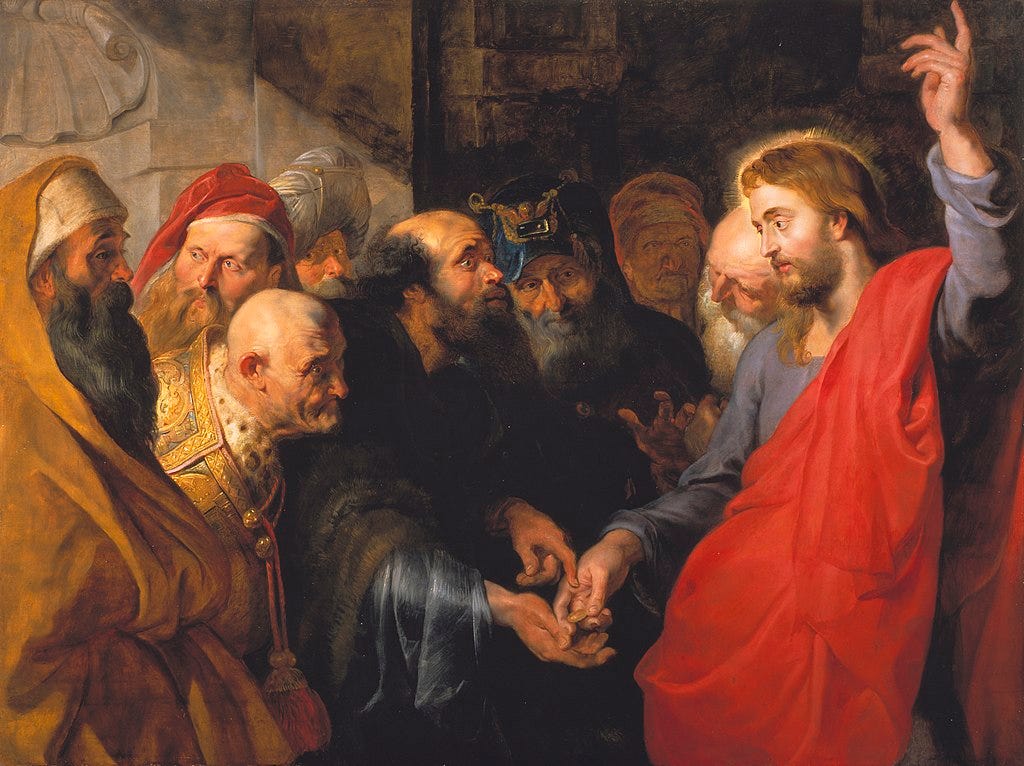
Carnival traditions were downstream of Christianity’s unique sociological and doctrinal structure. Social inversion is easier to imagine—and easier to justify, even in a festivalistic context—when your god-man lived amongst the sick and the poor and the oppressed and said things like “the first shall be last and the last shall be first” and “the meek shall inherit the earth.” A religion whose central image is a crucified criminal, whose founder washed the feet of fishermen and dined with prostitutes and tax collectors, carries within it an anti-structural charge that no amount of ecclesiastical hierarchy can fully neutralize. The boy bishop wearing the mitre or the fool crowned king for a day provides more than a social safety valve. It is a living reminder that the order of this world is not ultimate.
The paradoxical unity of Fatherly structure and Childly anti-structure within the Christian God maintained a tension whose potential energy fueled Christendom’s extraordinary cultural generativity. When that tension collapsed, when the god-energy dissipated and belief became reflective rather than naïve, both poles suffered. Structure, untempered by anti-structure, tends toward the totalitarian code that brooks no opposition. Anti-structure, severed from its sacred ground, tends toward utopian fantasy—the dream of a “purified non-code” that, as Taylor warns, invariably turns nightmare.
Christianity can be understood as a synthesis of monotheistic Judaism and Greco-Roman paganism. The Christian God is both One and Many (well, at least three); He is nothing like us—a distant divine creator, the unmoved mover—but also just like us: emotional, capricious, even foolish. The Greeks had Dionysus; Christianity has a god-man who turns water into wine.
The Dionysian inheritance that Christian cultures carried forward from their pagan ancestors may be more important than it seems. In fact, all of that theological and sociological mumbo-jumbo I described above might have had nothing to do with Christendom’s uniquely generative nature. It might have just been the alcohol.
Edward Slingerland has argued that by causing humans “to become, at least temporarily, more creative, cultural, and communal… intoxicants provided the spark that allowed us to form truly large-scale groups”.
A child-like state of mind in an adult is key to cultural innovation, argues Slingerland. Intoxicants provide an efficient route to that state by temporarily taking the prefrontal cortex offline.
The fact that Islam prohibits alcohol whereas Christianity sacramentalizes it may be no small detail: a civilization that gathers weekly to drink the blood of its god is a civilization that has built intoxication, and the loosening of codes it enables, into its very foundations.
While there is no real evidence of a direct historical connection between Carnival and Roman Saturnalia, the parallels are hard to dismiss as mere accident.
The holiday was celebrated with a sacrifice at the Temple of Saturn, in the Roman Forum, and a public banquet, followed by private gift-giving, continual partying, and a carnival atmosphere that overturned Roman social norms: gambling was permitted, and masters provided table service for their slaves as it was seen as a time of liberty for both slaves and freedmen alike. A common custom was the election of a ‘King of the Saturnalia’, who gave orders to people, which were followed and presided over the merrymaking.
Pagan influence aside, it does seem that Carnival had a largely independent origin in medieval theatre. Some historians trace the Feast of Fools to the Ordo Rachelis plays performed during the liturgy for Innocents Day, which included unscripted “Herod games” that mocked their namesake, the Jewish-Roman ruler who, according to the Gospels, ordered the massacre of Bethlehem’s infants. These games involved storming cathedrals, throwing wooden spears at the choir, and beating bystanders with inflated animal bladders. The story held that Herod’s own page-boys had thwarted the murder of Jesus and thereby gained God’s favor—an inversion of worldly rank that mirrored the inversions of the Feast of Fools itself.
This theatrical origin of Carnival points to something essential about Christianity that distinguishes it from the other major world religions. In Islam, God speaks through a prophet; in Buddhism, an enlightened teacher points the way. In Christianity, God becomes a character in a story—a strange tale, full of reversals and surprises, where the protagonist dies and then doesn’t.
Resurrection was the greatest ‘eucatastrophe’ possible in the greatest Fairy Story—and produces that essential emotion: Christian joy which produces tears because it is qualitatively so like sorrow, because it comes from those places where Joy and Sorrow are at one, reconciled, as selfishness and altruism are lost in Love. Of course I do not mean that the Gospels tell what is only a fairy-story; but I do mean very strongly that they do tell a fairy-story: the greatest. (Tolkien)
Islam and Buddhism, whatever their other virtues, are religions of teaching, of law, doctrine, right practice. A religion founded on teaching invites adherence; a religion of story invites imagination, hope, and meaning—all of which are in woefully short supply in this most secular age.
I realize this analysis may read as critical of non-Christian religions, Islam in particular. Two points by way of clarification.
First, while I have argued that Christianity’s unique structure made possible the birth of secular modernity, I hope it is clear by now that I regard modernity as, at best, an ambivalent achievement. Much has been gained, much has been lost; only time will tell whether the bargain will have been worth it. My hope, such as it is, lies in the possibility that modernity represents a transitional epoch, a necessary dialectical step towards some future synthesis of secular modernity and spiritual antiquity in which we might recover what was lost while retaining what was gained.
Second, if our secular age suffers most from a deficit of god-energy, then Islam’s resistance to secularization may position it to play an unexpectedly vital role in whatever comes next. Islam remains the world’s great reservoir of religious intensity, of the kind of spiritual voltage that Christendom once possessed but has long since dissipated. This may seem like a liability now, a source of civilizational friction and conflict. But God, and History, work in mysterious ways and delight in dramatic reversals (the first shall be last…); what is reactionary today may prove generative tomorrow.
I am not naïve about Islam's current challenges, its frequent incompatibility with liberal norms, the genuine problems posed by its fusion of religious and political authority. But I suspect, and this is only a suspicion, the kind of intuition that one offers tentatively, knowing it may prove foolish, that the Islam of the twenty-second or twenty-third century will surprise us—that its very potency, its refusal to dissolve into the godless nihilism of modernity, positions it to contribute something essential to the coming golden age. Perhaps it will itself undergo some internal enantiodromia, some unforeseeable transformation, or catalyze such transformations in others. Perhaps the tension between Islamic intensity and Western exhaustion will prove as generative as the medieval tension between structure and anti-structure once was.
The Romans borrowed Bacchus from the Greeks, who knew him better as Dionysus. Anthropologists would probably tell you that riotous festivals were common to many widespread primitive cultures.
The Christian church found that it couldn’t suppress these folk feasts, so it sanitized them and adopted them. They performed the useful function of encouraging superstition, which is a part of every successful religion.
Lovely piece. I kept being reminded of the tension between the order of multicellularity, which inevitably must give way to the naked simplicity of unicellular gametes from time to time. Maybe a similar tension makes it dangerous for a society to remain in a state of order for too long. Better to have numerous small earthquakes than one huge one. Did the European carnival tradition diminish in vitality in the lead up to the French Revolution I wonder?