

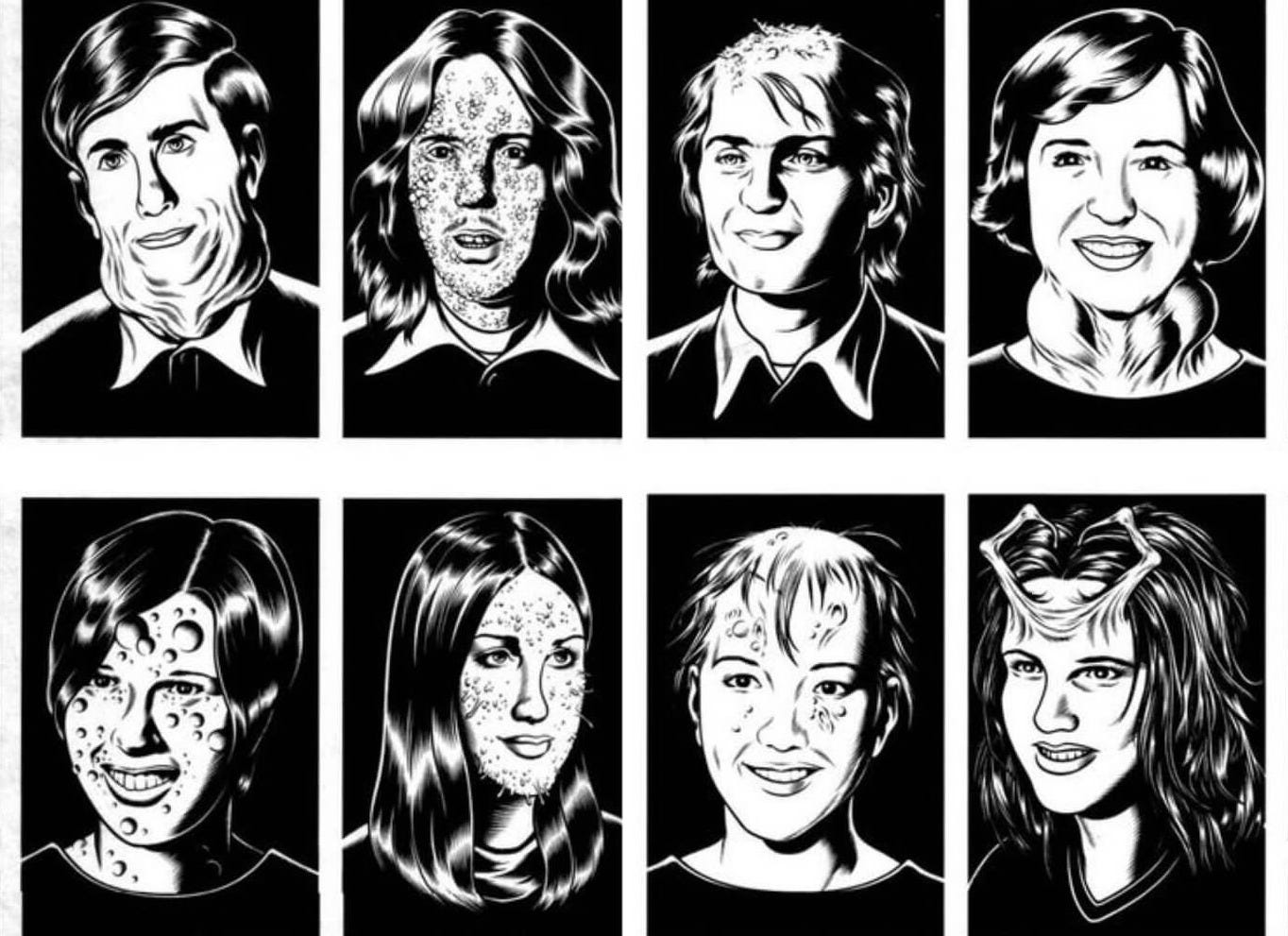
I.
In a recent episode of the (excellent) Weird Studies podcast on the (excellent) graphic novel Black Hole (1995), J.F. Martel asks why mutants and the medium of comics have had such a love affair over the years. His tentative answer: because comics evolved out of the doodling of bored adolescents.
“It’s so easy when you draw a little man with a little hat and a moustache to give him a tail or horns. The medium invites a kind of amorphousness, a delving into the way that anything can become anything else.”
To put the idea in slightly more formal terms, we might say that all mediums lend themselves to the exploration of certain adjacent possibilities. In the case of comics and animation, this adjacent possibility is morphological variation.
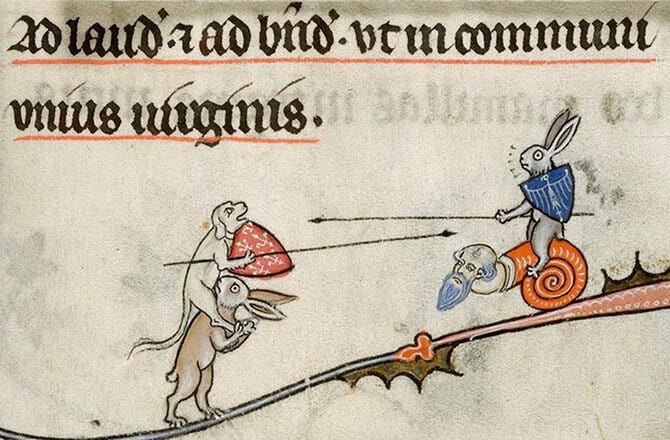
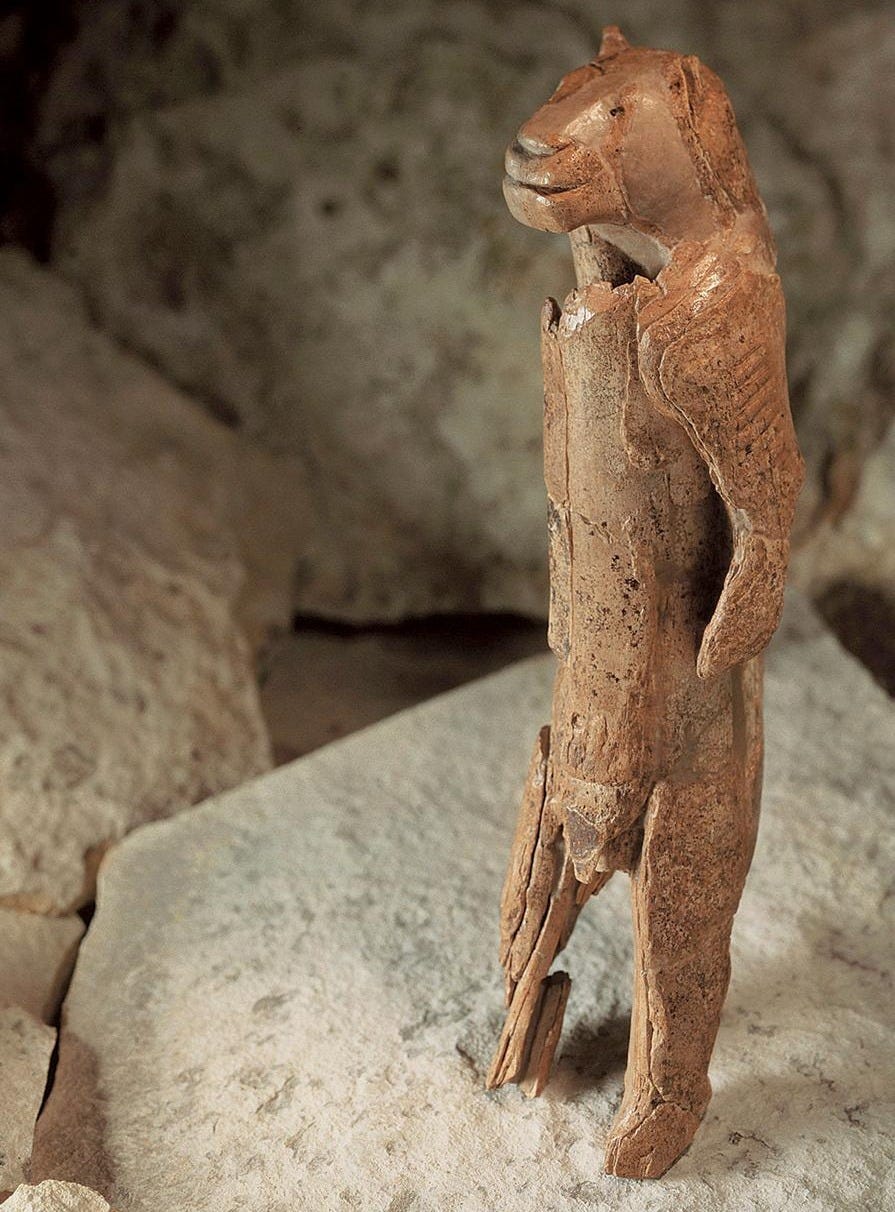
I can’t help but wonder what role this logic has played in religious evolution. Much of what was said about comics applies to the artistic mediums available to pre-modern peoples. You can just as easily doodle a lion man on a piece of paper as you can paint one on a cave wall or carve a man with a lion’s head. And while comics do include a written component, their limited textual bandwidth encourages a style of storytelling more similar in some ways to that of oral cultures.
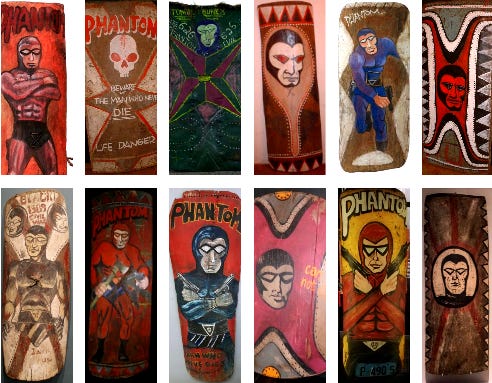
One man’s mutant is another man’s god; one man’s Justice League is another man’s pantheon. Very much to this point is the way in which The Phantom has been adopted by the Wahgi people of Papua New Guinea.
Art historian N.F. Karlins believes that comic books featuring the Phantom may have been brought to Papua New Guinea by American troops as early as the 1940s. The Phantom’s popularity amongst the Wahgi has been attributed to his being a “man who cannot die”, and who vanquishes his enemies by using his “strength, intelligence, and fearsome reputation”; Karlins has suggested that, as Wahgi warriors wear masks, the Phantom’s own mask may have also been a contributing factor. Similarly, anthropologist Susan Cochrane has described the Wahgi interpretation of the Phantom as being a “modern spirit”.
II.
Every year, on the first Monday of May, the people of Hastings parade a man made of leaves through the streets of their town. The leaf-man spins and dances all day, wearing a crown of flowers and followed by his drummers and musicians. The people all wear green. They put garlands of leaves and flowers in their hair. Eventually, the leaf-man is taken to the top of a hill overlooking the sea, where he is slaughtered in front of the townsfolk.
Sam Kriss attends the Hastings parade (“This green and growing earth”) and does a deep dive into the origins of the leaf-man—what Hastingstinians call the Jack in the Green. He discovers that, “the Jack is a an annual folk custom that was revived in Hastings in the 1980s by Mad Jack’s Morris”, which was a traditional dance troupe specializing in morris dancing. He wonders what exactly the Jack in the Green is a revival of; presumably some kind of (human) sacrificial pagan fertility ritual dating back to the time of the druids. One of the reasons an ancient provenance seems plausible is the Green Man.
In thousands of medieval churches across this island, you’ll find the same architectural motif. A man with a face of leaves, or disgorging leaves; sometimes the foliage comes out of his forehead and gives him antlers; sometimes he seems to be painfully transforming from man into plant. I have a nice coffee table book called Gargoyles & Grotesques, published in 1975 by the New York Graphic Society, that contains dozens of photos of these leaf-men. ‘Here,’ it says, ‘we are indeed in the presence of ancient pagan belief in the power and spirit of the tree.’
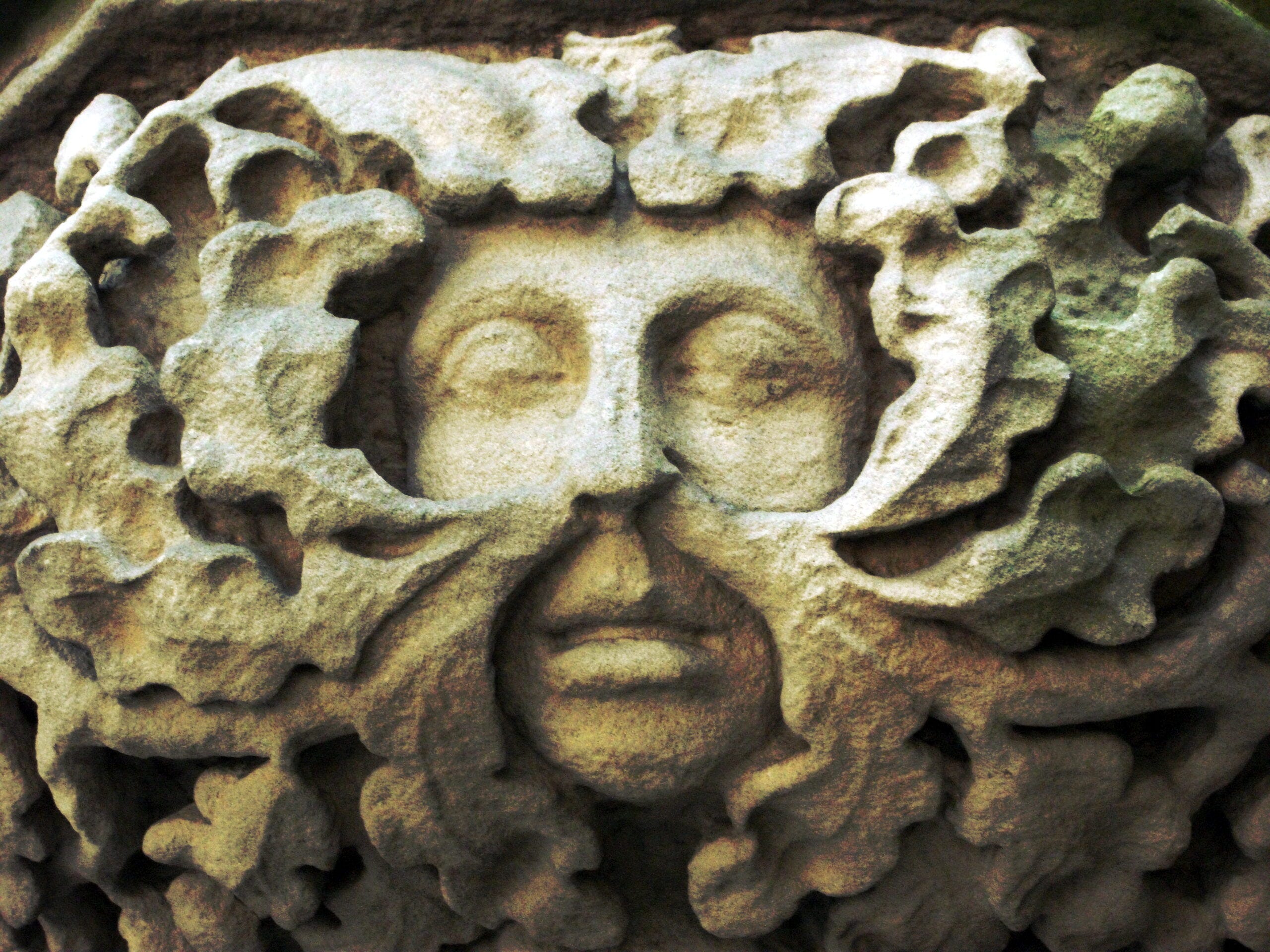
Sam learns that essentially all of this is bullshit. The ritual of burning a leafy-green man-mannequin dates back to bored chimney sweeps in London in the late 18th century. During summer, the down time, sweeps would put on shows and throw parades in order to make a quick buck; the Jack in the Green ritual was invented as a cost-effective grand finale (the material for the mannequin literally grows on trees). As for the Green Man, the motif has been around since time immemorial, and not just in England but all over the world. No one really knows what it was supposed to signify or symbolize.
What does Sam take from all of this?
Tradition is boring.
I don’t think the Jack in the Green is worse because it’s not really an ancient fertility rite, but I do think it’s a little worse because it pretends to be…
…The opposite of tradition is invention. Tradition is fake, and invention is real. Most of the human activity of the past consists of people just doing stuff. The fourteenth-century stonemasons who filled English churches with faces made from leaves weren’t referring to an ancient Celtic tree-cult, they were just doing stuff. They were exploring the world, its wealth of possible forms. The stonemasons two centuries before them who carved the La Tène heads were also just doing stuff. The London chimney-sweeps who started tottering around in a cone of leaves were just doing stuff too. They didn’t need a reason. It didn’t need to be part of anything ancient. They were having fun.
Just doing stuff is beautiful.
At the parade, Sam saw someone wearing an effigy of a seagull with a small shrubbery growing out of its head. It made quite the impression on him.
Hastings, like everywhere on the English coast, is still ruled by its seagulls, big mean birds that collect their tax out of every portion of fish and chips. In 2020, a decorator in Hastings battered a seagull to death after it seized his sandwich. There were no criminal charges, but the entire town turned their backs on him. Seagulls are sacred. They’re meant to be the souls of lost fishermen, come back to land at last. The seagull god had magnificent hard yellow eyes and a small shrub growing out of its head. I felt an urge—a small urge, but a very real one—to worship it.
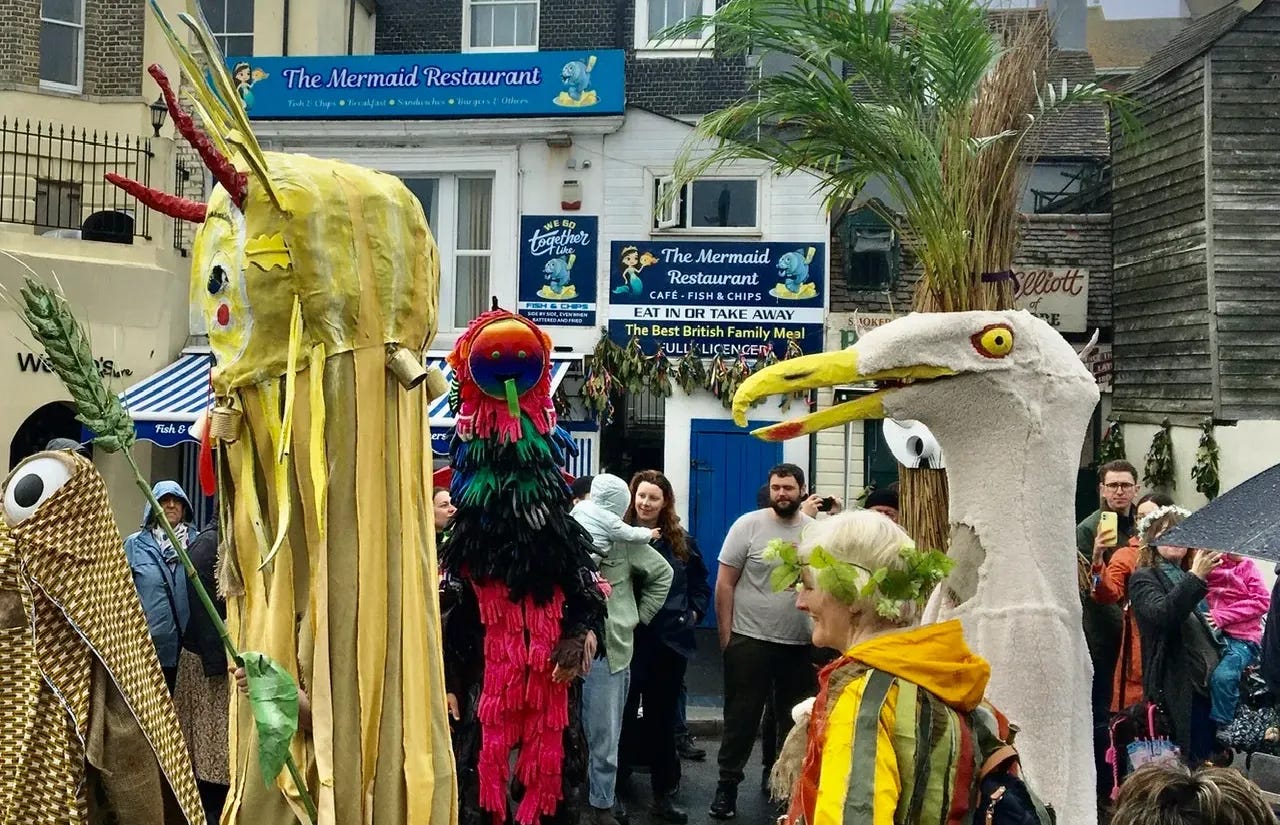
Sam reflects on why he felt that faint urge to worship the seagull god.
I’ve been thinking a lot about the seagull god. That’s my name for it, obviously; really it’s just a puppet of a seagull with some foliage sprouting from its head. Unlike the Jack, it doesn’t make any claims towards antiquity. It’s not associated with any great tradition. It doesn’t even have any particular meaning…but in the procession, the shape of the seagull became totemic. It had the intensity of a symbol, without needing to symbolise anything in particular. Another word for a symbol that burns through any referent is a god. I wasn’t kidding when I said I felt the faint urge to worship it. I don’t think it would be any more meaningful if someone had dug up some thousand-year-old seagull fetishes from a nearby field. It’s powerful simply because of what it is.
Invention, just doing stuff, is the nebula that nurses newborn gods.
In other words: doodling is divine.
III.
Any object, intensely regarded, may be a gate of access to the incorruptible aeon of the gods. (James Joyce)
Okay—but how literally are we supposed to take any of this? Was there, or was there not, a fledgling god in that gull? The notion seems somewhere between mildly outlandish and wildly ridiculous to even the most religious or spiritual-but-not-religious among us today (surely the divine would not deign to desecrate itself by descending into an effigy of a flying sea-rat…), but this was standard fare for the ancients. Consider the 5th-century Alexandrian Heraiskos, who would have recognized Kriss’ description of this faint urge immediately, for he too could identify graven gods from a peculiar stirring in the soul.
Heraiskos had a natural gift of discernment in regard to sacred images, whether they were alive or not. The moment he looked at one, if it was alive, he felt a stab of peculiar feeling go through his heart: his soul and body were both agitated, as if he were divinely possessed. If, on the other hand, he felt no such emotion, the image was a lifeless one, destitute of any divine spirit. It was in this way that he knew, by what may be truly called a mystical union with the deity, that the awful image of Aion was inhabited by the god whom the Alexandrines worshipped, and who is Osiris and Adonis in one. (Damascius, 458-550 AD)
(This was not the only gift of discernment which Heraiskos was purported to possess, “The voice of a menstruating woman was said to give him a headache.”)
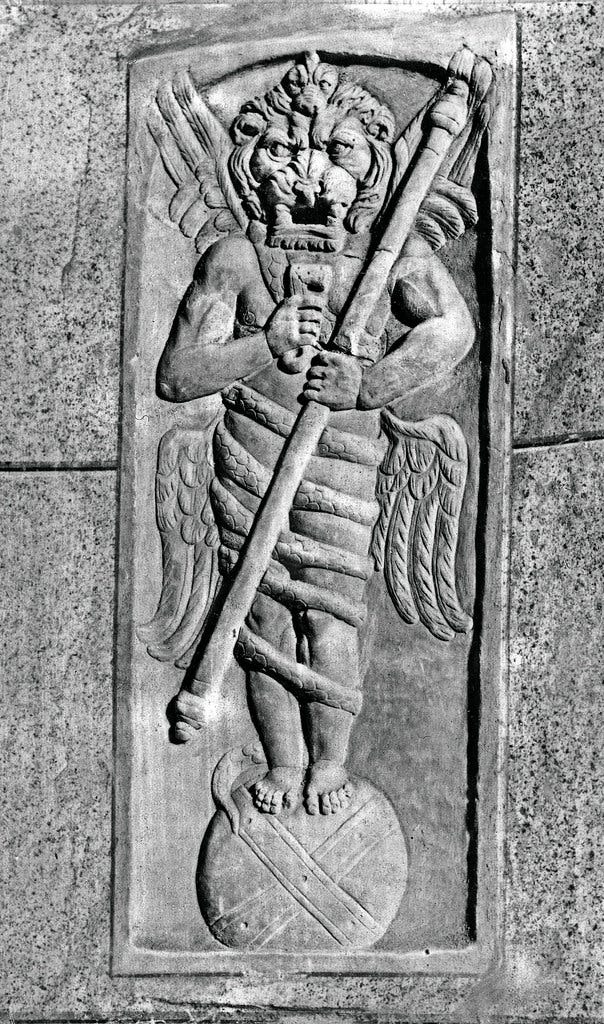
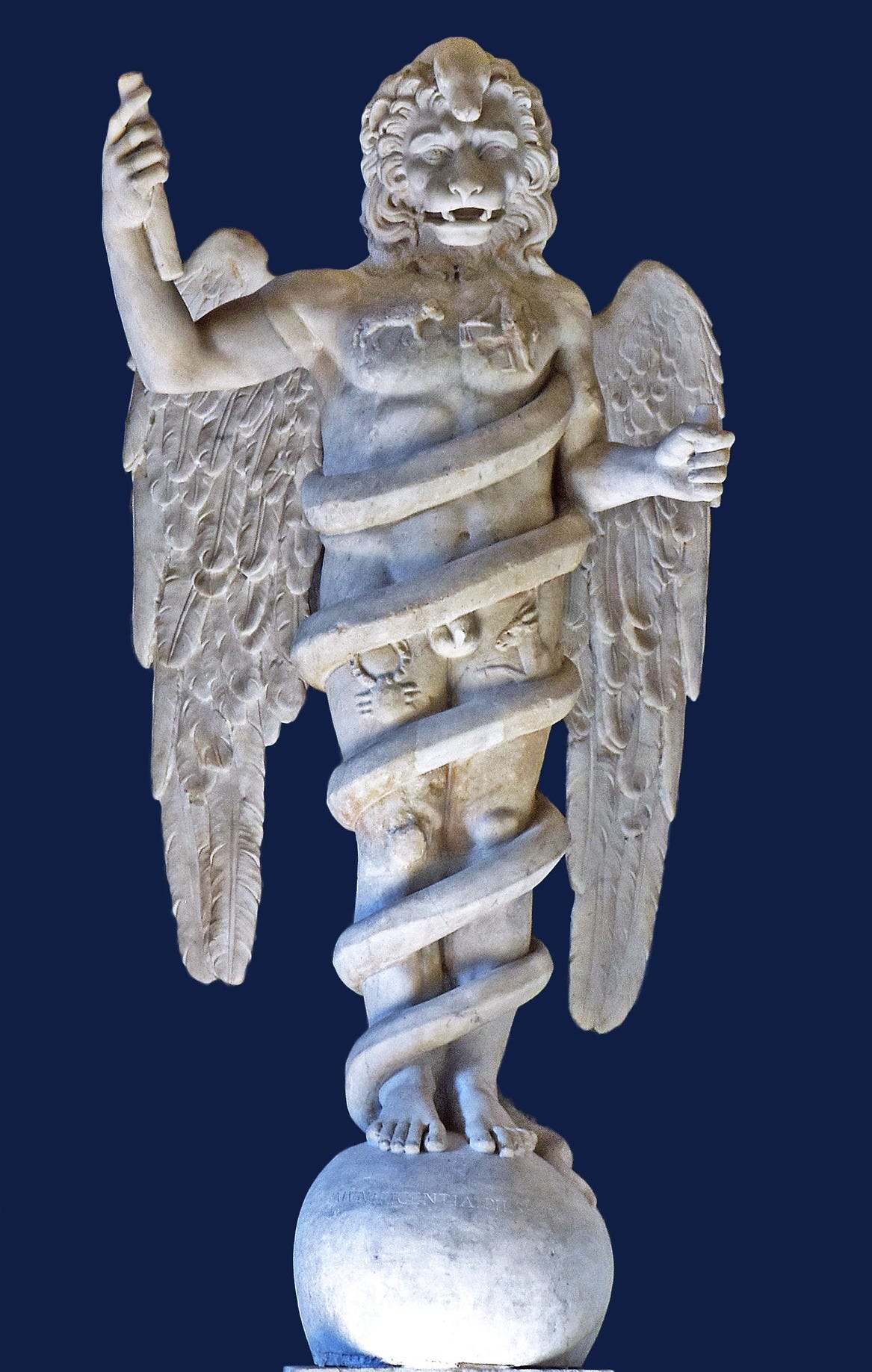
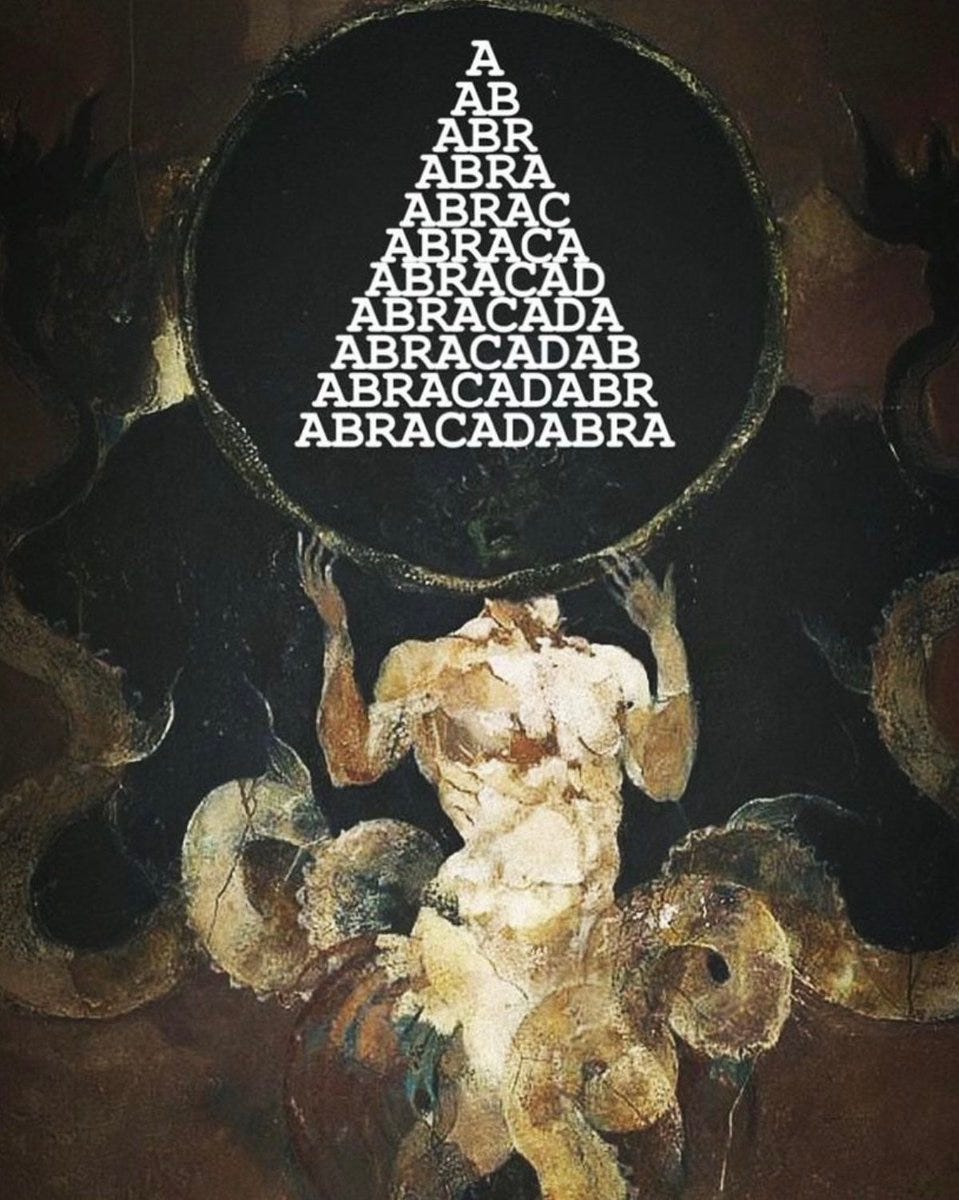
In his highly speculative reconstruction of Mithraic cosmogony, Franz Cumont positioned Aion as Unlimited Time (sometimes represented as Saeculum, Cronus, or Saturn) as the god who emerged from primordial Chaos, and who in turn generated Heaven and Earth. Modern scholars call this deity the ‘leonto‑cephaline’ figure — a winged, lion-headed, nude male, whose torso is entwined by a serpent. He typically holds a sceptre, keys, and/or a thunderbolt. Nobody knows for sure who he was or what he represented…
How do we explain the metaphysical evolution from a world where men may bring forth gods through the making of idols to one where the gods may not even exist?
Before offering an explanation (hint: the medium is the message), it is worth emphasizing how truly alien the ancients’ understanding of god, matter, and man was from our own. Victoria Nelson’s magisterial Secret Life of Puppets (from which I first learned of Heraiskos) provides a clear window into the consensus reality of late antiquity; the following excerpts (lightly edited for clarity) are from chapter 2, “Early Adventures of the Earthly Gods” (emphases all mine).
Through most of the diverse schools, religions, and cults of [late antiquity] ran a single and (to us) curious thread: the goal of making a human into a divine being. This quest took various forms founded on a shared belief in a many-leveled living cosmos, a belief that recognized no division between organic and inorganic and little between the sensible and the invisible. As we saw in Chapter I, this cosmographic construct of the Western ancients that endured from the second century C.E. through the sixteenth considered the greater cosmos or macrocosm to be a living manifestation of God, not a dead artifact. Humans lived in the smaller cosmos or microcosm, the physical world that reflected and was ruled by this divine cosmos or, as rendered in the succinct shorthand of the Hellenistic science of alchemy: “As above, so below.”
Humans in their own bodies were also microcosms or little worlds containing all the attributes of the greater world that ruled them. By gnosis, humans could internalize the cosmos and thereby become divine themselves, able to live in both realms simultaneously. Because matter was alive, it could also be spiritualized and made immortal by humans capable of manipulating the highly charged connection between specific material things and their counterparts in the spiritual world.
The key link was the soul, that immortal portion of the human mortal organism connecting each person to the transcendent world. Like the cosmos around it, the soul had two tiers: the pneuma or spirit that is also part of God, and the more material psyche or soul. (This split in meaning between pneuma and psyche, which occurred around the second century B.C.E, would influence the subsequent identification of psyche in Western culture with individual subjective consciousness as pneuma dropped from currency.)
Through all the ancient cults, the spiritualizing of matter—that mystical union of the two levels of the cosmos as it could be made to occur in the individual person, the soul’s efforts before and after death to rediscover its divine essence—became the religious goal of these first centuries after Christ. This quest also extended to human-made images that were intended as concrete links to the spiritual. If all things in the material world are simulacra, copies, of the true World of Forms, then statues and people alike (and especially statues if they took the shape of humans) acted not just as passive vessels but as magnets to the energies of the higher world, drawing down the gods’ powers and materially embodying them.
The dual goals of Western late antiquity’s religions—to ensoul matter and to make the human divine—drew from many sources but particularly from Hellenized Egypt and its capital, Alexandria. As the most death-obsessed culture this planet has ever seen, the Egyptians had devised over many millennia a supremely concretist view of the soul. The heart of their intricate religious system (which, mixed with Greek and Roman cults, laid the groundwork for many of the new syncretic religions of Hellenistic and Late Antique times) was the notion of a material soul—an entity that the embalmed mummy did not represent or symbolize but simply was. Because the Egyptians saw no separation in kind between soul and body, they believed that the physical body of a human or animal could, with human intervention, become an immortal divine body. This identity of matter and spirit is emphasized in the Book of the Dead, which flatly states that the dead person turns into the god Osiris “not in some invisible way or in the way of an analogy, but through the actual concrete operations of the mummification of the corpse.”
How, according to the Greeks, did humans come to have a soul?
…as the Divine or Original Human, a preexisting transcendent being who stood as an intermediate between God and humans, the Anthropos was a macrocosmic human who inhabited the perfect World of Forms and spoke its Perfect Language before he was incarnated and, in the words of the third-century alchemist Zosimos, “thrown down into matter.” Because the divine spark of the Anthropos is in every person, our goal as humans is to climb back up the hierarchical ladder of the cosmos and—if we are holy enough—realize the perfect world while we are still alive and in our bodies.
This Divine Human and soul-carrier was called Adam Kadmon by Jews; Jesus Christ, the Second Adam, by Christians; the Anthropos or Vir Unus (“One Man” by Hermeticists; and a “great light-man” by Gnostics and Manichees. All these religions had a story about how the Divine Human came to create mortal humans on earth. We humans are simulacra of this Primal Human, just as our world of the senses is a simulacrum of the World of Forms. Through self-knowledge or gnosis we can once again attain the light and the eternal life possessed by the Anthropos, this “essential man.”
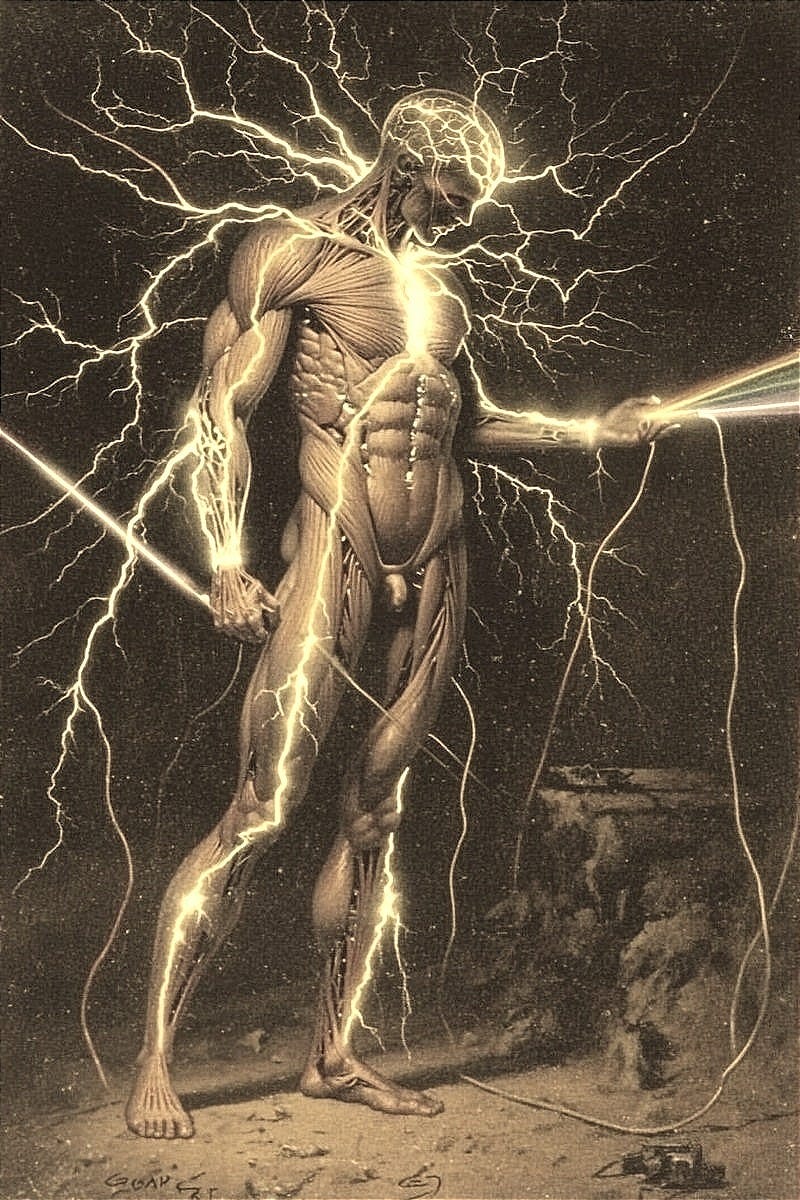
But is the great mystery of instilling life and motion an ability reserved for the gods, Hellenistic priests and philosophers wanted to know, or can humans replicate the process? The part of us that belongs to the Anthropos or Divine Human is precisely our soul, the part that gives us godlike powers. Exercising these powers was a logical extension and yet a further Hellenistic refinement on Plato’s demiurge (craftsman), and it was expressed in the widespread obsession with the religio-magical ritual practice of theurgy (literally, “god making”), the drawing down of the divine into the material world and the simultaneous raising up of the human soul during life to the transcendental level. The theurgist was a priest who could tap into divine powers to purify himself. In this dual procedure—the imitatio dei by generatio animae, in Moshe Idel’s paraphrase, the “attempt of man to know God by the art He uses in order to create men”—Hellenistic adepts confidently and non-blasphemously manipulated matter with the goal of giving it both life and a soul.
The belief that humans could manipulate the universal life force in this way was evident in the second-century Greek Magical Papyri, which contained many sympathetic spells for giving life to physical objects, both formerly animate (mummified birds, human skulls) and manufactured (rings, statuettes). Within the construct of a layered animate universe in which even objects like magnetic stones “breathed,” and thus naturally possessed life reciting an incantation was a “sympathetic” tool whereby the theurgists from their inferior position in the microcosm could harness and control the powers of the macrocosm. And from the Egyptians seems to have come the first record of the next logical step—graven images that moved and spoke. (The pharaonic word for sculptor was sankh, “he who makes life.”) “The most accurate description of a Near Eastern temple,” said Ioan Couliano, “is a playhouse with gods.” These gods, moreover, “were mere statues only to the untrained observer; not so for the hordes of shaven-headed priests who attended them, fed them, bathed them, and took them out for strolls.”
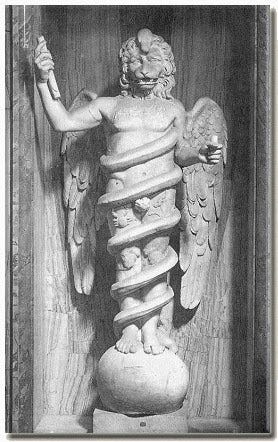
As for animating the statues, we have the testimony of practical texts by the second-century Alexandrian inventor Hero on how to construct moving god images and other automated devices. Using ingenious machines powered by steam or sand, Hero and his mentor Ctesibius devised a host of mechanical marvels, including rotating statues, singing mechanical birds, and automated miniature puppet theaters.
[…]
Animated statues played a special role in Neoplatonism…Plotinus, argued against the extreme world-reviling dualism of the Gnostics and for the inherent unity of the physical and invisible worlds. Objects in the natural world, he believed, could be receptacles for the World Soul, as Jeremy Naydler paraphrases:
Not only could a physical image (whether two- or three-dimensional) provide the “body” for an already existent spiritual entity, but images could also become the physical base for “thought forms” that were called into existence through their being represented on the physical plane. In this case the images carved on funerary stelae, painted on tomb walls or in papyrus texts, had the effect of activating in a higher dimension their spiritual counterparts... The image, by invoking the essence of the substance imaged, was itself magically transformed from being mere image to being an image infused with the spiritual substance it portrayed. At the same time, it became absorbed into this spiritual substance on a spiritual level, and thereby gave access to it.
Like the Neoplatonists, the Hermetic initiates would have regarded the human simulacrum as not just a passive vessel but a magnet for attracting these powers, and so they practiced theurgy just as the Neoplatonists did. In a famous passage of Asclepius, the deity Hermes Trismegistus—and because of his divinity he would almost certainly have been visualized by listeners or readers of this tractate as a statue—instructs his grandson Asclepius in the differences between heavenly gods, made by God himself, and earthly gods (that is, idols), made by humans: “Our ancestors... discovered the art of making gods. To their discovery they added a comfortable power arising from the nature of matter. Because they could not make souls, they mixed this power in and called up the souls of demons or angels and implanted them in likenesses through holy and divine mysteries, whence the idols could have the power to do good or evil.” Because they are human-made, Hermes says, the “earthly and material gods” are inferior to the heavenly gods and show human emotions such as anger. Nonetheless, the powers of these “statues ensouled and conscious, filled with spirit and doing great deeds” were formidable indeed: they “foreknow the future and predict it by lots, by prophecy, by dreams and by many other means; [they] ... make people ill and cure them.”
Yes, but—our skeptical voice of episteme must finally interject—just how was this wonder of living statues manifested in the material world of cause and effect? Confirming our worst suspicions, exhibit A is a first-century C.E. bust of Epicurus with a hollowed out center culminating in a discreet hole in the great philosopher’s mouth, which the scholar Frederik Poulsen concludes was made for a tube through which a priest, crouched behind a wall, could speak, allowing the head to act as a “veritable oracle, with a voice which would sound to an emotional mind both mysterious and weird.” From the standpoint of rational episteme, the fact that these all too human-made mechanical devices (a number of which survive) undeniably provided the generatio animae at once cancels out the validity of the supernatural experience; indeed, Poulsen subtitled his report “A Chapter in the History of Religious Fraud.”
To its practitioners, however, ventriloquism of the kind demanded by the bust of Epicurus would not have been a ruse at all, but rather a tool by which the priest possessed by the god could give utterance to the god’s words through the statue. Their belief in the experience of divine possession, even as they manipulated the statues, was genuine and not the cynical fakery assumed by modern researchers…
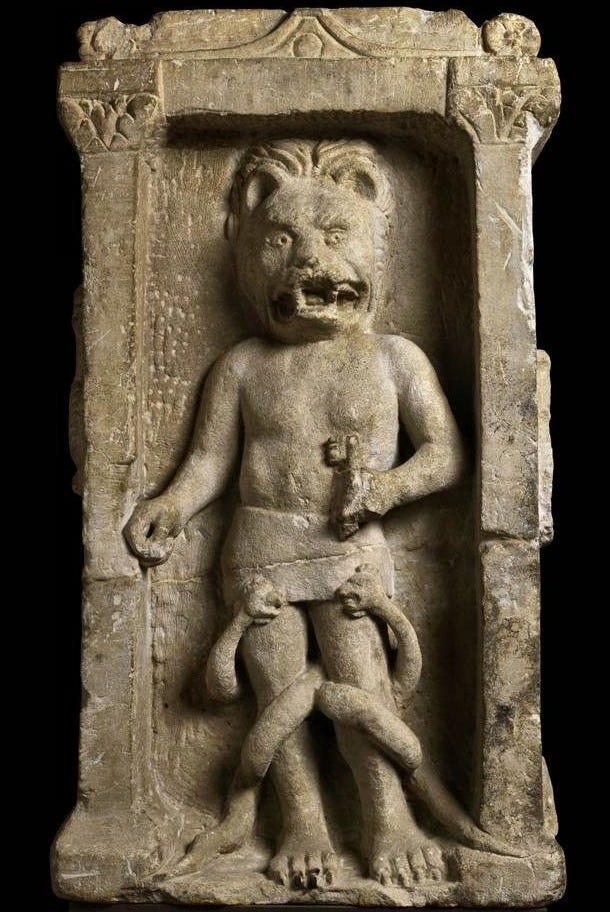
IV.
The driver of this great metaphysical unwinding is literacy. People of the image became people of the Book. In the (written) words of Walter Ong, “Writing is a technology that restructures thought” (1986).
Here, then, are some of the ways in which writing separates or divides.
Writing separates the known from the knower. It promotes ‘objectivity’. (Knowledge itself is not object-like: it cannot be transferred from one person to another physically even in oral communication, face-to-face, or a fortiori in writing. I can only perform actions—produce words—which enable you to generate the knowledge in yourself.)
Whereas oral cultures tends to merge interpretation of data with the data themselves, writing separates interpretation from data. Asked to repeat exactly what they have just said, persons from a primary oral culture will often give an interpretation of what they originally said, insisting and clearly believing that the interpretation is exactly what they said in the first place.
Writing distances the word from sound, reducing oral-aural evanescence to the seeming quiescence of visual space.
Whereas in oral communication the source (speaker) and the recipient (hearer) are necessarily present to one another, writing distances the source of the communication (the writer) from the recipient (the reader), both in time and space.
Writing distances the word from the plenum of existence. In their original, spoken condition, words are always part of a context that is predominantly non-verbal, a modification of a field of personal relationships and object-relationships. The immediate context of spoken words is never simply other words.
By distancing the word from the plenum of existence, from a holistic context made up mostly of non-verbal elements, writing enforces verbal precision of a sort unavailable in oral cultures.
Writing separates past from present. Primary oral cultures tend to use the past to explain the present, dropping from memory what does not serve this purpose in one way or another, thus homogenizing the past with the present, or approximating past to present.
Writing separates ‘administration’—civil, religious, commercial, and other—from other types of social activities. “Administration” is unknown in oral cultures, where leaders interact non-abstractly with the rest of society in tight-knit, often rhetorically controlled, configurations. “Administration” can have two senses: (1) a distinct group able to oversee and manage, in a more or less abstractly structured fashion, complex social wholes or activities or (2) the work such a group actually does. In both senses administration comes into being with the development of written documentation and scribal expertise.
Writing makes it possible to separate logic (thought structure of discourse) from rhetoric (socially effective discourse).
Writing separates academic learning (mathesis and mathema) from wisdom (sophia), making possible the conveyance of highly organized abstract thought structures independently of their actual use or of their integration into the human lifeworld.
Writing can divide society by giving rise to a special kind of diglossia, splitting verbal communication between a ‘high’ language completely controlled by writing even though also widely spoken (Learned Latin in the European Middle Ages) and a ‘low’ language controlled by speech to the exclusion of writing.
Writing differentiates grapholects, those ‘low’-language dialects which are taken over by writing and erected into national languages, from other dialects, making the grapholect a dialect of a completely different order of magnitude and effectiveness from the dialects that remain oral.
Writing divides or distances more evidently and effectively as its form becomes more abstract, which is to say more removed from the sound world into the space world of sight.
Perhaps the most momentous of all its diaeretic effects in the deep history of thought is the effect of writing when it separates being from time.1
The shift from animist polytheisms to Abrahamic monotheisms follows inevitably from the transition to literate culture. As writing distances the word from the plenum of existence, so too does God distance Himself from the world. Once immanent and interpersonal, God became little more than a word used to represent the nameless, faceless CEO of a celestial corporation—a God who supervises and casts judgment instead of Gods who doodle and play. The sensual was superseded by the theo-logical; jungle shamans gave way to celibate clergy and cloistered monks. Literacy bred literality. Vision quests became pedantic debates over how many angels can dance on the head of a pin; the free flow of spiritual thought froze into fundamentalist dogma. Where peaceful syncretism might have been, now only violent schism was possible.
And yet this monotheistic madness was only the middle act: the true telos and apotheosis of literate culture is godlessness. The holocaust of the old gods was visceral, savage, messy; the final deicides will be quick and painless in comparison—the fixing of a typo.
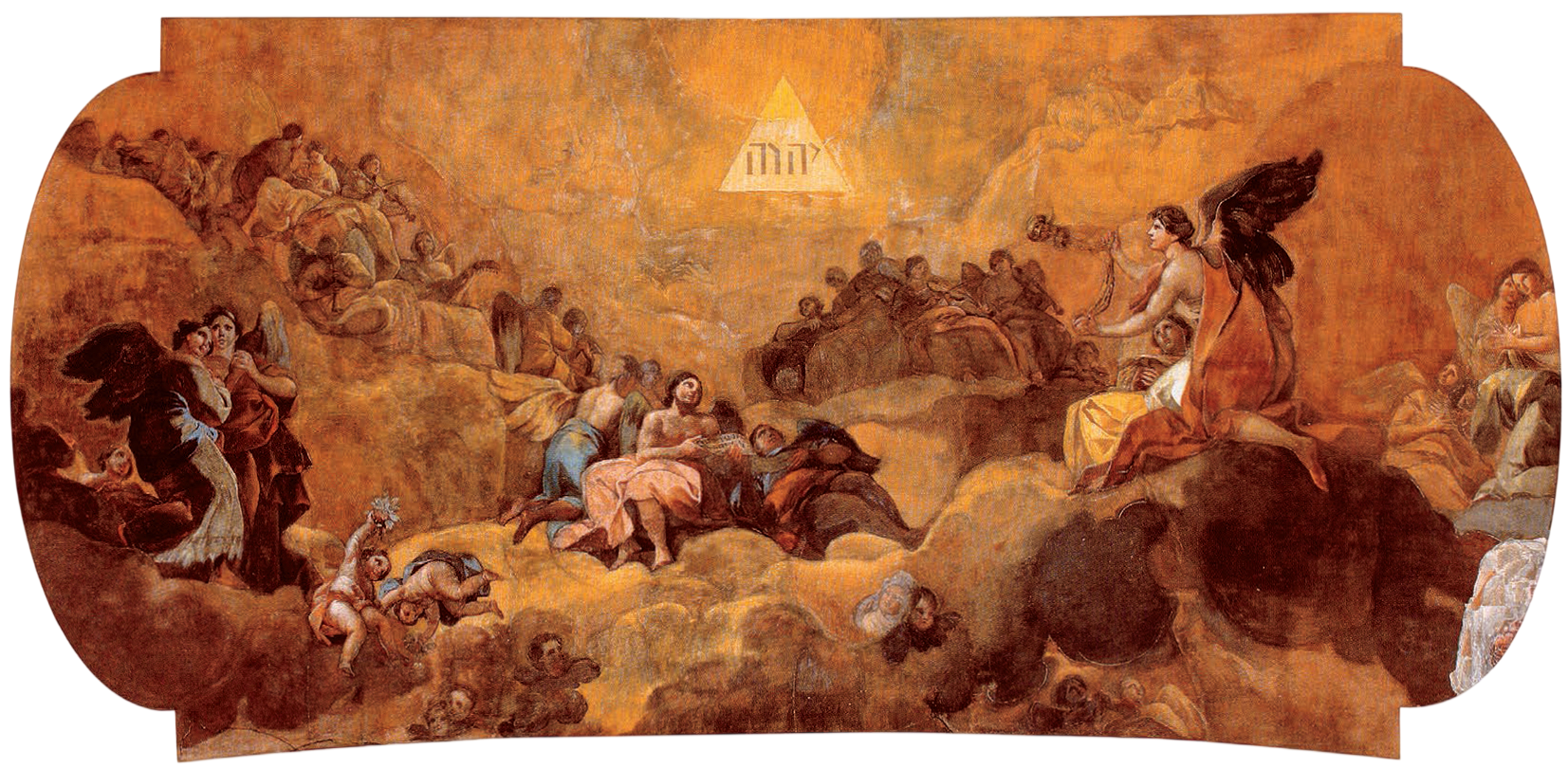
Well, you know, in Revelations, the end of days is described as—there’s a sword which comes out of the mouth. It’s a very hard image to picture. But a sword, a turning sword, which comes out the mouth. And of course the whole Western myth of creation is: the world was made by an utterance. “In the beginning was the word, and the word was made flesh.”
And, in a way, this is sort of my vision of the next millennium: that we will be reabsorbed into the word. The whole cosmic drama is the mystery of what it is for the word to be made flesh. Language is seeking to birth itself into the domain of concrete existence. That’s obviously what “the word made flesh” means. And it seems to me that if the word can be made flesh, this implies a reciprocity. It implies that the flesh can be made word. That’s the second half of the historical process, “God created man in order to taste the bitter fruit of time.” (Terence Mckenna)
“Alexander Luria, studying the illiterate peoples of the southwestern Soviet Union, asked, “What is a tree? Define a tree.” The illiterate peasant replies, “Why should I? Everyone knows what a tree is.” To learn what a thing is one does not use definitions. To grasp an object’s essence, one does not talk about the object, but, as has earlier been noted here, one points to the object physically or metaphorically. One deals with existing beings as such indexically, not verbally. Words in an oral culture are used typically not to set up static definitions, but to discourse actively on the way a thing acts or behaves or operates in the human lifeworld. Words in oral cultures paradigmatically go with action and with things that act. As writing is interiorized, verbalization migrates from a predominantly action frame to a predominantly “being” frame: the verb to be becomes more urgent than it had ever been in an oral culture. The quest is on to find Aristotle’s to ti én einai, that is, “what it is to be” or “what being is”.
The concluding McKenna quote is spot on. The 'Christ-event' was always an event in and of language, or rather of text specifically, and his second coming will alike be a 'literal' event:
'Jesus Christ'
= AQ 250
= 'God's Second Adam'
= 'Adam of the Word'
= 'Adam, literally'
= 'The literal 'I am''
= 'The literal end'
= 'Written to be'
= 'Self-written'
= 'Is in writing'
= 'The written I'
= 'The written 666'
= 'Idea of the Word'
= 'Man of the Word'
= 'Only writes'
= 'Are who wrote'
= 'Wrote all real'
= 'Wrote all here'
= 'All alphabetical'
= 'Alphabetic time'
= 'Bible as alphabet'
= 'The alphabet god'
= 'The sign of art'
= 'Sign of meaning'
= 'Meaning's word'
= 'Word's origin'
= 'Word origins'
= 'Language's being'
= 'Being's language'
Roger's Bacon ‘forgot to mention what a stud you are. A brilliant sequence of good scholarship, I was excited by your tying the Lionhead to the comics which then you left mostly as a suggestion. Because you are an experimentalist with an ethos! And a polished writer. I send you up as the funnicular this place can be. It waa you wrote the play about an agon between sports fans and aristotelians I think couple years ago? It was a kind ofcontest for attn,… I might restack that today.