

Mathematics, useful as it is now, was anything but for its first practitioners. Trace the river to its source and you find art, religion, leisure.
Hence when all such inventions were already established, the sciences which aim neither to give pleasure nor to procure the necessities of life were discovered, and discovered first in the places where men first began to have leisure. This is why the mathematical arts were founded in Egypt; for there the priestly caste was allowed to be at leisure. (Aristotle)
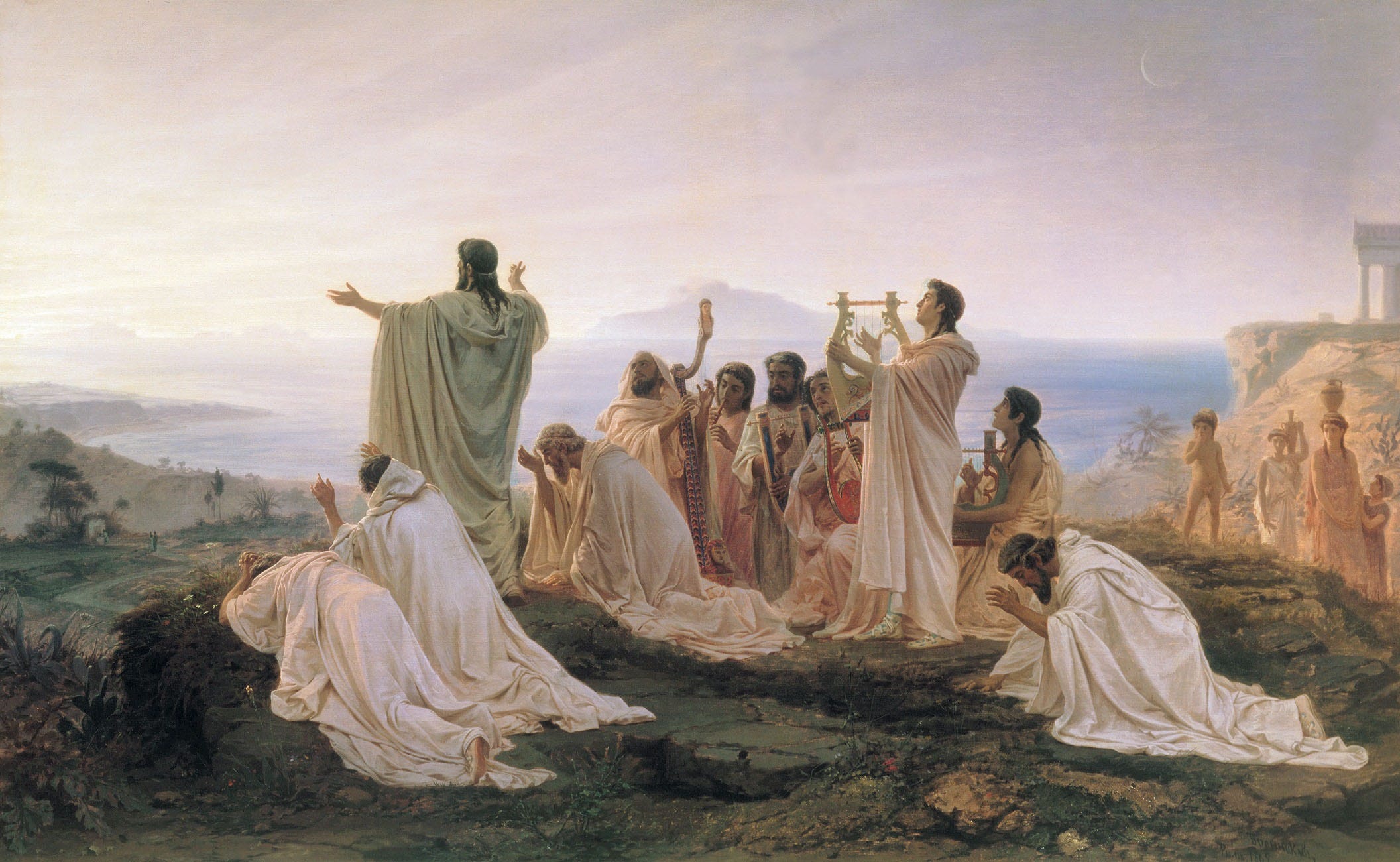
A little further downstream, in Pythagoras, you find uselessness in some of its purest forms: the singing of strings, the harmony of the heavens, contemplation of the numinous.
Only the mystical conception of geometry could supply the degree of attention necessary for the beginning of such a science… Attention only reaches its true dimensions when it is religious. (Simone Weil)
Mathematics was, of course, also an applied science from the very first. But its most exalted, most powerful truths have never flowed from engineering or accounting. To find their fount, you must look to idle curiosity, beauty, mystery, madness.
The pursuit of mathematics is a divine madness of the human spirit, a refuge from the goading urgency of contingent happenings. (Alfred North Whitehead)
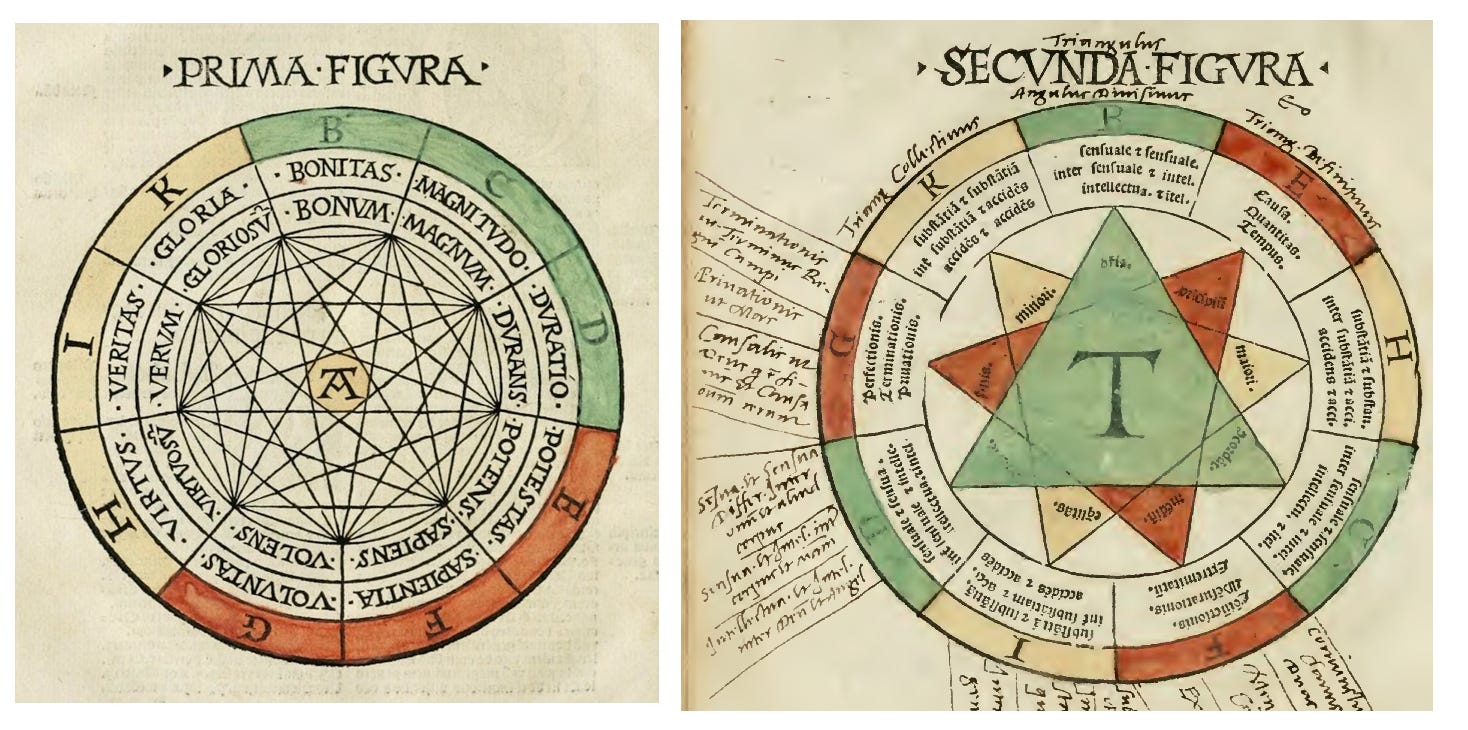
Medieval Kabbalists practiced tzeruf, the formal permutation of Hebrew letters, under the belief that symbolic sequences could unlock divine truth or quicken dead clay into life (a belief, it should be noted, later vindicated by the discovery of DNA1). Influenced by his study of Jewish mysticism, the 13th-century Catalan mystic Ramon Llull developed a Kabbalah-inspired theo-logic machine that algorithmically generated valid statements about the Christian God.
From Llull, the current flows to Gottfried Wilhelm Leibniz, the German polymath who dreamed of a characteristica universalis—a universal symbolic language capable of expressing all human knowledge—and a calculus ratiocinator, a machine that could mechanically resolve any dispute. His ambitions were modest: to end religious war through pure calculation. Leibniz drew on other streams as well, such as the divinatory I Ching, whose yin-yang structure directly inspired the development of binary arithmetic.
Two centuries after Leibniz came George Boole and his foundational work on symbolic logic, “An Investigation of the Laws of Thought” (1854). Boole’s algebra was the fruit of a thoroughly mystical vocation. At seventeen, he experienced what he felt was a call from God to map the mathematical laws of the human mind. The brain was God’s finest creation; to formalize its operations was to glimpse the architecture of the divine.
This computational-theological tributary would eventually merge with another stream. Barrel organs, music boxes, and player pianos came first, using physical ‘programs’ to produce sequences of notes, but the pivotal leap occurred, strangely enough, in the textile arts. The Jacquard loom, invented in 1804, used punch cards to control weaving patterns; Charles Babbage borrowed directly from the loom when designing his Analytical Engine.
“The Analytical Engine weaves algebraic patterns just as the Jacquard loom weaves flowers and leaves.” (Lovelace)
Ada Lovelace met Babbage at seventeen and became his collaborator, champion, and translator; her notes on the Engine are now recognized as the first computer program. For “the Enchantress of Numbers” (as she called herself), mathematics was “the instrument through which the weak mind of man can most effectually read his Creator’s works.” The sacred and technical—the useless and useful—were never really separate for Lovelace: “Religion to me is science and science is religion.” This more mystical sensibility allowed her to divine what Babbage himself could not: that the machine might process not only numbers, but any form of symbolic notation—words, music, art.
“Computers are useless. They only give you answers.” (Picasso)
A century and a half on from Lovelace and Babbage, computational innovation still flows from uselessness. The Graphics Processing Unit, first developed by NVIDIA to render the textures, lighting, and explosions of video game graphics, was later discovered to possess a parallel architecture ideal for training neural networks.
Also worth noting here is the “clay hypothesis” of abiogenesis, which proposes that the first self-replicating molecules were templated on the crystalline surfaces of clay minerals.