

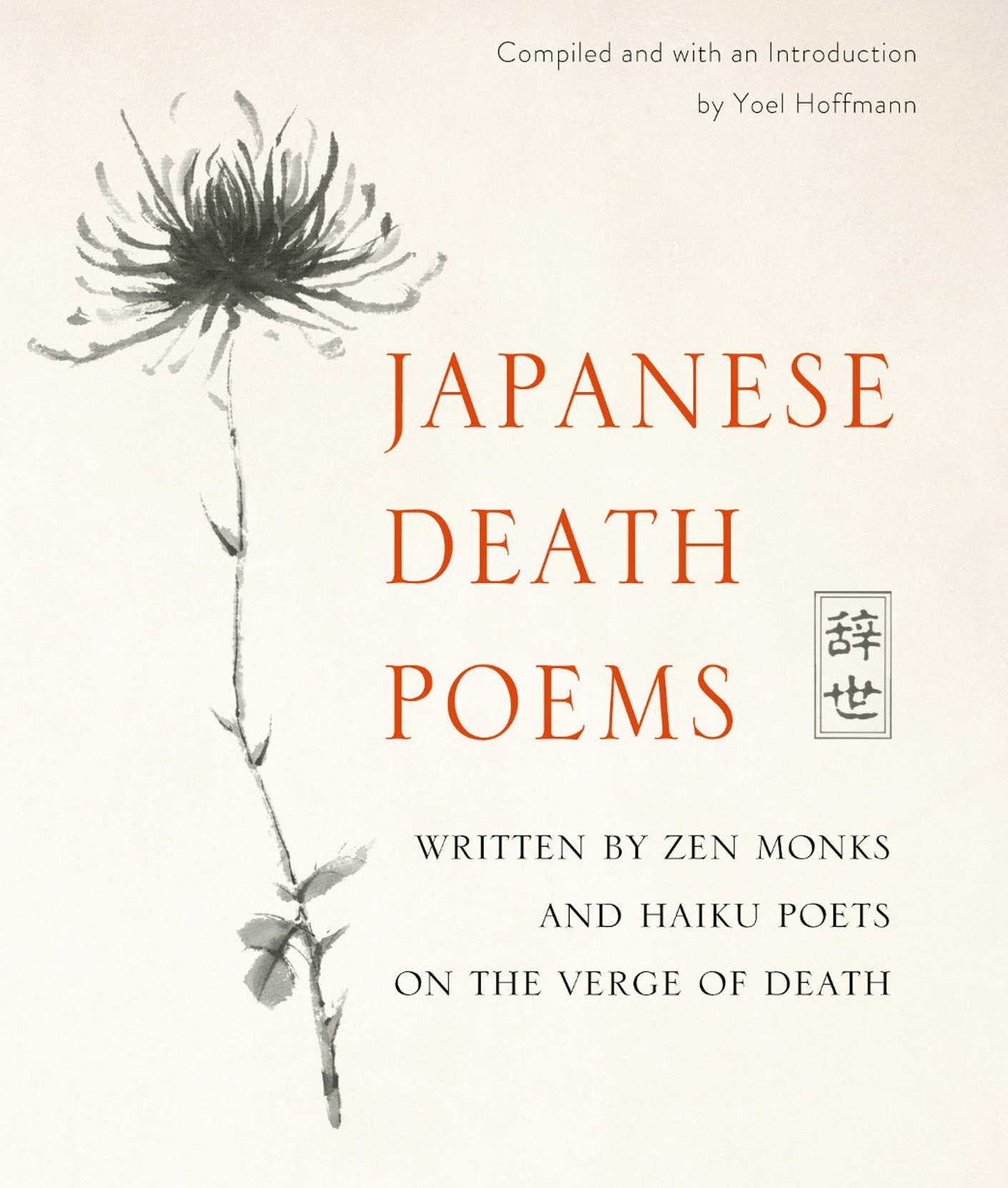
Although the consciousness of death is in most cultures very much a part of life, this is perhaps nowhere more true than in Japan, where the approach of death has given rise to a centuries-old tradition of writing jisei, or “death poems.” Such poems are often written in the very last moments of the poet’s life.
Hundreds of Japanese death poems, many with a commentary describing the circumstances of the poet’s death, are translated into English here, the great majority of them for the first time.
The following poems are selected from the second section of the book which features poems written by haiku poets (due to the number of poets, I will split this section into two posts). Enjoy.
Death poems by zen monks (part 1)
1.
BASHO (芭蕉)
Died on the 12th day of the 10th month, 1694 at the age of 51
On a journey, ill:
my dream goes wandering
over withered fields.
This is the last poem of one of the greatest haiku poets. Basho had fallen seriously ill on one of his travels. When his pupils hinted that he ought to leave a farewell poem, he replied that any of his poems could be his death poem. Nevertheless, on the 8th day of the 10th month, after gathering his pupils around his bed, he wrote this poem. He died four days later.
2.
BENSEKI (鞭石)
Died on the 15th day of the 2nd month, 1728 at the age of 80
Child of the way,
I leave at last—
a willow on the other shore.
Nori no chigo, “child of the way,” expresses not only the dream of an eighty-year-old man to renew his youth, but contains a play on words as well. In his last years Benseki abandoned the world and became a monk, changing his name to Honi, the Chinese-derived pronunciation of the characters used to write nori no [chi]go. “Honi” can mean both “child of the way” and “child of the doctrine.”
The willow (yanagi), common throughout Japan, is a tall tree that grows on the banks of rivers and lakes, its slender branches stretching down as thin as strings. A willow tree is often mentioned in haiku as a picture of spring, its branches covered with green and drifting in the wind.
The image of a journey from one bank of a river to the other appears often in Buddhist literature as a symbol of the transition from the state of ignorance and illusion to that of enlightenment.
3.
BUFU (蕪風)
Died on the 24th day of the 7th month, 1792
Oh, I don’t care
where autumn clouds
are drifting to.
4.
CHIYOJO (千代女)
Died on the 19th day of the 1st month, 1746 at the age of 20
A fawn frolics
in the field—I put on my new
spring robe.
Kisohajime refers to fresh clothes worn on New Year’s Day, which fell around the beginning of spring when the lunar calendar was used. The Japanese, principally women and children, wear new kimonos made especially for the occasion. Chiyojo makes a pun on the word kanoko, which signifies literally a fawn but also refers to a particular white-spotted tie-dyed pattern on a kimono, perhaps on the one she was wearing that year.
5.
CHOGO (朝伍)
Died on the 3rd day of the 9th month, 1806 at the age of 45
I long for people—
then again I loathe them:
end of autumn.
6.
CHORA (蝶羅)
Died on the 6th day of the 5th month, 1776 at the age of 54
“Paradise,”
I murmur, sleeping
in my netted tent.
After his death, Chora’s wife, Motojo, answered with a poem of mourning:
The drone of the mosquitoes
round the netting, too,
is sad.
Chora died in summer, when netting is hung down from the ceiling to form a kind of chamber, as protection from mosquitoes and flies.
7.
CHORI (登里)
Died on the 19th day of the 10th month, 1778 at the age of 39
Leaves never fall
in vain—from all around
bells tolling.
8.
ENSETSU (燕説)
Died on the 19th day of the 9th month, 1743 at the age of 73
Autumn gust:
I have no further business
in this world.
Ensetsu grew up in a Zen Buddhist temple and in his later years served as a priest. To the haiku written before his death he attached, as was the custom among Zen monks, a death poem in Chinese as well:
Many things befell me as I followed Buddha
Three and seventy years.
What is death?
Freely, from my own true self,
Ho! Ho!
“Ho!” is a translation of totsu, a cry of enlightenment. Ensetsu was very much attached to his haiku master, Rosen (p. 259), with whom he roamed all over Japan. When Ensetsu heard of his master’s having fallen ill, he hastened to his side, though he himself was suffering from severe stomach pains. From the day Rosen died, Ensetsu’s disease worsened, and he survived his master less than a month.
9.
ENSHI (燕枝)
Died on the 12th day of February, 1900 at the age of 63
All moving things
come to an end:
a knotty willow.
10.
FUKAKU (不角)
Died on the 21st day of the 6th month, 1753 at the age of 92
Empty cicada shell:
as we come
we go back naked.
11.
FUKYU (普求)
Died on the 21st day of the 7th month, 1771 at the age of 79
A bright and pleasant
autumn day to make
death’s journey.
Rise, let us go—
along the path lies
the clear dew.
12.
GAKI (我鬼)
Died on the 24th day of July, 1927 at the age of 36
One spot, alone,
left glowing in the dark:
my snotty nose.
Gaki, better known by his real name, Akutagawa Ryunosuke, prefaced his poem with the words “laughing at myself.” He gave the poem to his aunt on the night of July 23rd and asked her to deliver it the next morning to the family doctor, who was himself a haiku poet. The same night Akutagawa killed himself by drinking poison.
Akutagawa was one of Japan’s greatest modern authors. A short time after his birth his mother became insane, which cast a heavy shadow on his life. One of his first stories, entitled Hana (Nose), won much praise from the writer Natsume Soseki (1867-1916) and put Akutagawa well into the literary scene of his age.
13.
GOZAN (吾山)
Died on the 17th day of the 12th month, 1789 at the age of 71
The snow of yesterday
that fell like cherry petals
is water once again.
14.
HAMEI (巴明)
Died on the 26th day of the 12th month, 1837 at the age of 83
Man’s end,
a mound of gleaming bones:
a flowering and a fading.
15.
HAMON (巴紋)
Died on the 21st day of the 2nd month, 1804 at the age of 58
In stillness, I,
light-bodied, set out for
the other world.
16. HANRI (畔李)
Died on the 12th day of the 5th month, 1835 at the age of 71
My life:
echoes of a clucking tongue
above pure waters.
Shitauchi (clucking of the tongue) refers to the sound a person makes with his tongue signifying regret over failures in the past and resignation to the unavoidable.
Shimizu, “pure water,” calls to mind the water of streams breaking out of the ground in summer after the rainy season. But there may be, as well, a suggestion of shinimizu, the water given by Japanese to the dying.
17.
HOKUSAI (北斎)
Died on the 12th day of the 4th month, 1849 at the age of 90
Now as a spirit
I shall roam
the summer fields.
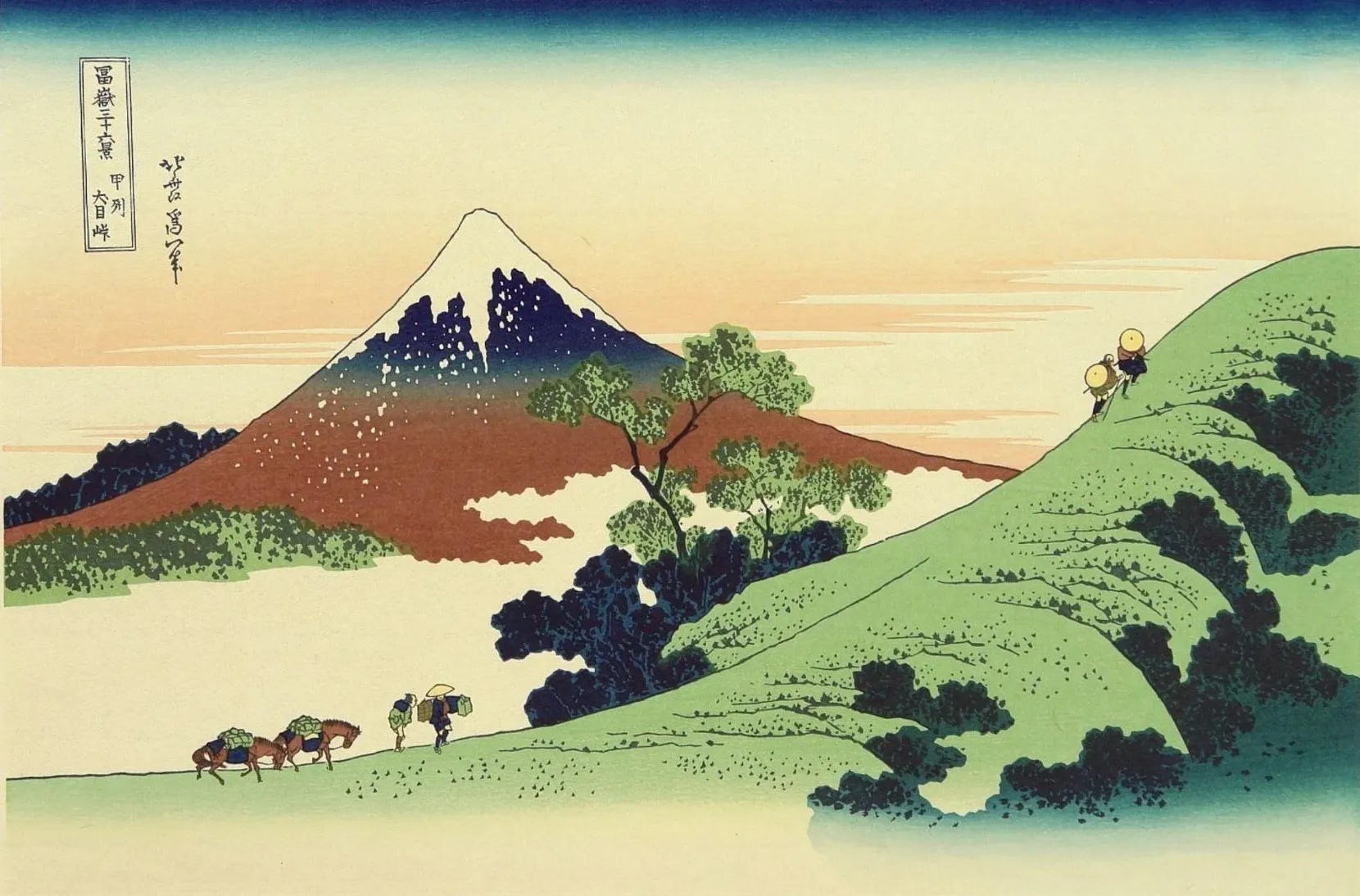
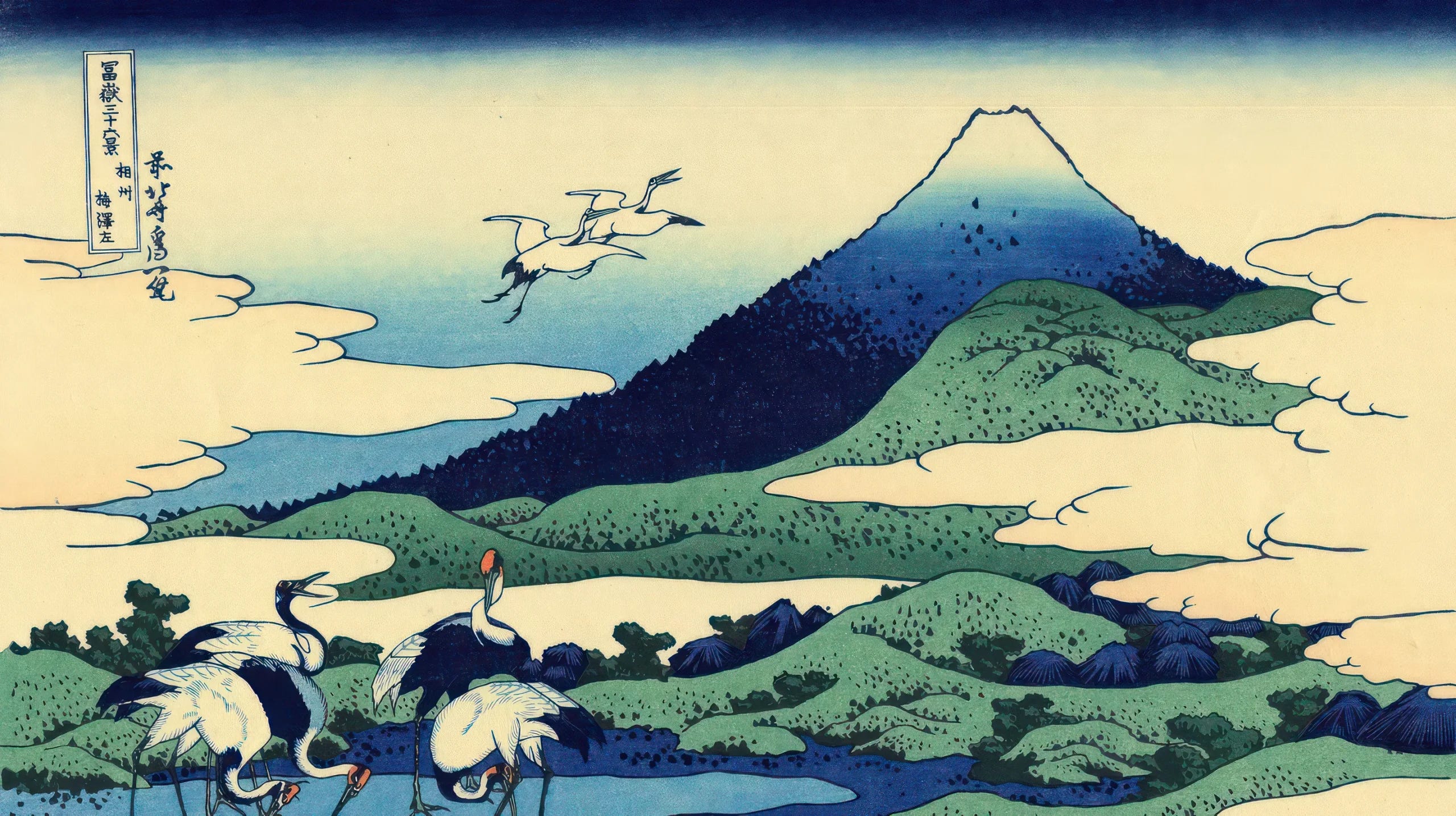
Hokusai was one of Japan’s greatest artists. His colorful paintings of Edo’s street life are among the best made in ukiyoe style, and his series of thirty-seven views of Mount Fuji brought him fame falling little short of that of the mountain itself.
18.
HOKUSHI (北枝)
Died on the 12th day of the 8th month, 1718
I write, erase, rewrite,
erase again, and then
a poppy blooms.
Hokushi’s death poem is built around a pun. Keshi means “to erase” as well as “poppy,” so the poem may be read, “I write, erase, rewrite, / erase again, and then / a flower erases.” However it is read, the poem’s intent remains the same—that nature eventually overwhelms culture. The poppy blooms in Japan at the beginning of summer, the season in which Hokushi died.
Hokushi, a sword-sharpener, learned to write haiku from Basho. He would not hesitate to suggest changes in his teacher’s poems, and Basho praised him for his helpful criticism.
It is said that Hokushi was extremely poor, but of a cheerful disposition. When his house burned down, he wrote:
Gone up in flames—
but look, the flowers droop
unknowing.
Hokushi had a weakness for liquor and used to ask for wine from his neighbor, the poet Joryu. Hokushi and his elder brother Bokudo, himself a poet, were famous for their ability to sleep while sitting and were accordingly styled “champion dozers.”
19.
HOKUSO (北窓)
Died on the 6th day of the 6th month, 1790
O sacred spirit
let us...
20.
HYAKKA (百花)
Died on the 20th day of the 2nd month, 1779 at the age of 64
Late-blooming cherry:
wondrous workings
of a flower’s mind.
Two death poems have been ascribed to Hyakka. Both cherry blossoms and melting ice are images of spring, the season in which the poet died.
Winter ice
melts into clean water—
clear is my heart.
21.
ISSA (一茶)
Died on the 19th day of the 11th month, 1827 at the age of 65
What matter if I live on—
a tortoise lives
a hundred times as long.
From one basin
to another—
stuff and nonsense.
Issa is considered one of Japan’s greatest haiku poets. Among the common people of Japan he is perhaps loved more than any other poet, because of the many vicissitudes of his life, and because of the human simplicity of his poetry. Accounts of Issa’s death do not indicate that he wrote a death poem; these two poems are held to be his death poems by popular tradition.
An ancient Oriental belief features the tortoise as a symbol of long life, ascribing to it a life of ten thousand years. Should man live to be one hundred, his life would be no more than a hundredth part of the life of this shell-covered creature that drags its tail in the mud. Why then should a man ask for another year, a month, or a day?
The word tarai in the second poem means “tub” or “basin.” The reference is perhaps to the basins for cleaning newborn babies and cleansing the dead. The life of man is no more than gibberish (chimpunkan means, in colloquial speech, the unintelligible sounds of a foreign language) that begins in the cradle and ends in the grave.
22.
ISSHO (一笑)
Died on the 6th day of the 12th month, 1688 at the age of 36
From deep in my heart
how beautiful the snow
clouds in the west.
The death of Issho is described in one source:
Issho, who lived in the city of Kanazawa, loved haiku. When Basho passed through Kanazawa on a journey, Issho wanted very much to lodge him in his home, but that very year Issho had fallen deathly ill and knew his end was near. It was the 13th year after his father’s death, and Issho decided to compose thirteen kasen [thirty-six-verse renga] in memory of his father. His friends tried to prevent this undertaking, saying, “Your breathing is not regular. Who knows what will happen to you after you have finished the thirteen poems?” But Issho replied, “Even if I die, I will not be sorry.” After five poems Issho’s breathing became heavy, and he could hardly hold his brush. In spite of this he held on and composed the other eight. When he had finished his task, his eyes shone with joy and he announced, “With these poems close to my body, I have nothing to regret.” As his eyelids grew heavier, he closed them and said [the poem above]. He looked like a man who had been freed from the chains of life and whose soul was pure. In the autumn of the year following Issho’s death, Basho wrote a poem of lamentation in his memory: “Move, O tomb / the sound of my weeping / is the wind of autumn [Tsuka mo ugoke / waga naku koe wa / aki no kaze].”
Issho’s phrase “from deep in my heart” (kokoro kara) is an expression rarely encountered in haiku. But death poems are, by nature, more personal than ordinary haiku. Issho died in the middle of winter, when snow had covered his province. The “clouds in the west” (nishi no kumo) may be regarded as a seasonal image, but in this poem they probably refer to the messengers of Amida coming to greet the dead on their way to the Pure Land.
23.
KANGYU (関牛)
Died in 1861
It is indeed like that—
and I had never noticed
dew on grass.
24.
KEIDO (径童)
Died in about 1750 past the age of 30
The cuckoo’s voice
is all the more intriguing
as I die.
25.
KIGEN (其諺)
Died on the 23rd day of the 8th month, 1736 at the age of 71
Seventy-one!
How did
a dewdrop last?
26.
KIKO (其香)
Died on the 2nd day of the 5th month, 1823 at the age of 52
That which blossoms
falls, the way of all flesh
in this world of flowers.
27.
KISEI (亀世)
Died on the 18th day of the 9th month, 1764 at the age of 77
Ninth-month moon:
of late, when I have said
my prayer, I’ve meant it.
28.
KOHA (香波)
Died on the 14th day of August, 1897
I cast the brush aside—
from here on I’ll speak to the moon
face to face.
29.
KOJU (湖十)
Died on the 24th day of the 7th month, 1806
And if I do
become a spirit...