

Arthur Koestler (September 5th, 1905 – March 1st, 1983) was an Austro-Hungarian-born author and journalist. Koestler was born in Budapest, and was educated in Austria, apart from his early school years. In 1931, Koestler joined the Communist Party of Germany but resigned in 1938 after becoming disillusioned with Stalinism.
Having moved to Britain in 1940, Koestler published his novel Darkness at Noon, an anti-totalitarian work that gained him international fame. Over the next 43 years, Koestler wrote several major novels, two volumes of autobiographical works, two volumes of reportage, a major work on the history of science, several volumes of essays, and a considerable body of other writing and articles on subjects as varied as genetics, Eastern mysticism, neurology, chess, evolution, psychology, the paranormal and more. In 1949, Koestler began secretly working with a British Cold War anti-communist propaganda department known as the Information Research Department (IRD), which would republish and distribute many of his works, and also fund his activities.
It is difficult to think of a single important twentieth-century intellectual who did not cross paths with Arthur Koestler, or a single important twentieth-century intellectual movement that Koestler did not either join or oppose. From progressive education and Freudian psychoanalysis through Zionism, communism, and existentialism to psychedelic drugs, parapsychology, and euthanasia, Koestler was fascinated by every philosophical fad, serious and unserious, political and apolitical, of his era.
— Anne Applebaum, The New York Review of Books
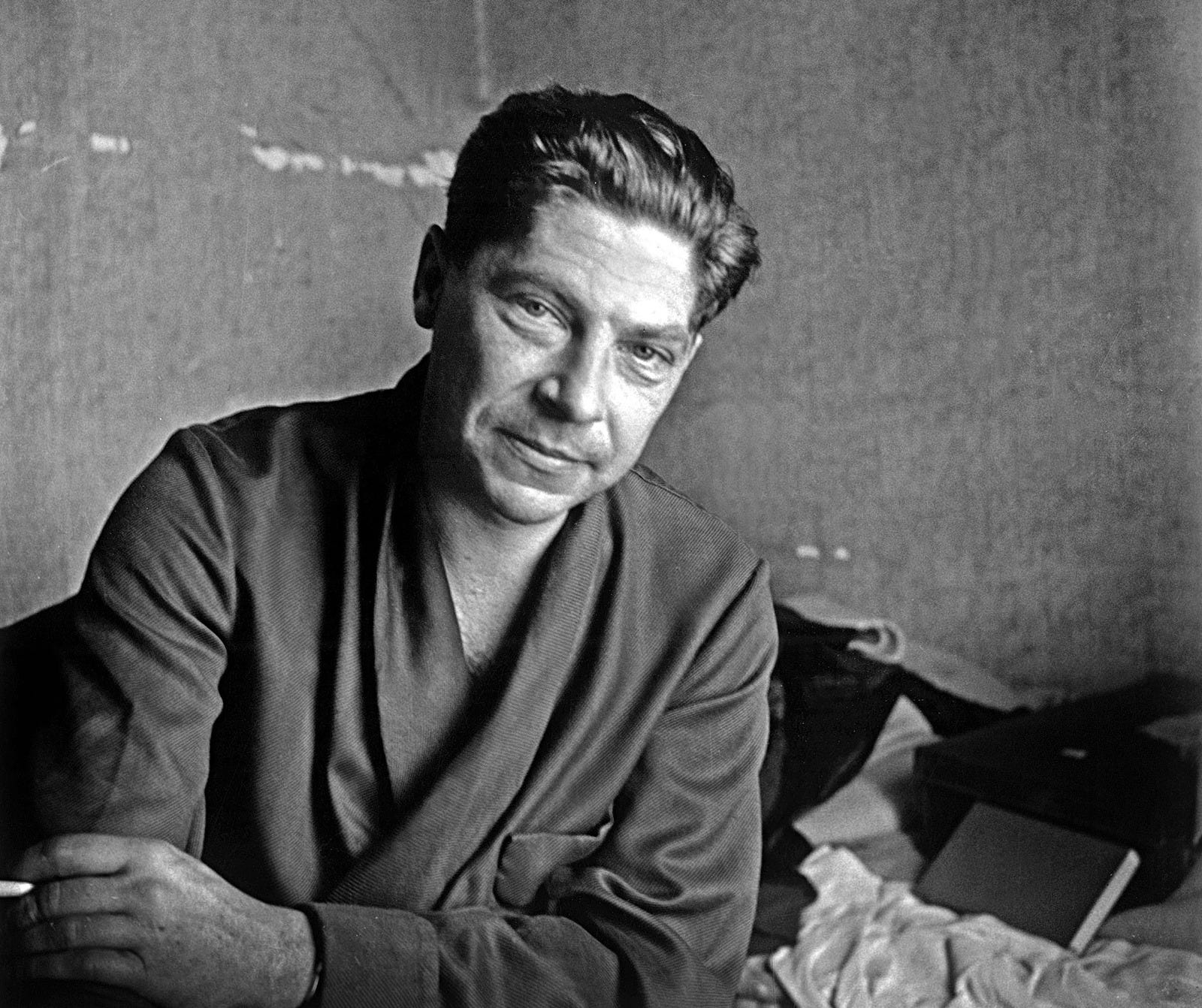
Koestler left the Soviet Union in 1933, and in September of that year, he returned to Paris and, for the next two years, was active in anti-fascist movements. He wrote propaganda under the direction of Willi Münzenberg, the Soviet Comintern’s chief propaganda director in the West. In 1935, Koestler married Dorothy Ascher (1905–1992), a fellow communist activist. They separated amicably in 1937.
In 1936, during the Spanish Civil War, Koestler undertook a visit to General Francisco Franco’s headquarters in Seville on behalf of the Comintern, pretending to be a Franco sympathiser and using credentials from the London daily News Chronicle as cover. He collected evidence of the direct involvement of Fascist Italy and Nazi Germany on Franco’s side, which at that time the Nationalist rebels were still trying to conceal. He had to escape after he was recognised and denounced as a communist by a former German colleague. Back in France, he wrote L’Espagne Ensanglantée, which was later incorporated into his book Spanish Testament.
In 1937, Koestler returned to Spain on the side of the Republicans as a war correspondent for the News Chronicle and was in Málaga when it fell to Benito Mussolini’s troops, who were fighting on the side of the Nationalists. He took refuge in the house of retired zoologist Sir Peter Chalmers Mitchell, and they were both arrested by Franco’s chief propagandist, Luis Bolín, who had sworn that if he ever got his hands on Koestler, he would “shoot him like a dog”. From February until June, Koestler was imprisoned in Seville under sentence of death. While awaiting execution he had a mystical experience, which he later wrote about in The Invisible Writing. He was eventually exchanged for a “high value” Nationalist prisoner held by the Republicans, the wife of one of Franco’s ace fighter pilots. As he noted in his autobiography, his estranged wife Dorothy Ascher had greatly contributed to saving his life by intensive, months-long lobbying on his behalf in Britain. When he went to Britain after his release, the couple tried to resume their marriage, but Koestler’s gratitude to her proved an insufficient foundation for a daily life together. Koestler returned to France, where he agreed to write a sex encyclopaedia to earn money to live on. It was published with great success under the title The Encyclopaedia of Sexual Knowledge, under the pseudonyms of “Drs A. Costler, A. Willy, and Others”.
I was standing at the recessed window of cell No. 40 and with a piece of iron-spring that I had extracted from the wire mattress, was scratching mathematical formulae on the wall. Mathematics, in particular analytical geometry, had been the favorite hobby of my youth, neglected later on for many years. I was trying to remember how to derive the formula of the hyperbola, and was stumped; then I tried the ellipse and parabola, and to my delight succeeded. Next I went on to recall Euclid’s proof that the number of primes is infinite…
Since I had become acquainted with Euclid’s proof at school, it had always filled me with a deep satisfaction that was aesthetic rather than intellectual. Now, as I recalled the method and scratched the symbols on the wall, I felt the same enchantment.
And then, for the first time, I suddenly understood the reason for this enchantment: the scribbled symbols on the wall represented one of the rare cases where a meaningful and comprehensive statement about the infinite is arrived at by precise and finite means. The infinite is a mystical mass shrouded in a haze; and yet it was possible to gain some knowledge of it without losing oneself in treacly ambiguities. The significance of this swept over me like a wave. The wave had originated in an articulate verbal insight; but this evaporated at once, leaving in its wake only a wordless essence, a fragrance of eternity, a quiver of the arrow in the blue. I must have stood there for some minutes, entranced, with a wordless awareness that “this is perfect—perfect”; until I noticed some slight mental discomfort nagging at the back of my mind—some trivial circumstance that marred the perfection of the moment. Then I remembered the nature of that irrelevant annoyance: I was, of course, in prison and might be shot. But this was immediately answered by a feeling whose verbal translation would be: “So what? Is that all? Have you got nothing more serious to worry about?”—an answer so spontaneous, fresh and amused as if the intruding annoyance had been the loss of a collar-stud. Then I was floating on my back in a river of peace, under bridges of silence. It came from nowhere and flowed nowhere. Then there was no river and no I. The I had ceased to exist.
When I say “the I had ceased to exist,” I refer to a concrete experience that is verbally as incommunicable as the feeling aroused by a piano concerto, yet just as real—only much more real. In fact, its primary mark is the sensation that this state is more real than any other one has experienced before—that for the first time the veil has fallen and one is in touch with “real reality,” the hidden order of things, the X-ray texture of the world, normally obscured by layers of irrelevancy. What distinguishes this type of experience from the emotional entrancements of music, landscapes or love is that the former has a definitely intellectual, or rather noumenal, content. It is meaningful, though not in verbal terms. Verbal transcriptions that come nearest to it are: the unity and interlocking of everything that exists, an interdependence like that of gravitational fields or communicating vessels. The “I” ceases to exist because it has, by a kind of mental osmosis, established communication with, and been dissolved in, the universal pool. It is the process of dissolution and limitless expansion which is sensed as the “oceanic feeling,” as the draining of all tension, the absolute catharsis, the peace that passeth all understanding.
Shortly before the German invasion of France, Koestler joined the French Foreign Legion to get out of the country. He deserted in North Africa and tried to return to England. He heard a false report that the ship Hardy was travelling upon had sunk and that she and his manuscript were lost. He attempted suicide but survived. Arriving in the UK without an entry permit, Koestler was imprisoned pending examination of his case. He was still in prison when Daphne Hardy’s English translation of his book Darkness at Noon was published in early 1941. Immediately after Koestler was released, he volunteered for Army service. While awaiting his call-up papers, between January and March 1941, he wrote his memoir Scum of the Earth, the first book he wrote in English. He served in the Pioneer Corps for the next twelve months.
In March 1942, Koestler was assigned to the Ministry of Information, where he worked as a scriptwriter for propaganda broadcasts and films. He also wrote several essays, which were subsequently collected and published in The Yogi and the Commissar. One of the essays, titled “On Disbelieving Atrocities” (originally published in The New York Times), was about the Nazi atrocities against the Jews.
There is a dream which keeps coming back to me at almost regular intervals; it is dark, and I am being murdered in some kind of thicket or brushwood; there is a busy road at no more than ten yards distance; I scream for help but nobody hears me, the crowd walks past laughing and chatting. I know that a great many people share, with individual variations, the same type of dream. I have quarrelled about it with analysts and I believe it to be an archetype in the jungian sense: an expression of the individual’s ultimate loneliness when faced with death and cosmic violence; and his inability to communicate the unique horror of his experience.
I further believe that it is the root of the ineffectiveness of our atrocity propaganda. For, after all, you are the crowd who walk past laughing on the road; and there are a few of us, escaped victims or eyewitnesses of the things which happen in the thicket and who, haunted by our memories, go on screaming on the wireless, yelling at you in newspapers and in public meetings, theatres and cinemas…
We, the screamers, have been at it now for about ten years. We started on the night when the epileptic van der Lubbe set fire to the German Parliament; we said that if you don’t quench those flames at once, they will spread all over the world; you thought we were maniacs. At present we have the mania of trying to tell you about the killing, by hot steam, mass-electrocution and live burial of the total Jewish population of Europe. So far three million have died. It is the greatest mass-killing in recorded history; and it goes on daily, hourly, as regularly as the ticking of your watch…
But the other day I met one of the best-known American journalists over here. He told me that in the course of some recent public opinion survey nine out of ten average American citizens, when asked whether they believed that the Nazis commit atrocities, answered that it was all propaganda lies, and that they didn’t believe a word of it. As to this country, I have been lecturing now for three years to the troops and their attitude is the same. They don’t believe in concentration camps, they don’t believe in the starved children of Greece, in the shot hostages of France, in the mass-graves of Poland; they have never heard of Lidice, Treblinka or Belzec; you can convince them for an hour, then they shake themselves, their mental self-defence begins to work and in a week the shrug of incredulity has returned like a reflex temporarily weakened by a shock.
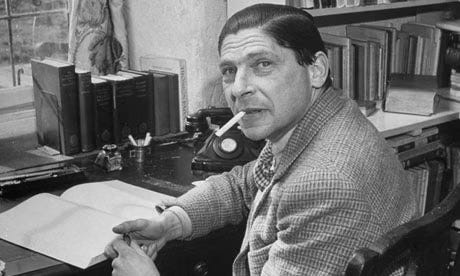
The first two volumes of his autobiography, Arrow in the Blue, which covers his life up to December 1931 when he joined the German Communist Party, and The Invisible Writing, which covers the years 1932 to 1940, were published in 1952 and 1954, respectively. A collection of essays, The Trail of the Dinosaur and Other Essays, on the perils he saw facing Western civilization, was published in 1955. On 13 April 1955, Janine Graetz, with whom Koestler had an on-off relationship over a period of years, gave birth to his daughter Cristina. Despite repeated attempts by Janine to persuade Koestler to show some interest in her, Koestler had almost no contact with Cristina throughout his life. Koestler’s main political activity during 1955 was his campaign for the abolition of capital punishment (which in the UK was by hanging). In July, he started work on Reflections on Hanging.
Although Koestler resumed work on a biography of Kepler in 1955, it was not published until 1959. In the interim, it was entitled The Sleepwalkers. The book’s emphasis had changed and broadened to “A History of Man’s Changing Vision of the Universe”, which also became the book’s subtitle. Copernicus and Galileo were added to Kepler as the major subjects of the book. Later in 1956, as a consequence of the Hungarian Uprising, Koestler became busy organising anti-Soviet meetings and protests. In June 1957, Koestler gave a lecture at a symposium in Alpbach, Austria, and fell in love with the village. He bought land there, built a house, and used it for the next twelve years as a place for summer vacations and organising symposia. In May 1958, he had a hernia operation. In December, he left for India and Japan and was away until early 1959. He wrote the book The Lotus and the Robot on his travels.
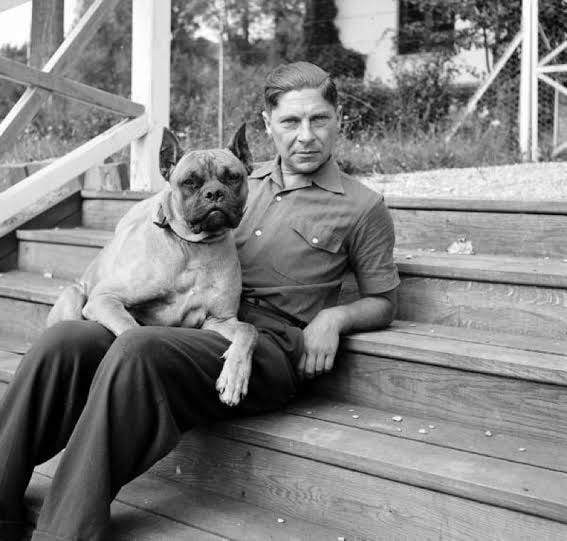
In early 1960, on his way back from a conference in San Francisco, Koestler interrupted his journey at the University of Michigan in Ann Arbor, Michigan, where some experimental research was going on with hallucinogens. He tried psilocybin and had a “bad trip”. Later, when he arrived at Harvard to see Timothy Leary, he experimented with more drugs but was not enthusiastic about that experience either.
In 1962, along with his agent, A. D. Peters, and the editor of The Observer, David Astor, Koestler set up a scheme to encourage prison inmates to engage in arts activities and to reward their efforts. Twenty years later he left £10,000 in his will to the Koestler Trust. Today, Koestler Arts supports over 7,000 entrants from UK prisons annually and awards prizes in fifty art forms.
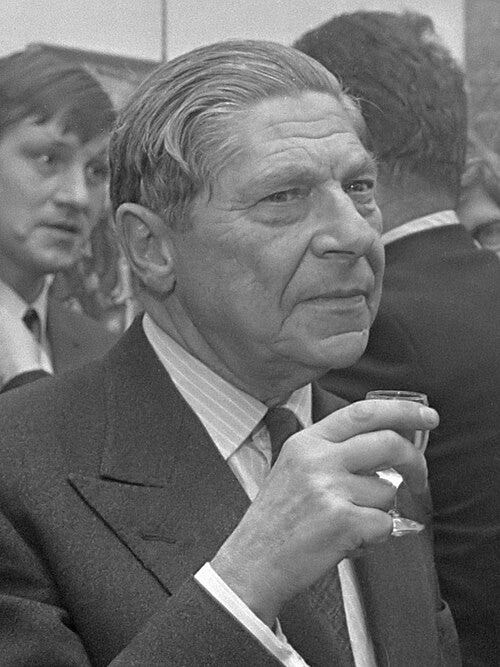
Early in 1976, Koestler was diagnosed with Parkinson’s disease. The trembling of his hand made writing progressively more difficult. He cut back on overseas trips and spent the summer months at a farmhouse in Denston, Suffolk, which he had bought in 1971. In 1978, Koestler published Janus: A Summing Up. In 1980 he was diagnosed with chronic lymphocytic leukaemia.
During the final years of his life, Koestler, Brian Inglis, and Tony Bloomfield established the KIB Society (named from the initials of their surnames) to sponsor research “outside the scientific orthodoxies.” After his death, it was renamed the Koestler Foundation. In his capacity as vice-president of the Voluntary Euthanasia Society, later renamed Exit, Koestler wrote a pamphlet on suicide, outlining the case both for and against, with a section dealing specifically with how best to do it.
Koestler and Cynthia killed themselves on the evening of 1 March 1983 at their London home, 8 Montpelier Square, with overdoses of the barbiturate Tuinal taken with alcohol. Their bodies were discovered on the morning of 3 March, by which time they had been dead for 36 hours. Koestler had stated more than once that he was afraid, not of being dead, but of the process of dying. His suicide was not unexpected among his close friends. Shortly before his suicide, his doctor had discovered a swelling in the groin, which indicated a metastasis of the cancer. Koestler’s suicide note read:
To whom it may concern.
The purpose of this note is to make it unmistakably clear that I intend to commit suicide by taking an overdose of drugs without the knowledge or aid of any other person. The drugs have been legally obtained and hoarded over a considerable period.
My reasons for deciding to put an end to my life are simple and compelling: Parkinson’s disease and the slow-killing variety of leukaemia (CLL). I kept the latter a secret even from intimate friends to save them distress. After a more or less steady physical decline over the last years, the process has now reached an acute state with added complications which make it advisable to seek self-deliverance now, before I become incapable of making the necessary arrangements.
I wish my friends to know that I am leaving their company in a peaceful frame of mind, with some timid hopes for a de-personalised after-life beyond the confines of space, time and matter and beyond the limits of our comprehension. This “oceanic feeling” has often sustained me at difficult moments, and does so now, while I am writing this.
What makes it nevertheless hard to take this final step is the reflection of the pain it is bound to inflict on my surviving friends, above all my wife Cynthia. It is to her that I owe the relative peace and happiness that I enjoyed in the last period of my life – and never before.
The note was dated June 1982. Below it appeared the following:
Since the above was written in June 1982, my wife decided that after thirty-four years of working together she could not face life after my death.
Further down the page appeared Cynthia’s own farewell note:
I fear both death and the act of dying that lies ahead of us. I should have liked to finish my account of working for Arthur – a story which began when our paths happened to cross in 1949. However, I cannot live without Arthur, despite certain inner resources.
Double suicide has never appealed to me, but now Arthur’s incurable diseases have reached a stage where there is nothing else to do.
Controversy arose over why Koestler allowed, consented to, or (according to some critics) compelled his wife’s simultaneous suicide. She was only 55 years old and believed to be healthy. In a typewritten addition to her husband’s suicide note, Cynthia wrote that she could not live without her husband. Reportedly, few of the Koestlers’ friends were surprised by this admission, apparently perceiving that Cynthia lived her life through her husband and that she had no “life of her own”. Her absolute devotion to Koestler can be seen clearly in her partially completed memoirs. Despite this, according to a profile of Koestler by Peter Kurth:
All their friends were troubled by what Julian Barnes calls “the unmentionable, half-spoken question” of Koestler’s responsibility for Cynthia’s actions. “Did he bully her into it?” asks Barnes. And “if he didn’t bully her into it, why didn’t he bully her out of it?” Because, with hindsight, the evidence that Cynthia’s life had been ebbing with her husband’s was all too apparent.
With the exception of some minor bequests, Koestler left the residue of his estate, about £1 million (worth about £3.59 million in 2021), to the promotion of research into the paranormal through the founding of a chair in parapsychology at a university in Britain. The estate’s trustees had great difficulty finding a university to establish such a chair. Oxford, Cambridge, King’s College London and University College London were approached, and all refused. Eventually, the trustees reached an agreement with the University of Edinburgh to set up a chair, the Koestler Parapsychology Unit, in accordance with Koestler’s request.
In his book The Case of the Midwife Toad (1971) Koestler defended the biologist Paul Kammerer, who claimed to have found experimental support for Lamarckian inheritance. According to Koestler, Kammerer’s experiments on the midwife toad may have been tampered with by a Nazi sympathiser at the University of Vienna. Koestler came to the conclusion that a kind of modified “Mini-Lamarckism” may explain some rare evolutionary phenomena.
In addition to his specific critiques of neo-Darwinism, Koestler was opposed to what he saw as dangerous scientific reductionism more generally, including the behaviourism school of psychology, promoted in particular by B. F. Skinner during the 1930s. Koestler assembled a group of high-profile anti-reductionist scientists, including C. H. Waddington, W. H. Thorpe, and Ludwig von Bertalanffy, for a meeting at his retreat in Alpbach in 1968. This was one of many attempts which Koestler made to gain acceptance within the mainstream of science, a strategy which brought him into conflict with individuals such as Peter Medawar who saw themselves as defending the integrity of science from outsiders. Although he never gained significant credibility as a scientist, Koestler published a number of works at the border between science and philosophy, such as Insight and Outlook, The Act of Creation, and The Ghost in the Machine.
Mysticism and a fascination with the paranormal imbued much of Koestler’s later work and he discussed paranormal phenomena, such as extrasensory perception, psychokinesis, and telepathy. In his book The Roots of Coincidence (1972) he claims that such phenomena can never be explained by theoretical physics. According to Koestler, distinct types of coincidence could be classified, such as “the library angel”, in which information (typically in libraries) becomes accessible through serendipity, chance or coincidence, rather than through the use of a catalogue search.
If the first thing you see each and every morning is the eyes of your cellmate who has gone insane, how then shall you save yourself during the coming day? Nikolai Aleksandrovich Kozyrev, whose brilliant career in astronomy was interrupted by his arrest, saved himself only by thinking of the eternal and infinite: of the order of the Universe — and of its Supreme Spirit; of the stars; of their internal state; and what Time and the passing of Time really are.
And in this way he began to discover a new field in physics. And only in this way did he succeed in surviving in the Dmitrovsk Prison. But his line of mental exploration was blocked by forgotten figures. He could not build any further — he had to have a lot of figures. Now just where could he get them in his solitary-confinement cell with its overnight kerosene lamp, a cell into which not even a little bird could enter? And the scientist prayed: “Please, God! I have done everything I could. Please help me! Please help me continue!”
At this time he was entitled to receive one book every ten days (by then he was alone in the cell). In the meager prison library were several different editions of Demyan Bedny’s Red Concert, which kept coming around to each cell again and again. Half an hour passed after his prayer; they came to exchange his book; and as usual, without asking anything at all, they pushed a book at him. It was entitled A Course in Astrophysics! Where had it come from? He simply could not imagine such a book in the prison library. Aware of the brief duration of this coincidence, Kozyrev threw himself on it and began to memorize everything he needed immediately, and everything he might need later on. In all, just two days had passed, and he had eight days left in which to keep his book, when there was an unscheduled inspection by the chief of the prison. His eagle eye noticed immediately. “But you are an astronomer?” “Yes.” “Take this book away from him!” But its mystical arrival had opened the way for his further work, which he then continued in the camp in Norilsk.