

Previously: Are Stars Conscious?
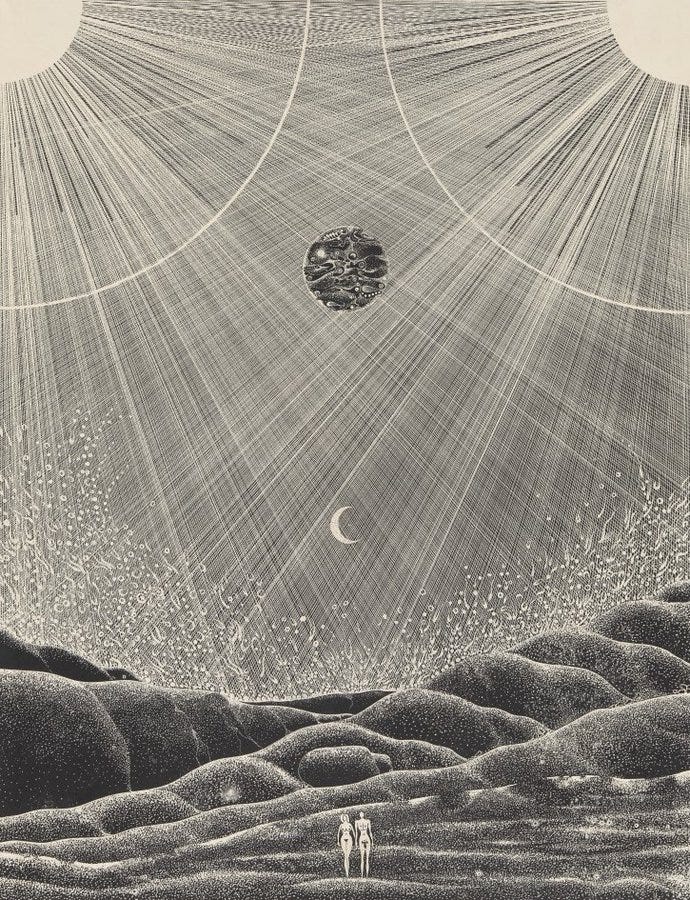
We may safely predict that it will be the timidity of our hypotheses, and not their extravagance, which will provoke the derision of posterity. (H. H. Price)
From the (digital) book jacket of Psyche and Singularity: Jungian Psychology and Holographic String Theory by Timothy Desmond (2018):
“The most original and important contribution to the integration of Jungian psychology and physics since the original collaboration between Jung and Pauli.”
— Sean Kelly“Timothy Desmond’s theory that the psyche is a gravitational singularity would drive both Isaac Newton and Sigmund Freud crazy. But any theory that doesn’t is a waste of time. Desmond articulates a vision that just might be wild enough to take us home.”
— Brian Thomas SwimmeThe discussion may sound like insane science fiction, but Desmond offers a refreshingly accurate picture, a synthesis of psyche and quantum physics that becomes the key to unlock a map of consciousness and synchronicity backed by the central ideas of Pauli, Susskind, and Jung.” Shelli Joye, Author of Tuning the Mind: Holonomic Brain Theory and the Implicate Order
According to Stanford physicist Leonard Susskind, our three-dimensional universe is essentially a holographic “movie,” an illusion projected by one-dimensional threads of energy from the spherical horizon of the cosmos, where the past, present, and future are eternally superimposed. Psyche and Singularity shows how Susskind’s string theory of holographic information conservation corroborates some of psychologist Carl Jung’s most profound ideas. Timothy Desmond suggests that Susskind’s inside-out black hole model of the universe forms a geometrically perfect mandala: a central singularity encompassed by a two-dimensional sphere which serves as a universal memory bank. In precise fulfillment of Jung’s theory about the unifying quality of the mandala image as the “archetype of wholeness,” Susskind’s model of the universe reconciles the notoriously incommensurable paradigms of general relativity and quantum mechanics, providing a mathematically plausible explanation for Jung’s near-death experience of his past, present, and future life simultaneously at the cosmic horizon. Susskind’s theory also provides a plausible cosmological model to explain Jung’s theory of synchronicity: meaningful coincidences may be tied together by strings at the cosmic horizon, from which they radiate inward.
I asked Claude for some elaboration.1
Carl Jung once wrote that the psyche is “the highest intensity in the smallest space,” a phrase Desmond takes literally and expands upon. He suggests that the psyche (the totality of one’s conscious and unconscious mind) is structurally similar to a gravitational singularity, where immense energy is condensed into an infinitesimal space, like in a black hole.
Desmond connects Jung’s ideas with holographic string theory, which proposes that all information about a higher-dimensional reality could be encoded on a lower-dimensional boundary (similar to how a hologram works). He argues that the psyche might function similarly, where individual consciousness (our ego and personal unconscious) is a projection of a more fundamental collective or cosmic consciousness—similar to Jung’s idea of the collective unconscious.
In Jungian psychology, individuation is the process of integrating different aspects of the psyche into a unified whole (the Self). Desmond proposes that this process mirrors the collapse of energy into a singularity, where the psyche, upon reaching a certain intensity, might “fold in” on itself, much like how matter collapses into a black hole. This could explain mystical experiences, ego death, and spiritual enlightenment as moments where the individual mind converges with a greater, non-dual awareness.
Obviously Desmond is on to something here. At the very least, he is not wasting our time with some trite, dinky little theory that Freud and Newton would find reasonable.
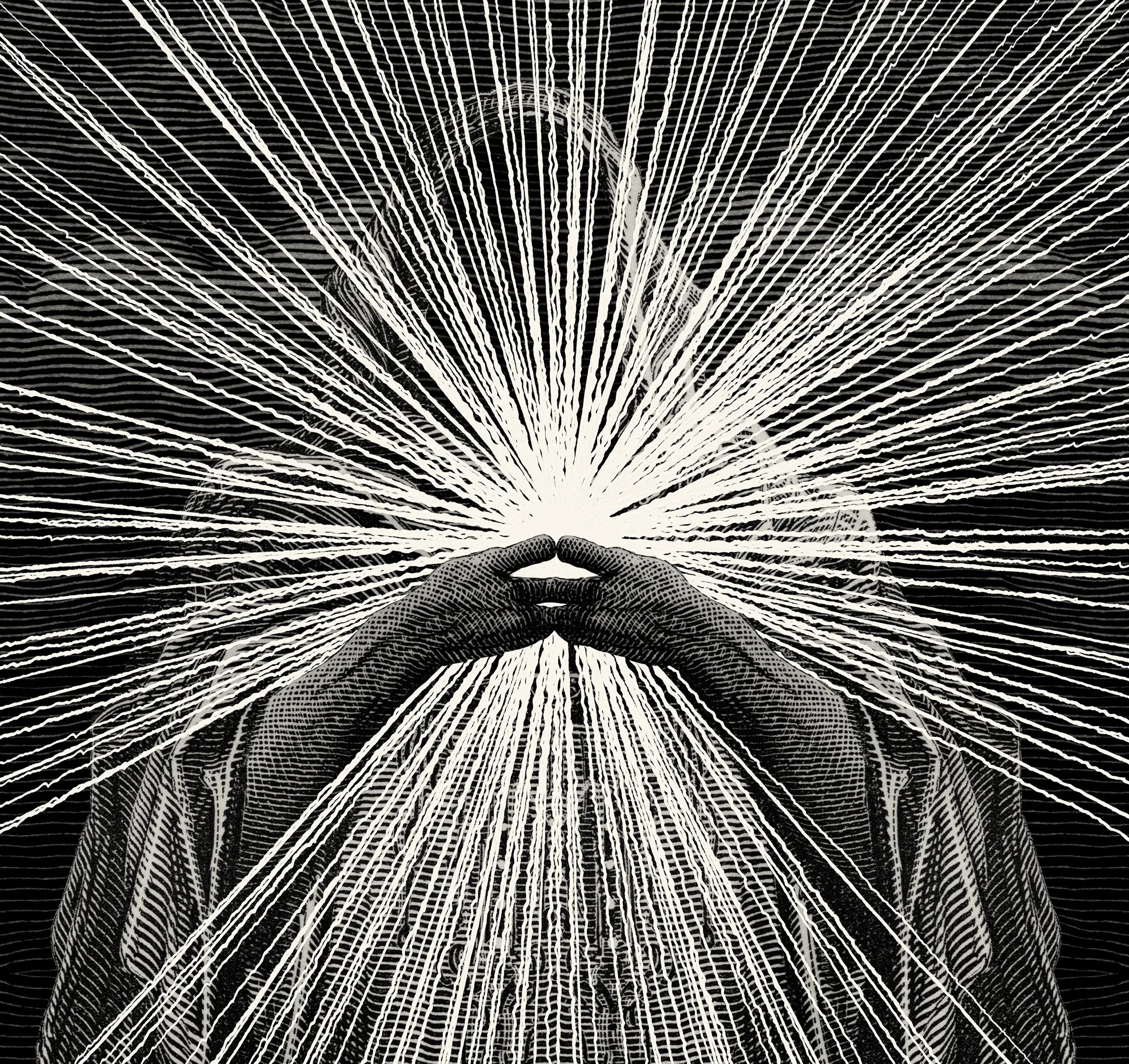
Jeffrey Kripal (The Flip, 2019) shares a number of reflections and speculations which speak to the idea that physical laws and phenomenon possess a spiritual or mental dimension emphases mine).
In order to advance our knowledge of particle physics, we had to build billion-dollar technologies to expose matter to some of the most extreme and violent conditions in the universe. Only then did matter display some of its deepest secrets in the form of quantum fields, which, in turn, gave us a window into the high-energy states of the early cosmos.
While ethically we cannot expose people to extreme and violent conditions, life does this for us. If we look at what happens to a human being in extreme conditions (like a near-death experience or a traumatic paranormal event), we will likely get much closer to the truth of consciousness than we ever will by talking endlessly about qualia and cognitive modules.
It is no accident that the pioneers of quantum mechanics themselves went straight to mystical literature for the best “up here” analogies to quantum mechanical theory. They did not claim scientific status for these speculative comparisons, but they suggested deep parallels. It is difficult to read them without suspecting that they thought that mystical states were quantum mechanical in structure and nature.
As already noted, it was Niels Bohr who put the Chinese Dao symbol on his coat of arms to capture his famous logic of complementarity. Werner Heisenberg was nicknamed “the Buddha” for his profound interests in Indian philosophy. He was also the first to suggest that the so-called matter of quantum mechanic looks very Platonic in nature (that is, it looks more like a thought than a thing). Erwin Schrödinger had a similar interest in Hindu and Buddhist literature and thought that consciousness was fundamental—that is, not reducible to anything else. Wolfgang Pauli was convinced that some fusion of quantum physics and mystical experience constituted the future of thought.
How do we make sense of such physics-to-mystics intuitions and experiences? What all such quantum mystical literature has in common with the five models of the mind-matter relationship discussed previously is the understanding that the mathematical behavior and physical structure of reality—that is, the “objective” or “outside” structures mapped by science—must be realized by some inner stuff or substance, even if the math and physics can never tell us what that “something” on the “inside” is. The further bold thought here is that the realizer of all that structure and mathematics might be consciousness itself. In other words, there might well be a “subjective” or “inside” to reality that the scientific method can never get to in principle (since it only deals with the “outside” of things) but that mystical experience can and does all the time.
If this bold thought were true, one would expect that the inside of things would reflect or be complementary to the outside of things, that the physics and the mystics would correlate in some parallel fashion, without ever, of course, being confused as the “same thing”. This is exactly what the quantum mystical literature has argued now for almost a century.
As the early quantum physicists intuited, the structural features of mystical forms of “mind” and the weird behavior of “matter” in quantum mechanics do, in fact, look remarkably alike. The intuition is is likely correct, although we must be careful not to push the parallelism too far or take it too literally. Here are some shared, parallel, or coinciding features.
Like a quantum state, many mystical states of consciousness are in principle unrepresentable and indeterminable. Accordingly, they deconstruct any and all traditional images of “God” or the “human.” In the technospeak of the study of religion, they are apophatic, a Greek-based term that means “saying away.”
Such states typically engage both mental or spiritual and material or physical domains and effects. They commonly appear as an immanent irruption into human awareness of a pure presence or undifferentiated experiential ground without distinctions and without any subject-object splitting, much as we have it modeled in dual-aspect monism.
Such states are often profoundly “hermeneutical” or “interpretive” in radical ways-that is, in mystical experience as in quantum mechanics, it is the act of observation or the experience itself that determines the behavior or appearance of the real. This is why the expressions of mystical experience are so different across cultures and times.
Like quantum processes, it is equally true that mystical states are fundamentally holistic—that is, they emphasize sameness over difference, unity over plurality. Indeed, if there is any common message of mystical literature, it its that everything is one thing, that “all is One.”
Such states are routinely expressed through symbolisms of complementarity or open paradox, things like snakes biting their own tails, sexual union, and the yin and yang of Chinese Daoism. Hence Bohr's attraction to the same.
Such states are commonly expressed and experienced through the same phenomenon that transformed classical Newtonian physics into quantum physics—the cosmic nature of light. It is not for nothing that mystical states are routinely described as “illumination,” “enlightenment,” “conscious light,” “uncreated energies,” and so on. I really cannot stress this enough, although I know it will generally not be well received: I strongly suspect that mystical experiences of light and energy are experiences of light and energy “from the inside,” whereas the physics of light and energy is mathematically mapping light and energy “from the outside.”
Symeon (949–1022AD) repeatedly describes the experience of divine light in his writings, as both an inward and outward mystical experience. These experiences began in his youth, and continued all during his life. They came to him during inward prayer and contemplation, and were associated with a feeling of indescribable joy, as well as the intellectual understanding that the light was a vision of God. In his writings, he spoke directly to God about the experience variously as “the pure Light of your face” and “You deigned to reveal Your face to me like a formless sun.” He also described the light as the grace of God, and taught that its experience was associated with a mind that was completely still and had transcended itself. At times he described the light speaking to him with kindness, and explaining who it was.
Kripal continues:
Such [mystical] states often express themselves through dramatic “nonlocal” anomalous phenomena, like experiences of eternity (or no time) and the immediate knowledge of objects or events at a spatial or temporal distance.
Such states often propose two levels of truth, a conventional or exoteric level and an ultimate or esoteric level, much as physicists today make a “two-domain distinction” to discuss the differences between classical and quantum features of reality.
In a similar vein, such states often result in doctrines of what I have called the “Human as Two”: that is, they posit two forms of human consciousness—one that is entirely invisible and in some sense “transcendent” to any local realism; and one that is embodied, historical, material, social, and so on (the human as a classical Newtonian object or embodied and “particularized” material ego).
It strikes me that the circle offers an image of the Human as Two: the “Newtonian” ego is the outward shape of the circle and the transcendental consciousness is Pi, that wild infinity which haunts the circle’s finite form.
On the surface, there is order, logic—form. But beneath that surface, there is that which is none of these things, that which is beyond all system and definition, a seething formlessness, an ineffable madness at the heart of being. (source)
The black hole possesses this same dualistic structure, writ cosmic. Beyond the event horizon, physics as we know it collapses; the singularity is radically unknowable, inaccessible both in practice and in principle. And yet the black hole behaves with perfect lawfulness, warping the orbits of nearby stars and bending their light in predictable fashion. Pi and the singularity name the same scandal: an irrational core at the heart of all rationality, a lawless center without which lawfulness could not exist. As with the circle and the black hole, so too with the soul.
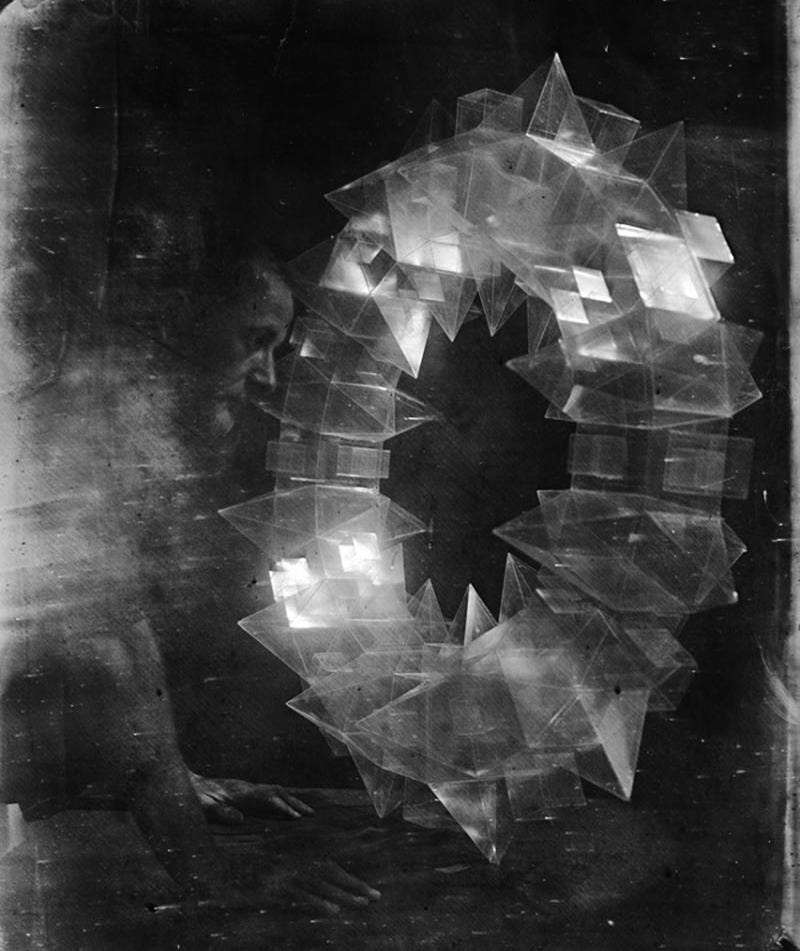
The hesychast tradition offers what might be the most precise spiritual technology for producing Jung’s “highest intensity in the smallest space.” If the soul is structurally analogous to a black hole, hesychasm is the discipline of crossing one's own event horizon.
Hesychasm is a contemplative monastic tradition in the Eastern Christian traditions of the Eastern Orthodox Church and Eastern Catholic Churches in which stillness (hēsychia) is sought through uninterrupted Jesus prayer (“the practice of inner prayer, aiming at union with God on a level beyond images, concepts and language”). While rooted in early Christian monasticism, it took its definitive form in the 14th century at Mount Athos.
St. Nicephorus the Hesychast (13th century), a Roman Catholic who converted to the Eastern Orthodox faith and became a monk at Mount Athos, advised monks to bend their heads toward the chest, “attach the prayer to their breathing” while controlling the rhythm of their breath, and “to fix their eyes during prayer on the middle of the body”, concentrating the mind within the heart in order to practice nepsis (watchfulness).
According to the standard ascetic formulation of this process, there are three stages:
Katharsis (κάθαρσις) or purification
Theoria (θεωρία) or illumination
Theosis (θέωσις) or deification
Katharsis (ascese/purification)
Sobriety contributes to this mental ascesis that rejects tempting thoughts; it puts a great emphasis on focus and attention. The hesychast is to pay extreme attention to the consciousness of his inner world and to the words of the Jesus Prayer, not letting his mind wander in any way at all. While he maintains his practice of the Jesus Prayer, which becomes automatic and continues twenty-four hours a day, seven days a week, the hesychast cultivates nepsis, watchful attention, to reject tempting thoughts (the “thieves”) that come to the hesychast as he watches in sober attention in his hermitage. St. John of Sinai describes hesychast practice as follows:
Take up your seat on a high place and watch, if only you know how, and then you will see in what manner, when, whence, how many and what kind of thieves come to enter and steal your clusters of grapes. When the watchman grows weary, he stands up and prays; and then he sits down again and courageously takes up his former task.
The hesychast is to attach Eros, that is, “yearning”, to his practice of sobriety so as to overcome the temptation to acedia (sloth). He is also to use an extremely directed and controlled anger against the tempting thoughts, although to obliterate them entirely he is to invoke Jesus Christ via the Jesus Prayer.
Theoria (illumination)
The primary task of the hesychast is to engage in mental ascesis. The hesychast is to bring his mind (nous) into his heart so as to practise both the Jesus Prayer and sobriety with his mind in his heart. In solitude and retirement, the hesychast repeats the Jesus Prayer, “Lord Jesus Christ, son of God, have mercy on me, the sinner.” The hesychast prays the Jesus Prayer ‘with the heart’ — with meaning, with intent, “for real”. He never treats the Jesus Prayer as a string of syllables whose “surface” or overt verbal meaning is secondary or unimportant. He considers bare repetition of the Jesus Prayer as a mere string of syllables, perhaps with a “mystical” inner meaning beyond the overt verbal meaning, to be worthless or even dangerous. This emphasis on the actual, real invocation of Jesus Christ mirrors an Eastern understanding of mantra in that physical action/voice and meaning are utterly inseparable.
The goal at this stage is a practice of the Jesus Prayer with the mind in the heart, which practice is free of images. By the exercise of sobriety (the mental ascesis against tempting thoughts), the hesychast arrives at a continual practice of the Jesus Prayer with his mind in his heart and where his consciousness is no longer encumbered by the spontaneous inception of images: his mind has a certain stillness and emptiness that is punctuated only by the eternal repetition of the Jesus Prayer.
This stage is called the guard of the mind. This is a very advanced stage of ascetical and spiritual practice, and attempting to accomplish this prematurely, especially with psychophysical techniques, can cause very serious spiritual and emotional harm to the would-be hesychast. St. Theophan the Recluse once remarked that bodily postures and breathing techniques were virtually forbidden in his youth, since, instead of gaining the Spirit of God, people succeeded only “in ruining their lungs”.
The guard of the mind is the practical goal of the hesychast. It is the condition in which he remains as a matter of course throughout his day, every day until he dies.
Theosis (deification)
The hesychast usually experiences the contemplation of God as light, the “uncreated light” of the theology of St. Gregory Palamas. The hesychast, when he has by the mercy of God been granted such an experience, does not remain in that experience for a very long time, but he returns “to earth” and continues to practise the guard of the mind.
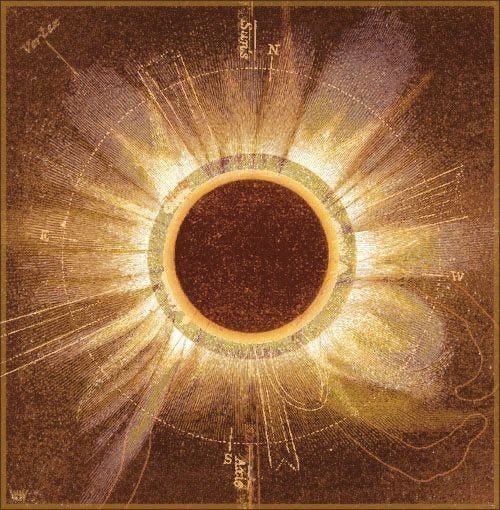
Orthodox tradition warns against seeking ecstasy as an end in itself. Hesychasm is a traditional complex of ascetical practices embedded in the doctrine and practice of the Orthodox Church and intended to purify the member of the Orthodox Church and to make him ready for an encounter with God that comes to him when and if God wants, through God’s grace. The goal is to acquire, through purification and grace, the Holy Spirit and salvation. Any ecstatic states or other unusual phenomena which may occur in the course of hesychast practice are considered secondary and unimportant, even quite dangerous. Moreover, seeking after unusual “spiritual” experiences can itself cause great harm, ruining the soul and the mind of the seeker. Such a seeking after “spiritual” experiences can lead to spiritual delusion—the antonym of sobriety—in which a person believes himself or herself to be a saint, has hallucinations in which he or she “sees” angels, Christ, etc. This state of spiritual delusion is in a superficial, egotistical way pleasurable, but can lead to madness and suicide, and, according to the hesychast fathers, makes salvation impossible.
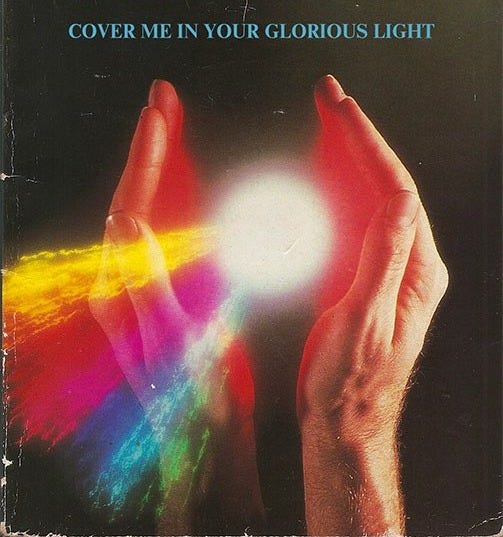
From my early childhood, before my bones, nerves, and veins were fully strengthened, I have always seen this vision in my soul, even to the present time when I am more than seventy years old. In this vision, my soul, as God would have it, rises up high into the vault of heaven and into the changing sky and spreads itself out among different peoples, although they are far away from me in distant lands and places. And because I see them this way in my soul, I observe them in accord with the shifting of clouds and other created things. I do not hear them with my outward ears, nor do I perceive them by the thoughts of my own heart or by any combination of my five senses, but in my soul alone, while my outward eyes are open. So I have never fallen prey to ecstasy in the visions, but I see them wide awake, day and night. And I am constantly fettered by sickness, and often in the grip of pain so intense that it threatens to kill me, but God has sustained me until now. The light which I see thus is not spatial, but it is far, far brighter than a cloud which carries the sun. I can measure neither height, nor length, nor breadth in it; and I call it “the reflection of the living Light.” (Hildegard of Bingen)
Some more thoughts from Claude on the theory:
The holographic principle, made explicit. Susskind’s claim is that all information about the black hole’s interior is encoded on the event horizon—the 2D surface contains the 3D reality. If the psyche shares this structure, the implication is that the ego (the “surface” we experience) is a projection or encoding of the depths, not a separate thing sitting on top of them. This would support Jung’s intuition that the Self is prior to and encompassing of the ego, not the other way around.
Gravitational time dilation. Near a black hole, time slows toward stillness. Mystics consistently report that in deep states, time stops or becomes meaningless—Hildegard sees past, present, and future simultaneously; Jung at the cosmic horizon experiences his whole life at once. The “event horizon” of contemplative experience may involve something structurally similar: approaching the singularity, duration dissolves.
Maximum entropy. Black holes are understood as maximally entropic—they contain the most information possible for their size. If the psyche is analogous, this supports Jung’s claim that the unconscious is incomprehensibly vaster than consciousness. The ego is a tiny ordered surface floating on an ocean of compressed information.
The bindu. Hindu and tantric traditions have the concept of the bindu—a dimensionless point from which all creation emanates and into which it returns. Meister Eckhart’s “ground of the soul” (Seelengrund) is similar: a placeless place where God and soul are indistinguishable. These map almost exactly onto your singularity-as-soul imagery.
I like this idea a lot. I've always viewed the concept of engaging with someone's soul as sending messages across an impassable void, hoping in blind faith that the communication is received. In this framework, where you could physically reach into the soul, we all have connections to a truly shared space.
It's important to have agreeable expressions of things.