

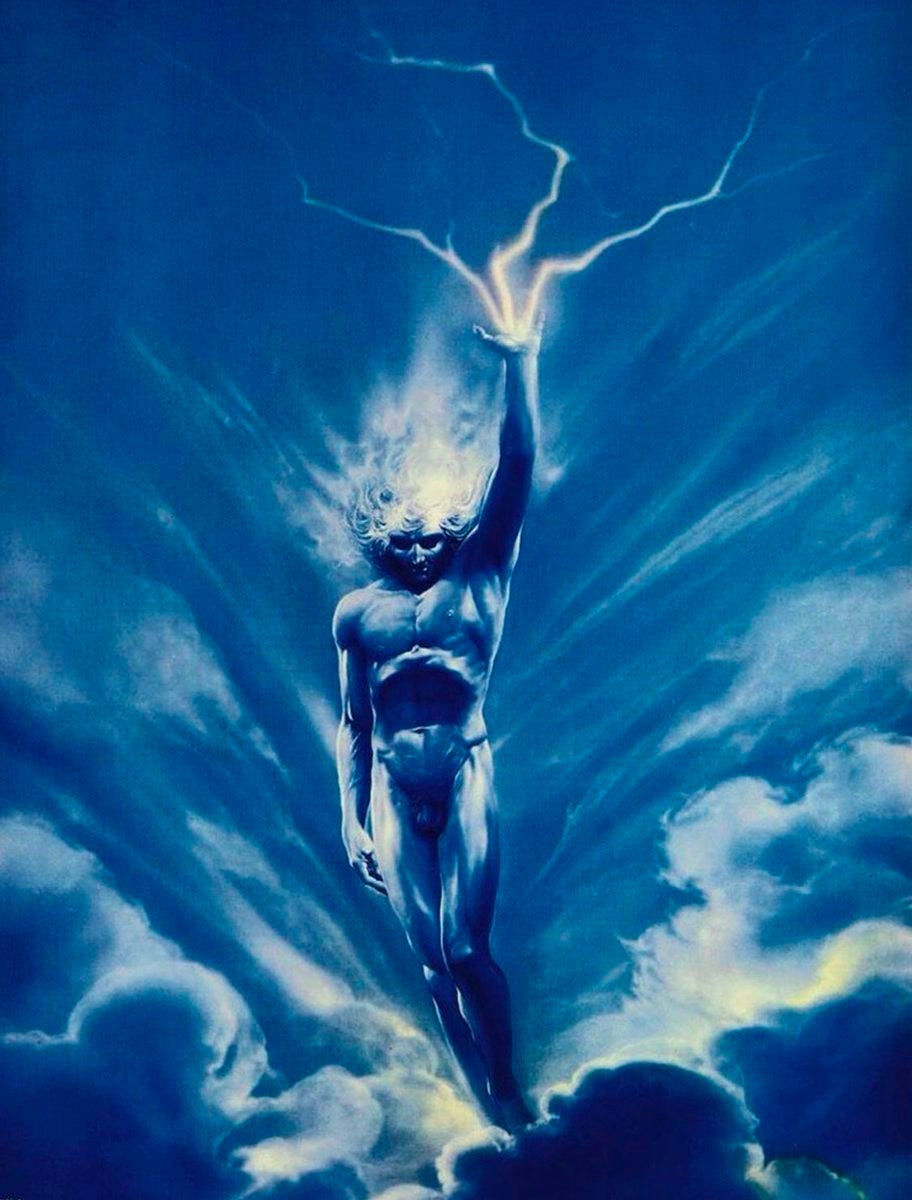
I do not believe that some of the most impactful, really world-changing ideas of the humanities emerged from thinking, much less cognitive, logical, or linear thought. I think they emerged from altered states of knowledge and energy, that they were experienced as given. They crash-landed. This does not mean that such world-changing ideas were religious in any traditional sense (although sometimes they were) or even that this givenness does not always have a history. But it does mean that these forms of alien thought or experience cannot be understood in any conventional mode and that they are often not under the control of the conscious ego or reasonable thinker.
We do not think. We are thought.

We certainly have a long way to go, and nothing is guaranteed. I cannot tell you how many times I have heard an otherwise admired colleague say something like, “Well, it does not really matter if Joseph of Cupertino flew up into the tree after a scream, or if Teresa of Avila floated off the floor as her sisters piled on top of her to avoid a social embarrassment. What matters is how the popular belief in such presumed evtations was disciplined, controlled, and maintained by the Church and later constructed as sanctity and as a saint.” Here is another doozy: “I do not care if the psychedelic trip leads a person to an actual encounter or identity with the personal Source or Ground of the universe. That does not matter. What matters are the institutional and now medical structures built up around such a belief and their social production of medicine and religion.”
Really? I want to pull my hair out in such moments (and I don’t have much hair left). A super-pious Italian man ecstatically flies into a tree and has to be retrieved with a ladder, or a raptured Spanish nun cannot keep herself on the floor in front of some visiting noblewomen, and these physical events do not matter to you? Uh, excuse me, if either of those things actually happened (and our historical records suggest strongly that they did), such anomalous events change pretty much everything we thought we knew about human consciousness and its relationship to physics, gravity, and material reality. Either single event would fundamentally change our entire order of knowledge. And you don’t care?
The argument goes as follows: “It is better not to make any claim on the real, since we know that such claims in the past have been wrong or partial, and that endless injustices and violences have been done in their names. We do not do metaphysics, because metaphysics always leads to bad things.”
But such a claim, of course, is itself a metaphysics, and it is doing bad things as you read these lines. It is reducing the human to the only human, to a dying social animal that has every reason to despair and turn to endless distractions, which themselves have some pretty devastating moral consequences.
My argument rather goes like this: We must imagine other ontologies, new realities, not just because our sciences already are doing this but also because, if we do not reimagine the real, the dials will simply reset and return to where they are now— to a materialist reductionism—and the humanities will continue to be sidelined and ignored as so much depression, which they have in effect become.
Agnosticism is the position to not take a position. It is noble and understandable enough, but it will not work. The problem is that any such refusal to make a different claim on the real, however moral it might seem, simply ends up, in practice, supporting business as usual. The refusal to do ontology is itself a surrender to the present reigning ontology.
I often joke to my students that I once naively thought that the Buddha came to teach us about the ultimate nonexistence of the self and the fantastic realizations of nirvana and emptiness—fundamental ontological questions that are as true in Texas as they are in Nepal. But now I know that what Buddhism is really about is how to help us lower our blood pressure and make us good office workers.
One should pay attention not to bleed oneself to death when shaving with Occam's razor.
Listen to The Emerald Podcast.